3D Secure (3DS) is an identity check your card issuer runs while you pay online. Sometimes it happens silently in the background. Sometimes it sends you a one-time code or asks you to approve the payment in your banking app. If you have ever been bounced to a bank page mid-checkout, or watched a payment fail on a designer bag you had been eyeing for weeks, this guide explains what happened and what to do next.
TL;DR
- 3D Secure adds a real-time identity check to online card payments. Low-risk purchases may pass without any extra step, and riskier ones may trigger a code or biometric prompt.
- In the US, 3DS is not a legal requirement and adoption is lower than in Europe, so you will meet it at some stores and not others.
- A decline is not always a 3DS problem. Funds, card limits, typos and unusual-activity flags at your bank are just as common causes.
- If a payment fails, re-check your details, call the bank that issued the card, and use another payment method while you sort it out.
- 3DS reduces fraud but does not make a purchase risk-free, so pair it with smart habits when you shop luxury online.
Table of Contents
- What 3D Secure actually means
- How the checkout flow works, step by step
- Do all US stores and cards use it?
- Does 3D Secure make a purchase completely safe?
- Why was my card declined online?
- What to do when a payment is declined
- Shop luxury online with confidence
- Perspective
- Buy designer pieces your way
- FAQ
- Sources
What 3D Secure actually means
The “3D” stands for three domains. PayPal explains that these are the card issuer, the merchant’s bank and the payment platform that connects them. Stripe describes the full name as Three-Domain Secure: an extra layer of verification on online credit and debit card payments.
Think of it as the online version of a salesperson glancing at your ID when you hand over a card. Visa describes 3DS as a global authentication protocol that checks identity in real time. Low-risk payments can be authenticated frictionlessly, while higher-risk ones may require step-up verification.
You may never see the words “3D Secure” on screen. Stripe notes that shoppers usually recognize it through network branding: Visa Secure, Mastercard Identity Check or American Express SafeKey.
Authentication is not authorization
This distinction explains a lot of confusing declines. Authentication confirms that you are the cardholder. Authorization decides whether the payment can go ahead based on funds and account status, according to Visa. You can pass the first and still fail the second.

How the checkout flow works, step by step
Here is what happens when you buy something with a card at a store that supports 3DS. The sequence follows Mastercard’s gateway guide and the EMVCo overview.
- You pick a card and hit pay. The store starts authentication through a 3DS network.
- The store shares context with your bank. EMVCo says the merchant sends the issuer transaction, payment-method and device data so the issuer can decide whether it is really you.
- Your bank scores the risk. Familiar device, normal spending pattern and a sensible order? Visa says such low-risk payments may use a frictionless flow, verified in the background with no extra customer steps.
- If the risk looks higher, you get a challenge. EMVCo lists one-time passcodes, knowledge-based questions and biometrics as possible methods. PayPal adds that the challenge can redirect you to your issuer’s security page and return you to the store afterward.
- The store submits the payment for authorization. Your bank then approves or declines based on funds and account status.
- You see your confirmation.
Who decides whether a challenge appears? Not you, and not just the store. Stripe’s documentation says the decision can rest on regulatory mandates, fraud rules, issuer soft declines and other criteria. That is why the same card can breeze through one checkout and ask for a code at another.
Why it sometimes feels slow
The U.S. Payments Forum notes that EMV 3DS can add friction because authentication is a multi-step process that happens before authorization. If your code text takes a minute to arrive, that is the system working, not your order failing. Keep the tab open and do not tap pay twice.
Do all US stores and cards use it?
No. The same U.S. Payments Forum brief says North American adoption of EMV 3DS has been low and that it is not currently a regulatory requirement there, unlike certain mandated cases in the EU and India. Stripe also describes 3DS as optional in regions without a mandate.
On the cardholder side, enrollment is also not guaranteed. For US cards, Stripe’s issuing documentation says 3DS enrollment is optional rather than automatic, and that authentication can deliver a one-time code by phone number or email. If a store ever tells you your card is not enrolled or not supported, that is usually the reason.
So when someone asks which sites do not use 3D Secure, the honest answer is: many US stores run it only when risk signals call for it, and some do not run it at all. A missing prompt does not mean a checkout is unsafe, and a prompt does not mean something is wrong.
Does 3D Secure make a purchase completely safe?
No, though it helps. Visa reports that authenticated transactions showed roughly a 45% reduction in fraud in its cited data: 11 basis points of fraud versus 20 for non-authenticated e-commerce transactions.
There is also a liability angle. Shopify explains that a successful authentication can shift liability for fraud-related chargebacks from merchant to card issuer, subject to card-network policies and exceptions. The U.S. Payments Forum cautions that this shift is not automatic and depends on region, network, merchant category and network rules. In plain terms: it is a tool for the store and the bank, and you still need your own good habits.
Why was my card declined online?
A failed payment feels personal, especially at the moment a Prada blazer is in your cart. Most causes are boring and fixable. Sort them into two groups.
Declines that have nothing to do with 3DS
The FTC says a bank or credit union can decline or block a card transaction because of insufficient funds, being near or over a credit limit, or unusual activity such as a large purchase or a charge from a foreign merchant. Luxury shopping often ticks the “large purchase” box, and international shipping or a store based abroad can tick the second.
Add the simple stuff: a mistyped digit, a wrong billing ZIP code, or an expired card.
Declines where authentication failed
When the 3DS step itself fails, the store’s payment provider often receives a specific reason code. Checkout.com’s failure code reference shows what these look like:
| Code | Meaning | What you can do |
|---|---|---|
| 05 | Expired card | Use a current card |
| 06 | Invalid card number | Re-enter the number carefully |
| 09 | Security failure | Try again, then call your bank |
| 11 | Suspected fraud | Call the number on the back of your card |
| 12 | Transaction not permitted | Ask your bank whether online use is allowed |
| 13 | Cardholder not enrolled | Ask your bank about 3DS enrollment |
| 14 | Issuer server timeout | Wait a few minutes and retry |
| 22 | Issuer technical issue | Retry later or switch cards |
You will not normally see these numbers at checkout, since they sit on the merchant’s side. They are useful because they show the range of reasons: some are about you, and some are about timeouts and technical glitches on the bank’s end.
There is one more factor. The U.S. Payments Forum says inaccurate merchant data can cause problems in issuer fraud engines. That one is on the store, not you, which is a good reason to prefer shops with a clean, professional checkout.
What to do when a payment is declined
The FTC’s guidance is refreshingly simple. Use it as your checklist:
- Check your information. Card number, expiry date, security code, billing address.
- Contact the bank or credit union that issued the card. Ask whether they blocked the charge as unusual and whether they can approve it.
- Use another payment method if sorting it out will take time.
A few extra tips that fit how luxury shoppers actually buy:
- Warn your bank before a big order. A quick note in your banking app can save a blocked charge.
- Have your phone handy. If your issuer sends a code, it will go to the number on file, so make sure that number is current.
- Do not retry five times in a row. Repeated attempts can look like card testing and make a block more likely. Stop after a retry or two, then call.
- Stay on one tab. If you are redirected to your bank’s page, finish there and let it send you back to the store.
If your card is not enrolled in 3DS, ask your issuer whether it offers enrollment and how it delivers codes. Stripe’s documentation says a payment may be marked as not supported when 3DS cannot be used, and the resulting path depends on why 3DS was triggered. In practice, a second card from a different issuer is often the quickest workaround.
Shop luxury online with confidence
Authentication is one layer. Here is how to stack the others when you are buying designer pieces.
How to spot a trustworthy checkout
How to style your safety checklist: keep it as polished as your outfit.
- Check the address bar for the padlock and a clean, correct domain before you type card details.
- Look for clear contact details, return terms and shipping terms.
- Prefer stores that state how they authenticate their products. At Naise Shopper, we guarantee the authenticity of every product we sell, and we offer shipping insurance from the US on top of secure international delivery.
- Use a credit card or a card with strong dispute protections where you can, and keep your order confirmation.
- Never approve a code or app prompt you did not trigger yourself. If a request pops up when you are not checking out, it is not part of your purchase. Close it and contact your bank.
Understand how stores verify you
If you run a business and are curious how 3-D Secure verifies shoppers from the store’s side before a card payment is authorized, that view is worth a look. As a shopper, the takeaway is simple: the extra step exists to protect you, and a few seconds of friction beats a fraudulent charge.
Perspective
We see 3D Secure from the buyer’s chair every day. A shopper who has spent weeks watching a Gucci sandal or a Fendi shoulder bag does not want a payment screen to be the plot twist. Our view: treat the verification step as part of the purchase, the same way you would treat a store clerk checking ID on a high-value piece.
What matters to us is that the whole experience feels dependable. We guarantee the authenticity of the designer handbags, shoes, ready-to-wear, watches and accessories we offer, we ship internationally with secure delivery, and we offer localized currency and payment options for many countries. If you are buying from the US, shipping insurance is available too.
Our advice is to plan the payment like you plan the outfit. Know which card you will use, make sure your bank has your current phone number, and keep a backup card ready. Then enjoy the part that is supposed to be fun.
Camila
Buy designer pieces your way
Not every shopper wants to handle checkout, shipping and verification alone, especially when ordering across borders. At Naise Shopper, our personal shopper services and assisted online purchasing experience are designed to make buying easier, and our re-directioning of purchases and shipping insurance from the US add convenience and protection after you pay.
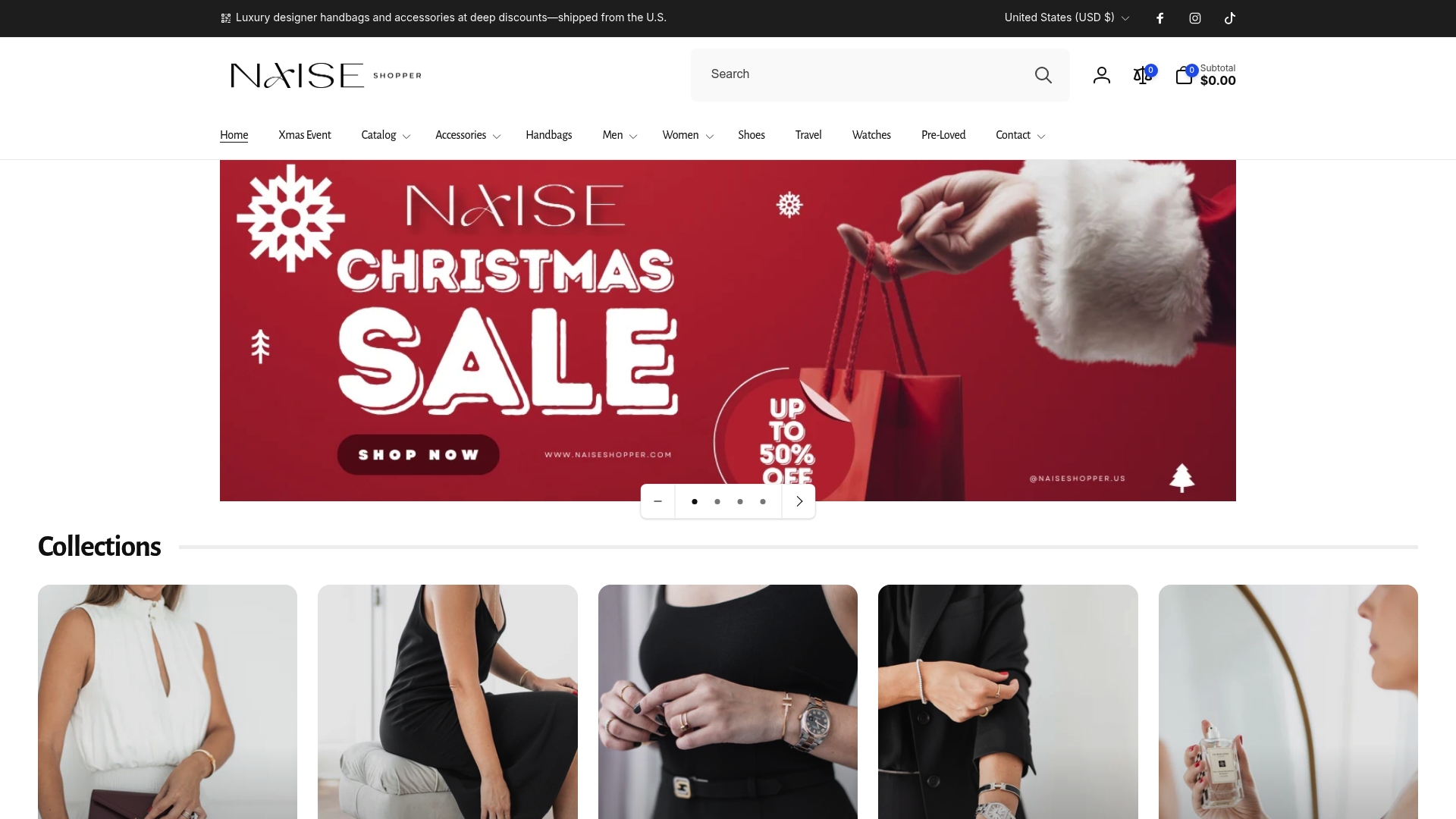
Browse our authenticated handbags, shoes, ready-to-wear, watches and accessories, or ask about personal shopper help, on our home page. If sun-ready accessories are on your list, start with our sunglasses collection.
FAQ
What is 3D Secure checkout?
It is an extra identity check that runs when you pay by card online. Your issuer looks at the transaction and either approves the check silently or asks for a code, a password or a biometric confirmation. Afterward the store submits the payment for authorization.
Why was my card declined online if I have enough money?
Funds are only one factor. The FTC lists being near a credit limit and unusual activity, such as a large purchase or a foreign-merchant charge, as reasons for a block. A typo or a failed authentication step can do it too. Check your details, then call the bank that issued the card.
Is 3D Secure required in the US?
No. The U.S. Payments Forum says EMV 3DS is not currently a regulatory requirement in North America, and adoption has been low. Whether you see a prompt depends on the store, your issuer and the risk of the order.
Does 3D Secure guarantee my purchase is safe?
It lowers fraud risk but does not remove it. Visa’s cited data shows fewer fraud cases on authenticated transactions, yet authentication and authorization are separate steps, and approval still depends on funds and account status.
What should I do if my payment fails at checkout?
Re-check your card details, contact the bank or credit union that issued the card, and consider another payment method while you resolve it. Avoid repeated rapid retries.
Sources
- 3D Secure: your guide to safer transactions, Visa
- What Is 3D Secure Authentication? PayPal US
- How does 3D Secure authentication work? Stripe
- 3D Secure authentication, Stripe Documentation
- Authenticate with 3D Secure, Stripe Documentation
- Cardholder authentication using 3D Secure, Stripe Issuing
- EMV 3-D Secure, EMVCo
- Mastercard Integration Guide: 3-D Secure authentication
- EMV 3-D Secure: A U.S. Payments Forum Resource Brief
- When a Company Declines Your Credit or Debit Card, FTC
- Diagnose authentication failures, Checkout.com
- Understanding PSD2 and 3D Secure, Shopify Help Center
- Payment security overview, Merchant Solutions Corp