When a luxury checkout asks whether you want to pay in local currency or U.S. dollars, you are really choosing who does the math: your card issuer or the merchant’s payment provider. For most shoppers, the issuer’s conversion is the lower-cost route, and the right move is to read both totals before you tap anything. At Naise Shopper, we offer localized pricing for numerous countries, so you can see what a Gucci, Prada or Saint Laurent piece costs in terms that make sense to you, and this guide shows you how to keep the final card charge as close to that number as possible.
TL;DR
- The currency choice at checkout decides who converts your money: your card issuer (local currency) or the merchant’s provider (dollars).
- Paying in dollars through dynamic currency conversion (DCC) is typically the pricier option, with markups that can reach up to 12% according to PayPal’s U.S. guide.
- Visa and Mastercard rules require a clear choice, both amounts, and the exchange rate on screen. If you don’t see them, decline the conversion.
- Your card’s foreign transaction fee (typically 1% to 3%) is separate and can apply either way, so look it up before a big purchase.
- Refunds, customs and sales tax all move the final number too, so plan for the full landed cost.
Table of Contents
- What the currency choice actually means
- How to spot dynamic currency conversion
- What it costs: markups, fees and the gap between them
- Check your own card before you buy
- The costs that live outside the currency choice
- Refunds and returns in another currency
- If a store doesn’t give you a clear choice
- Shop authenticated designer pieces with confidence
- FAQ
- Sources
What the currency choice actually means
Three different currencies can be in play on one order, and shoppers often mix them up. The price tag currency is the one the store displays. The payment currency is the one you are charged in. The settlement currency is what the merchant ultimately receives. An expert in a Nov 2026 Paypers interview put it neatly: pricing currency is a commercial choice, payment currency is the customer’s choice, and settlement currency is a treasury choice.
That is why a price shown in dollars on an international site does not, on its own, tell you what currency your card will be billed in. The only reliable signal is the final payment screen and, afterward, your receipt and statement.
Here is the split in plain terms, based on Mastercard’s 2025 DCC guide:
- Pay in the local (merchant’s) currency: the amount is converted at the exchange rate provided by your card issuer.
- Pay in your billing currency (U.S. dollars): the conversion happens at the exchange rate offered by the merchant’s acquirer, the bank or provider that processes the store’s card payments.
Mastercard also states that DCC is a service provided by acquirers and their merchants, not a Mastercard product. In other words, the dollar option is a convenience the merchant’s side sells you, and its rate includes the merchant side’s pricing.
How to spot dynamic currency conversion
Dynamic currency conversion is the offer to convert your purchase into your home currency at the moment you pay. It feels helpful, because you see a familiar dollar figure. The catch is that the rate behind that figure is set by the merchant’s side.
Visa’s DCC explainer says a compliant offer must show:
- The purchase amount in both the local currency and your currency.
- Both currency symbols.
- The exchange rate.
- Any additional fees or markup.
You must also be given the choice to accept or decline, and the merchant must not make it for you. Visa’s advice is to decline, and report it to your card issuer, if details are missing or you feel pressured.
Mastercard’s 2025 rules go further. No conversion method may be the default, cardholders must not be steered toward DCC, and automatic DCC is prohibited. For e-commerce, a conversion option may be preselected only if you are clearly given a way to opt out and pay in local currency.
What to look for on a checkout page
- A currency dropdown or toggle near the order total. Check which currency is selected before you confirm.
- Two totals side by side, with a stated exchange rate. That is DCC.
- A single total with no rate and no explanation of conversion. Treat that as a cue to confirm the currency on the final review screen.
- Your receipt and confirmation email. They should show the total in both currencies if DCC was used.
One reassurance: declining a conversion is not cancelling the purchase. As TrustFinance’s guide puts it, you are only choosing the transaction currency, and the sale still goes through.
What it costs: markups, fees and the gap between them
Two separate charges get confused all the time, and both can hit the same order.
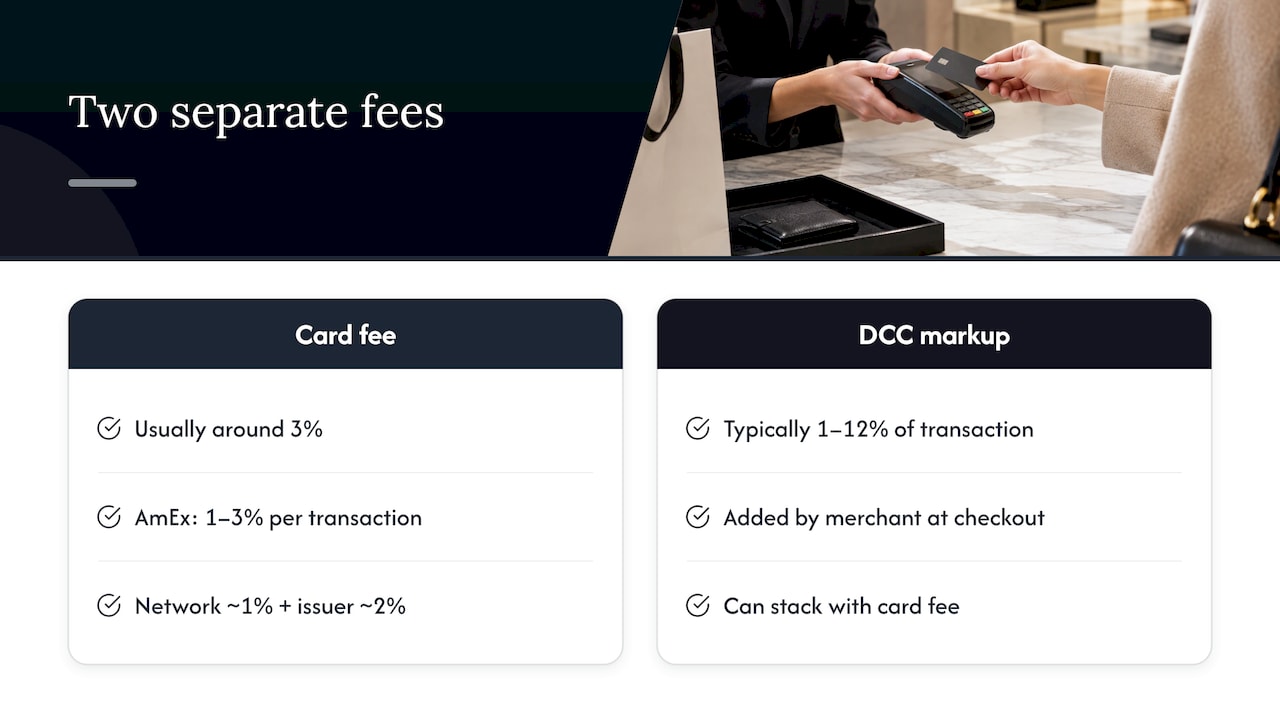
Foreign transaction fee. This is charged by your card company for using the card abroad or with a foreign-based merchant. NerdWallet says it is usually around 3%. American Express describes about 1% to 3% per transaction for cards that charge one. TD Bank breaks it into a network fee of roughly 1% plus an issuer fee of typically 2%. Chase notes it may not appear until your statement.
Currency conversion fee (DCC markup). This is added by the merchant’s side at the point of sale. PayPal’s U.S. guide lists currency conversion fees typically at 1% to 12% of the transaction, and says DCC at checkout is typically more expensive than your bank’s rate and can reach 12%.
Because a foreign transaction fee can still apply even when you were billed in dollars, paying in dollars does not cancel your card’s fee. It can stack a DCC markup on top.
A worked example
Take a €1,000 bag at an overseas boutique and assume, for round numbers, that the market rate gives you $1,100.
| Choice | How it’s calculated | You pay |
|---|---|---|
| Pay in euros, card with no foreign fee | Issuer converts at its rate | About $1,100 |
| Pay in euros, card with a 3% foreign fee | $1,100 + 3% | About $1,133 |
| Pay in dollars via DCC at a 5% markup | $1,100 + 5% | About $1,155, and a card fee may still apply |
The 5% markup case mirrors the Tagada illustration of a €100 bill: paying in dollars via DCC at a 5% markup costs $115.50 against about $110 in local currency, plus any bank fee. PayPal’s own example makes the same point at scale: on a $1,000-equivalent purchase, a 1% conversion markup costs about $10 more, while a 10% DCC rate costs an extra $100.
On a luxury ticket, a few percentage points is a real sum. If you want to sanity-check a quote before you pay, a currency exchange calculator gives you a quick benchmark to compare against the figure on the terminal or checkout screen. Then compare it with the rate your card network publishes, since Experian notes that Visa and Mastercard both offer online conversion calculators.
Check your own card before you buy
Your card’s fee is the one number only you can look up, and it takes two minutes.
- Find the rates-and-fees table. On your issuer’s website or app, or in the pricing table of your card agreement, look for a row headed “Foreign Transaction.” A missing row or “none” generally means no fee, as Card Calculator explains in its walk-through of the CFPB (Consumer Financial Protection Bureau) rules.
- Ask two specific questions if you call the number on the back of your card: does the fee apply to dollar-priced purchases from foreign merchants, and does it apply to international websites? Mastercard’s U.S. FAQ recommends contacting your issuer to learn about currency-conversion charges, and says letting your bank convert is the best practice.
- Compare at checkout. Read both totals and the stated rate. If the dollar total is meaningfully above what the local-currency total converts to, choose local currency.
- Save the receipt. Match the statement line to the receipt, separating the conversion rate, any merchant charge and your issuer’s fee.
If you shop abroad often, a card with no foreign transaction fee removes one layer of cost entirely, and local-currency payment then leaves only the issuer’s conversion rate.
The costs that live outside the currency choice
The exchange rate is only part of what a luxury order costs when it crosses a border. Duties, brokerage fees and tax change the landed price, and they are easy to miss while you are focused on the dollar-versus-local question.
- Customs and brokerage. Our guide to customs brokerage fees for luxury shoppers walks through what carriers can add on delivery.
- U.S. sales tax. If you are buying in the States, see what sales tax does to a luxury bag’s price.
- Card security prompts. Cross-border orders are more likely to trigger a verification step or a decline. Our explainer on 3D Secure online shopping covers why and what to do.
- U.S. exclusives. If you live abroad and want pieces released only in the States, read how to buy US exclusives from abroad.
Refunds and returns in another currency
Currency choice matters again if you return something. Under Mastercard’s 2025 DCC rules, refunds of DCC transactions must be processed as a reversal, a credit in the same currency and amount, or a credit converted at the exact original rate, so you are not hit by a second conversion loss. If a cardholder suffers a loss due to currency conversion, there is a chargeback right for the loss amount.
For disputes, the Michigan Department of Insurance and Financial Services consumer guide explains that the Fair Credit Billing Act applies to overseas purchases and calls for a written dispute within 60 days of the bill’s postmark date. It also advises getting overseas refund and exchange policies in writing before you buy. Change-of-mind returns are not a billing error, so read the store’s return terms at the product page, not after the parcel arrives.
If a store doesn’t give you a clear choice
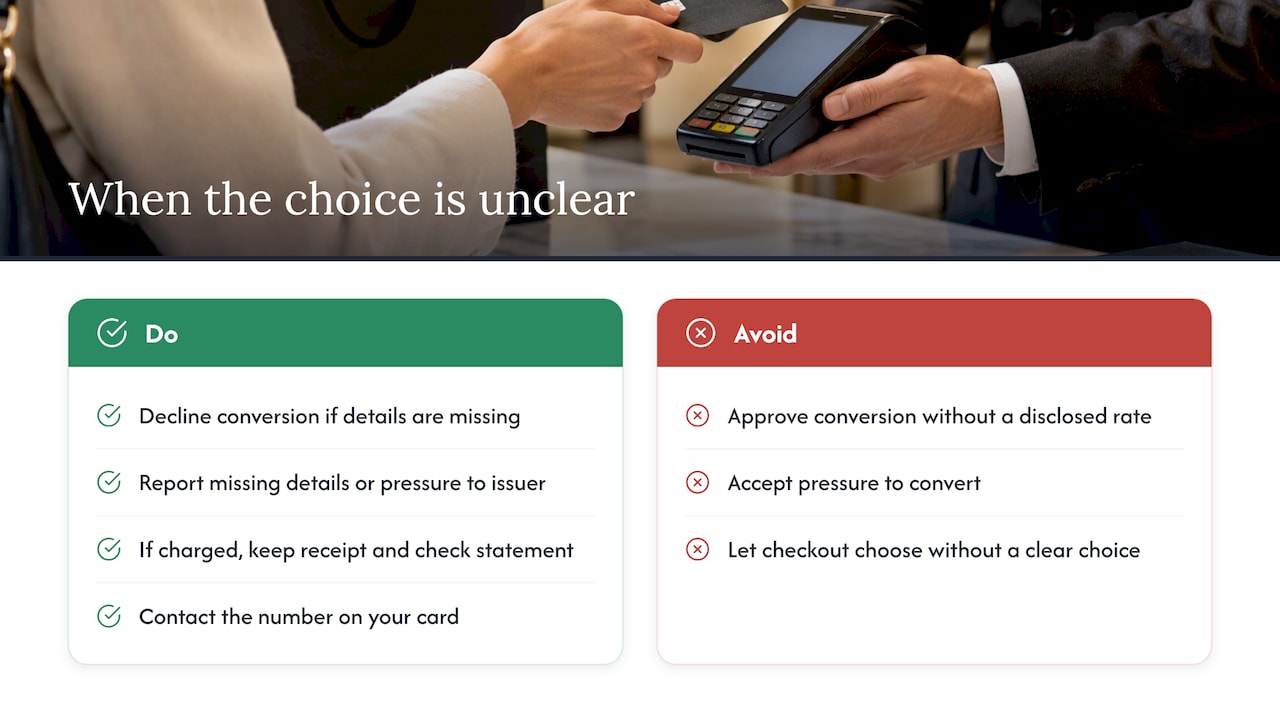
Say a terminal simply asks you to approve a total in dollars, or a site converts at the last step without showing a rate. Visa’s guidance is straightforward: decline the conversion and report it to your card issuer when the required details are missing or you feel pressured. If you’ve already been charged, keep the receipt, check the statement for the converted amount, and contact the number on the back of your card. Mastercard also lists its assistance line at 1-800-627-8372 for cardholders.
Merchants are not meant to put a thumb on the scale. Stripe’s guidance calls automatically opting customers into DCC bad practice that can damage trust, and says shoppers should get a clear choice with the rate and fees disclosed up front.
Our take: see your price your way
Luxury shoppers tell us the same thing: the sticker price is only half the story. A Bottega Veneta or Saint Laurent piece can be a great find, but the thrill fades if the final charge surprises you.
That is why we built Naise Shopper around localized pricing for numerous countries, flexible payment options and secure international shipping. We want you to see a price that makes sense for where you live, then pay without guesswork.
Our authenticated designer pieces come at significant discounts, and our personal shopper assistance and shipping insurance for U.S. purchases are there so a big order feels safe from cart to doorstep. Our advice: read both totals, choose the one your card issuer converts, and enjoy the bag.
Camila
Shop authenticated designer pieces with confidence
If you are shopping for handbags, shoes, ready-to-wear, watches, sunglasses or accessories from Gucci, Chanel, Prada, Valentino, Balenciaga and more, you can browse our authenticated, discounted collections with localized pricing for numerous countries. For U.S. purchases, our personal shopper services and shipping insurance take extra legwork off your plate.
Start at Naise Shopper and pick the category you are after, from handbags to sunglasses.
FAQ
Is it better to pay in foreign currency or home currency?
Usually the foreign (local) currency. In that case your card issuer converts, and as Experian notes, paying in U.S. dollars means the merchant’s network applies a built-in markup that is often higher. Compare both totals and the rate on screen before you decide.
Does paying in dollars mean I avoid my card’s foreign transaction fee?
Not necessarily. A foreign transaction fee, typically 1% to 3%, can still apply to a purchase made with a foreign merchant even when you are billed in dollars. Check the “Foreign Transaction” row in your card’s rates-and-fees table, or ask your issuer.
How do I know if a checkout is using dynamic currency conversion?
Look for two totals, two currency symbols and an exchange rate, which Visa requires merchants to display. Your receipt should show the same. If the rate or fees are missing, decline the conversion and, if needed, report it to your issuer.
Can I still return an item if I paid in another currency?
Yes, but the refund path depends on how you paid. Mastercard’s 2025 rules say DCC refunds must avoid a second conversion loss. Get the store’s return terms in writing before you buy, and keep your receipt.
Sources
- Mastercard DCC Performance Guide 2025
- Visa: Decoding Dynamic Currency Conversion
- The Paypers: Cross-border payments and FX
- TrustFinance: DCC at checkout
- NerdWallet: Foreign transaction vs. currency conversion fee
- American Express: Should you pay in local currency?
- TD Bank: Foreign transaction fees
- Chase: Using credit cards internationally
- PayPal: Currency conversion fees
- Tagada: DCC meaning
- Experian: How to avoid foreign transaction fees
- Card Calculator: Foreign transaction fees and currency conversion
- Mastercard U.S. FAQ
- Michigan DIFS: Using credit and charge cards overseas
- Stripe: What is dynamic currency conversion?
- Currency exchange calculator: benefits and uses