The leather on a designer shoe or bag is a mix of two choices: the animal it comes from and the way the surface is finished. Get both right and a pair of heels or a structured tote looks better at year three than at day one. Get them wrong and you pay luxury money for a surface that scuffs, stretches or peels. This guide walks through the leathers you will meet on Gucci, Prada, Valentino and Saint Laurent labels, what each one feels like, how it ages and where it belongs in your closet. At Naiseshopper we sell authenticated designer shoes, handbags and accessories at a discount, so these are the questions we want you asking before any checkout.
TL;DR
- Grade tells you how much of the hide’s strong outer layer survives: full-grain keeps all of it, corrected-grain is sanded and stamped, split is the weakest.
- Finish tells you how it behaves: suede and nubuck are velvety and water-shy, pull-up and calfskin polish and burnish, patent is glossy and needs gentle care.
- Calfskin is the everyday luxury standard for shoes and structured bags. Lambskin is the softest and best kept for evenings.
- Exotics like crocodile, python and ostrich come with extra US import rules, so check before you buy across borders.
- Read the label, look at the cut edge and the pores, and ask how the piece will look in two or three years.
Table of Contents
- Grade first: full-grain, corrected-grain and split
- Shoe leather types by finish
- Handbag leather types: where the hide meets the shape
- What is lambskin leather?
- Exotic leather types
- How to spot quality leather before you buy
- Which leather for which piece?
- Shop these leathers with us
- Our view on leather
- FAQ
- Sources
Grade first: full-grain, corrected-grain and split
Every hide has a tight, strong outer layer (the grain) and a looser fibrous layer underneath. Grade describes what has been done to that outer layer. The familiar ladder of full-grain, top-grain and split is not an official government or trade standard, as Popular Mechanics explains. Red Wing Shoes’ product design manager Mike Larson told the magazine that full-grain is really a type of top-grain, and that it is cleaner to think in three grades: full grain, corrected grain and split.
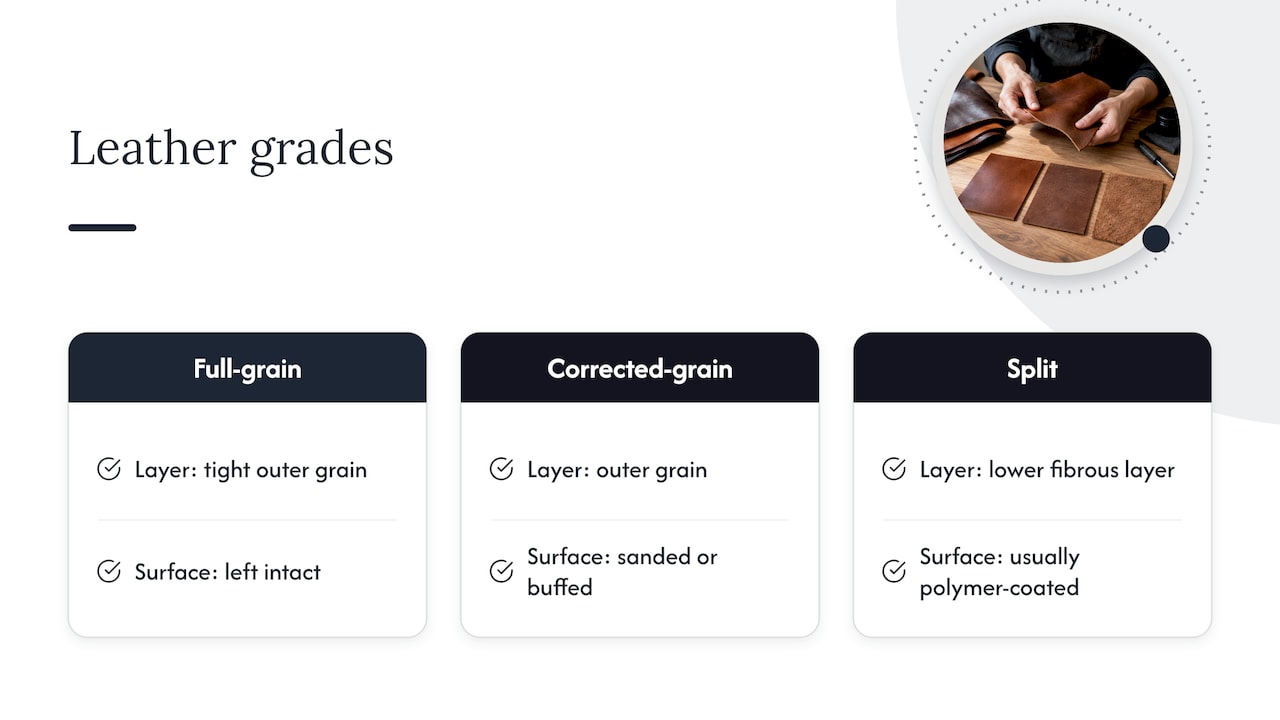
Full-grain. The surface is left intact, so you see natural pores, small scars and variation. It is the most durable, breathes well and develops a patina instead of flaking. On a luxury shoe, that is the leather that rewards years of wear.
How to style: let it age. Full-grain loafers and boots look best with a few honest creases, paired with sharp tailoring or straight denim.
Corrected-grain. The surface is sanded or buffed to remove marks, and often embossed with a pattern. It cleans more easily and looks uniform, which is why it is common on dress shoes and on bags where a flawless look matters. Larson makes a point worth remembering: a corrected-grain cowhide can outlast a full-grain lambskin, so grade alone never settles durability.
How to style: this is your polished-office leather. Pair a smooth black pump or a stiff, structured satchel with minimal, clean lines.
Split (often labeled “genuine”). This is the lower, fibrous layer, usually coated with polymer to imitate a grain. It ages poorly. Larson’s advice is to avoid polyurethane-coated splits and imitations because they break down fast. Bonded leather, made from shredded scraps, sits below it and can crack and peel.
The legal word “leather” matters here too. In the US, the FTC Leather Guides say a product called leather must be animal hide with its fibrous structure intact, and bonded material cannot be described as leather without qualification.
Shoe leather types by finish
Grade is only half the story. Finish is what you see and feel, and it decides how you care for the pair.
-
Smooth calfskin. Fine grain, takes a high polish and can last for years, per Heddels’ footwear guide. It is the backbone of designer dress shoes, stilettos and boots. Calf leather is the material listed on pieces like the Versace black calf leather lace-up boots and the Tom Ford blue calf leather stiletto sandals.
How to style: let a slim calf sandal carry the outfit. A bold color against a neutral dress does the work.
-
Suede. The flesh side of the hide, buffed to a velvety nap. The nap is short and even, and it shows water stains and marks more readily. Heddels notes that a good suede brush, a protector spray and the right cleaner keep it looking sharp.
How to style: suede is the texture play. Try a chocolate or sand boot with a tonal knit for a monochrome, quietly rich look.
-
Nubuck. Top-grain leather sanded on the outer side. Its stronger fiber structure makes it tougher than suede, though it still marks with water. It reads like suede with a little more backbone.
How to style: nubuck sneakers or boots sit well with relaxed trousers when you want texture without fragility.
-
Roughout. Full-grain turned flesh side out. It is rugged and builds a deep patina, and it suits work-inspired boots more than evening shoes.
-
Pull-up. Heavily waxed or oiled leather that lightens where it is bent or stretched, then settles into a lived-in finish. It breaks in easily and handles weather well.
-
Patent. Smooth leather with a high-gloss coating. It looks sharp on evening pumps and clutches, and it has its own care routine, which we cover in our guide to patent leather care.
Creasing at the toe box is the most common complaint on smooth leathers of any kind, and it is mostly preventable. See our notes on shoe creasing prevention before you start wearing a new pair.
Handbag leather types: where the hide meets the shape
Bags use the same grades, but the stress is different. A shoe flexes at the toe. A bag scuffs at corners, bottoms and handles. That is why handbag makers care about finish as much as grain.
Cowhide is thick and tough, and suits big totes and travel bags. Calfskin is finer and lighter, which makes it ideal for structured satchels and top-handle bags. Goatskin has a natural pebbly grain and wears well for its weight. Lambskin and sheepskin are buttery and light but scratch and stretch more easily, so many shoppers keep them for evening bags and use calfskin for daily carry.
Finish then decides how the bag looks after six months of commuting:
- Pebbled or grained surfaces hide scuffs well.
- Saffiano-style crosshatch is stiff and very scratch-resistant, a smart choice for a work bag.
- Aniline (dyed but barely coated) feels natural and marks easily.
- Quilted leathers add structure and a plush, sculpted look. The Versace taupe quilted leather handbag is one example of the style.
- Soft nappa-style leathers give you slouch and drape, as on the Dolce & Gabbana Sicily soft leather handbag.
How to style: pick the finish for your week, not your photo. A pebbled calf bag handles the subway and still looks sleek with a blazer. Keep the featherweight lambskin clutch for dinner.
Strap choice also changes how a bag wears. Leather straps soften and take on your shape, while chains behave differently on shoulders and clothing. Our comparison of a chain strap vs leather strap helps you choose.
What is lambskin leather?
Lambskin comes from sheep under two years old, and it is typically thin, around 0.4 to 1.2 mm. That thinness is its charm: it is extremely flexible, buttery and light. It is also why lambskin is the signature leather of quilted flap bags and slim evening pieces at houses such as Chanel, Prada and Dior.
Texture. Smooth, supple, with tight and small pores that look refined rather than rugged. It drapes instead of standing up on its own, so makers often pair a lambskin outer with a sturdier calfskin base.
Properties to know.
- It is lightweight, far lighter than cowhide.
- It scratches more readily from nails, jewelry or rough surfaces.
- It is not water resistant, and oil marks are hard to lift.
- Corners, bottoms and handles show wear sooner than on cowhide or Saffiano.
How to style: wear lambskin where it shines. A lambskin jacket, evening clutch or ballet flat suits occasions when touch matters most. Store the bag stuffed and upright, away from sharp jewelry, and keep it out of the rain. The Valentino Garavani Preshoes ballet flats are a good example of a soft, slim silhouette that belongs in the dressier part of the closet.
Exotic leather types
Exotics are the statement end of the market: ostrich, alligator, crocodile, caiman, python and stingray. Popular Mechanics notes they appear mostly in dress shoes and cowboy boots. Each has its own personality:
- Ostrich: durable yet easy to break in, recognizable by raised quill follicles.
- Alligator: prized for pliability and large, smooth scales.
- Crocodile and caiman: hard to work because of calcium deposits, but they make durable leather.
- Python: a fine scale pattern with a supple hand, popular on bags and belts.
- Stingray: a pebbled, bead-like surface that is very hard-wearing.
The practical issue for US shoppers is paperwork. Wild-species skins are regulated, and some require permits to cross a border, even when the piece is for personal use. Cattle, sheep and goat leather are domesticated and not affected in the same way. Before you fall for a crocodile bag or python boots, read our exotic leather restrictions guide for US shoppers.
How to style: let an exotic be the single loud thing. A python boot with a plain column dress, or an ostrich bag against a monochrome coat, keeps the texture the star.

How to spot quality leather before you buy
A few quick checks work whether you are holding a boot in a boutique or studying photos online.
- Read the label. Look for “full grain” or “top grain.” A bare “genuine leather” often signals a split, and bonded material should be stated as bonded.
- Check the pores. Irregular pores suggest an authentic grain. A perfectly repeating pattern means embossing, which is not a flaw on corrected-grain, but it is not full-grain.
- Look at the cut edge. Real leather shows packed fibers. Layered or papery edges suggest bonded material.
- Bend a corner. Good leather wrinkles finely. Heavy coatings crease or whiten.
- Smell it. Rich and earthy is right. A sharp chemical smell is a warning.
- Think in years. Larson’s test is to ask how the piece will look two or three years from now.
One more point for secondhand and discounted buying: when you are paying for a designer name, the leather should match the name. That is why authentication matters. Every item we sell is authenticated, and that includes our Pre-Loved category.
If you are unsure how to care for a textured or unusual hide, the cobbler Antony Frith tells The Guardian that most smooth leathers are treated alike, while suede, nubuck and unusual hides need a different approach. A local cobbler is the right person for a stubborn stain on a pair you love.
Which leather for which piece?
| Piece | Best leather | Why |
|---|---|---|
| Daily work bag | Pebbled or Saffiano calfskin | Hides scuffs, holds its shape |
| Evening clutch | Lambskin | Light, buttery, quilts beautifully |
| Dress shoes and stilettos | Smooth calfskin | Fine grain, polishes well |
| Weekend boots | Full-grain, nubuck or pull-up | Tough, ages with character |
| Statement boots or belt | Python, ostrich, stingray | Texture as the focal point |
| Spring flats | Suede or soft lambskin | Light, but keep away from rain |
Shop these leathers with us
If you want to see calfskin, quilted leather and soft nappa-style hides side by side, our collections cover handbags, shoes, ready-to-wear, watches, accessories, sunglasses and pre-loved pieces from Gucci, Chanel, Prada, Valentino, Bottega Veneta, Saint Laurent and Balenciaga, all authenticated and discounted. We show localized pricing for many countries and ship internationally with secure delivery. If a piece you want is only sold in the US, our personal shopper service can buy it for you, and shipping insurance from the US is available.
Browse the full range on Naiseshopper, or start with a leather you now know how to read, such as the Dior black leather handbag or the Prada black leather sneakers.
Our view on leather
We think the best way to buy luxury leather is to learn four words: grain, finish, thickness and shape. Once you can read those, the price tag starts to make sense.
Our favorite everyday answer is calfskin. It is fine, it holds a structure and it takes a polish, which is why so many of the stilettos and boots we sell are calf leather. For bags, we match the hide to the life of the bag: pebbled and Saffiano finishes for daily carry, lambskin for the nights you want a soft, light touch.
Designer leather should be authentic and it should be accessible. That is why we guarantee the authenticity of every piece and offer deep discounts on the houses you love, so the right hide for you does not have to mean a full-price commitment.
Camila
FAQ
What is the most durable leather for shoes?
Full-grain leather is the most durable, because it keeps the hide’s strong outer fibers intact and develops a patina over time. Nubuck is tougher than suede, and pull-up leathers resist weather well. Quality of tanning and construction matter too, so a good corrected-grain cowhide can outlast a poor full-grain piece.
Is calfskin good leather?
Yes. Calfskin has a fine grain, takes a high polish and can last for years with regular care, which is why it is the standard for designer dress shoes, boots and structured bags. It is lighter and finer than leather from older animals.
Is lambskin good for handbags?
Lambskin is the softest, lightest option and looks wonderful on evening bags and quilted styles. It scratches and stretches more easily than calfskin, so many shoppers save it for occasional use and choose calfskin or Saffiano for daily carry.
What is the lowest quality leather?
Bonded leather sits at the bottom, made from scraps held together with a coating that can eventually crack and peel. Split leather with a polymer coating, often labeled “genuine leather,” is just above it. Look for full-grain or top-grain wording on the label instead.
Do exotic leathers need special handling in the US?
Some do. Wild-species skins such as crocodile, alligator, python and stingray fall under wildlife rules that can require permits for importing, even for personal use. Our exotic leather guide explains what to check.
Sources
- A Guide to Leather: The Truth Behind Grains, Grades, and More (Popular Mechanics)
- The 10 Most Common Leathers in Quality Footwear (Heddels)
- Lambskin Leather: When to Use This Soft Leather (International Leather Club)
- How to care for and clean leather (The Guardian)