Start with the Intrecciato weave. If the weave, the leather feel, the interior heat stamp, and the hardware all check out, you’re likely holding something real; if even one looks off, stop and dig deeper. No single detail proves authenticity on its own, so treat this as combined evidence, not a pass/fail test on any one feature.
TL;DR:
- Authentic Bottega Veneta weaves will have uniform strip width and tight, pliable construction without glue residue or frayed edges.
- Genuine leather feels soft, springy, and has a deep, even color with a mild scent, while counterfeit leather often looks glossy, plastic, or smells synthetic.
- The interior heat stamp should be crisp, evenly embossed, and read “BOTTEGA VENETA – MADE IN ITALY,” with serial tags showing consistent font and placement.
- Hardware must be weighty, metal, and often branded Riri zippers with clean, evenly engraved pulls; loose or rough edges signal fakes.
- Low prices, vague provenance, inconsistent details, or reluctance on detailed photo sharing are strong red flags that warrant professional authentication or caution.
Table of Contents
- What Is Bottega Veneta Authentication and Where Do You Start?
- How Do You Judge the Intrecciato Weave for Authenticity?
- What Do Authentic Bottega Veneta Leathers Feel Like?
- Are the Hardware and Zippers Real Riri Quality?
- What Should Stitching and Edges Look Like Up Close?
- How Do You Read the Interior Heat Stamp and Serial Tag?
- Does the Packaging Support the Bag’s Provenance?
- What Pricing and Listing Red Flags Should Stop You?
- When Should You Hire a Professional Authenticator?
- How Do You Buy Safely and Protect Resale Value Later?
- How Have Bottega Veneta’s Authentication Markers Changed Over Time?
- Do Authentication Checks Differ for Bags, Shoes, and Accessories?
- Where Can You Get Official Help With Authentication Questions?
- Where Buyers Usually Go Wrong
- Naise Shopper: A Guaranteed-Authentic Alternative to the Guesswork
- Sources
What Is Bottega Veneta Authentication and Where Do You Start?
Bottega Veneta authentication is the process of verifying a handbag’s origin by examining its construction rather than relying on a logo, since the brand’s stealth-luxury design famously skips obvious branding. That means you’re checking substance over signage: the weave, the leather, the stamp, the hardware, and the tag, in roughly that order of reliability. Here’s a fast pass you can run on any listing photo or in-person viewing in under two minutes.
- Zoom into the Intrecciato weave and check strip width and tightness.
- Get a macro shot of the interior heat stamp and read the embossing depth.
- Flip the zipper pull and look at the underside for engraving.
- Pick up the hardware (or ask a seller to weigh it in hand) and gauge heft.
- Check the dust bag’s logo print and stitching quality if one is included.
If you’re buying online, request detailed macro photos before you pay anything. Immediate deal breakers include a “Made in China” or “Made in Vietnam” stamp (Bottega Veneta production is Italian), leather that looks plasticky in photos, or hardware that looks hollow around the edges. Any one of those ends the conversation.
How Do You Judge the Intrecciato Weave for Authenticity?
The weave is the brand’s signature and its biggest tell. Authentic Intrecciato uses leather strips woven in a tight, consistent over-under pattern, and the strip width stays uniform across the entire panel rather than swelling or narrowing in spots. Run your thumb across a real piece and it flexes evenly, lying flat with a soft, almost fabric-like drape instead of sitting stiff or bunched.
Counterfeits usually give themselves away in the details cheap production can’t fake. Look for glue residue peeking out from between strips, frayed leather edges where the weave meets the trim, or strips that don’t quite line up at the seams. A bulky, thick-feeling weave that doesn’t move with the bag is a strong signal something’s wrong, since genuine Intrecciato is engineered to be lightweight and pliable despite the layered construction.
If you’re shopping from photos, ask for a straight-on macro of one weave panel with even lighting. Shadows hide inconsistencies that a flat, well-lit close-up reveals instantly.
What Do Authentic Bottega Veneta Leathers Feel Like?
Bottega Veneta works primarily in nappa lambskin and calfskin, both known for a buttery softness that’s hard to replicate cheaply. In photos, look for color that reads deep and even, with pores that appear naturally irregular rather than stamped in a repeating pattern. Genuine leather picks up a soft, low-key sheen under light. It never looks glossy or plastic.
In person, the leather should yield gently to light pressure and spring back without holding a crease. Stiff, rubbery, or overly shiny leather almost always signals a synthetic substitute. Smell matters too: real leather carries a mild, earthy scent, while chemical or plastic odors point straight to a counterfeit. If a seller can’t or won’t let you handle the piece before buying, that alone should raise your guard.
Are the Hardware and Zippers Real Riri Quality?
Pick up the bag and feel the hardware before you look at it. Authentic Bottega Veneta pieces use solid, weighty metal hardware that never rattles or feels hollow when tapped. Zippers glide smoothly with no snagging, and many styles carry Riri zippers, a Swiss brand known for precision manufacturing.
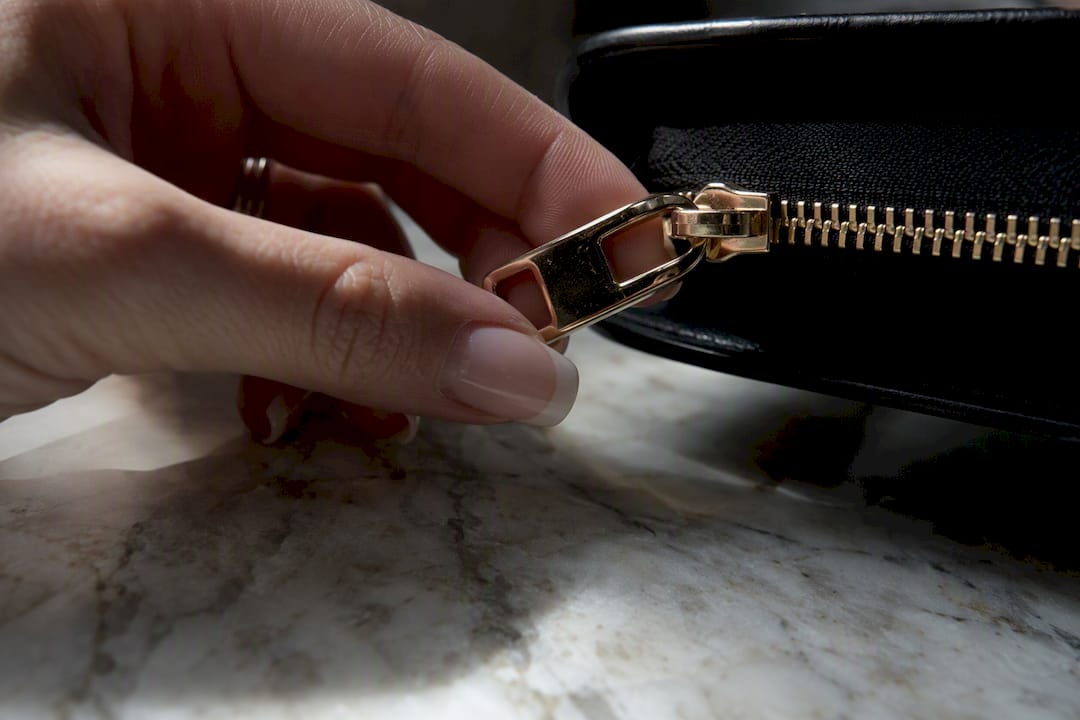
Flip the zipper pull over and check the engraving on the underside. It should be crisp, evenly spaced, and consistent in depth. Sloppy, shallow, or off-center engraving is a common shortcut counterfeiters take because precision stamping costs more than most fake operations are willing to spend. Thin metal that feels light in your palm, or clasps with visible seams and rough edges, are both red flags worth walking away from.
What Should Stitching and Edges Look Like Up Close?
Genuine Bottega Veneta stitching runs at a consistent length with even spacing across straps, handles, and seams, and it lines up perfectly where panels meet. Edge paint or coating covers the leather’s raw edges smoothly, with no drips, bubbling, or flaking anywhere along the trim.
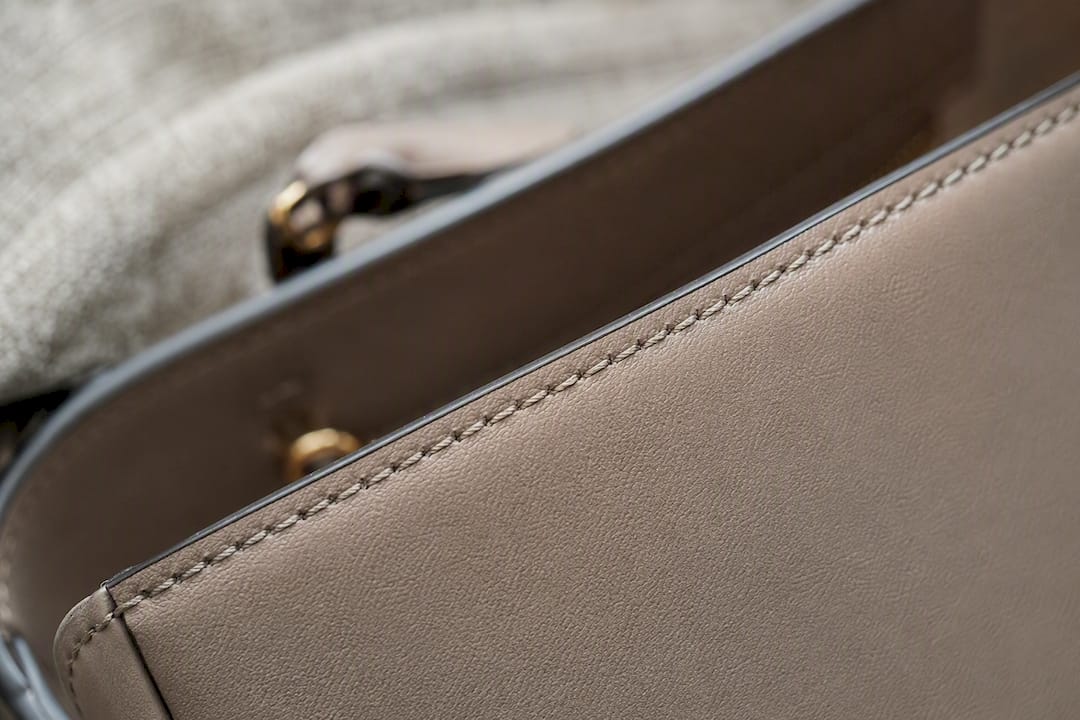
Replicas tend to slip on the small stuff: stitches that vary in size within the same seam, thread that puckers the leather instead of sitting flush, or edge coating that looks painted on in a hurry with visible brush strokes. Run your finger along an edge. If it feels rough or tacky, that’s rarely something an authentic piece would let through quality control.
How Do You Read the Interior Heat Stamp and Serial Tag?
Every authentic bag carries an interior heat stamp reading “BOTTEGA VENETA – MADE IN ITALY,” and the embossing should look crisp and evenly pressed into the leather, with consistent letter spacing and depth. Shallow, uneven, or oddly kerned lettering is one of the most common counterfeit tells because heat stamping precision is expensive to replicate.
The sewn-in originality tag is a separate element, usually stitched into an interior seam or pocket. Older tags carried multi-line codes noting style, leather type, color, and a four-digit year; later production shifted to shorter single-line codes with no publicly documented decoding system. Here’s the part sellers online rarely mention: typing a code into a serial checker tells you almost nothing on its own, because anyone can copy digits from a photo. What actually matters is the printing itself, the ink color, and the digit shapes, which is exactly why photo evidence of the tag beats a typed-out code every time.
Does the Packaging Support the Bag’s Provenance?
Genuine dust bags use consistent font spacing, correct brand coloring, and clean, high-quality printing with the logo placed exactly where Bottega Veneta positions it. Chipped letters, blurry edges, or a slightly wrong font are the kind of small printing errors that show up on fakes far more than on real inventory.
Original boxes, care cards, and receipts add real weight to a resale listing, but their absence isn’t automatically disqualifying. Vintage pieces bought decades ago rarely still have their box, so judge missing packaging in context rather than treating it as a hard red flag.
What Pricing and Listing Red Flags Should Stop You?
A price sitting far below market average for a current-season style deserves suspicion before anything else. Compare the listing against recent resale averages for that exact style and condition, not against the original retail price.
Watch seller behavior too. No-returns policies, vague or missing provenance, and pressure to close the sale fast are all patterns worth pausing on. Listings with inconsistent details, like photos showing a “Made in Italy” stamp while the description mentions a different country of origin, point to either a fake or a seller who hasn’t actually checked the item themselves.
When Should You Hire a Professional Authenticator?
High-value pieces, vintage styles with unfamiliar tag formats, or any listing where something feels slightly off are all worth the cost of a professional opinion before you commit. Authenticators work from photos, and a clear image of the tag is worth more than the typed code itself, since there’s no public database to verify a serial number remotely.
Send these exact shots for the fastest, most accurate read:
- A flat, well-lit macro of one Intrecciato weave panel
- A straight-on close-up of the interior heat stamp
- The originality tag, both front and reverse
- The zipper pull underside showing any engraving
- Close-ups of every hardware piece, including clasps and feet
Naise Shopper builds this same rigor into every listing, guaranteeing authenticity on each piece before it ships, backed by secure international shipping and personal shopper assistance for buyers who’d rather skip the guesswork entirely.
How Do You Buy Safely and Protect Resale Value Later?
Whether you’re buying for yourself or planning to resell down the line, following a set order protects you at every step:
- Request full macro photos before paying anything.
- Verify the weave, heat stamp, tag, and hardware against everything covered above.
- Ask for provenance: original receipt, boutique tag, or purchase history.
- Get professional authentication if the value or details warrant it.
- Pay through secure, buyer-protected methods rather than direct transfer.
- Keep every document and photo from the transaction.
Pro Tip: Save your authentication photos and any professional report in a dedicated folder the moment you buy. Resellers who can hand over that paper trail typically move inventory faster because buyers don’t have to start their own verification from zero.
How Have Bottega Veneta’s Authentication Markers Changed Over Time?
Bottega Veneta’s approach to marking authenticity has shifted noticeably since the Intrecciato weave debuted in the 1970s as the house’s signature technique. In the brand’s early decades, the design philosophy leaned hard into anonymity. Founder guidance reportedly favored letting the craftsmanship speak instead of branding the exterior, which is part of why the interior heat stamp and sewn tag became the primary authentication points rather than an exterior logo.
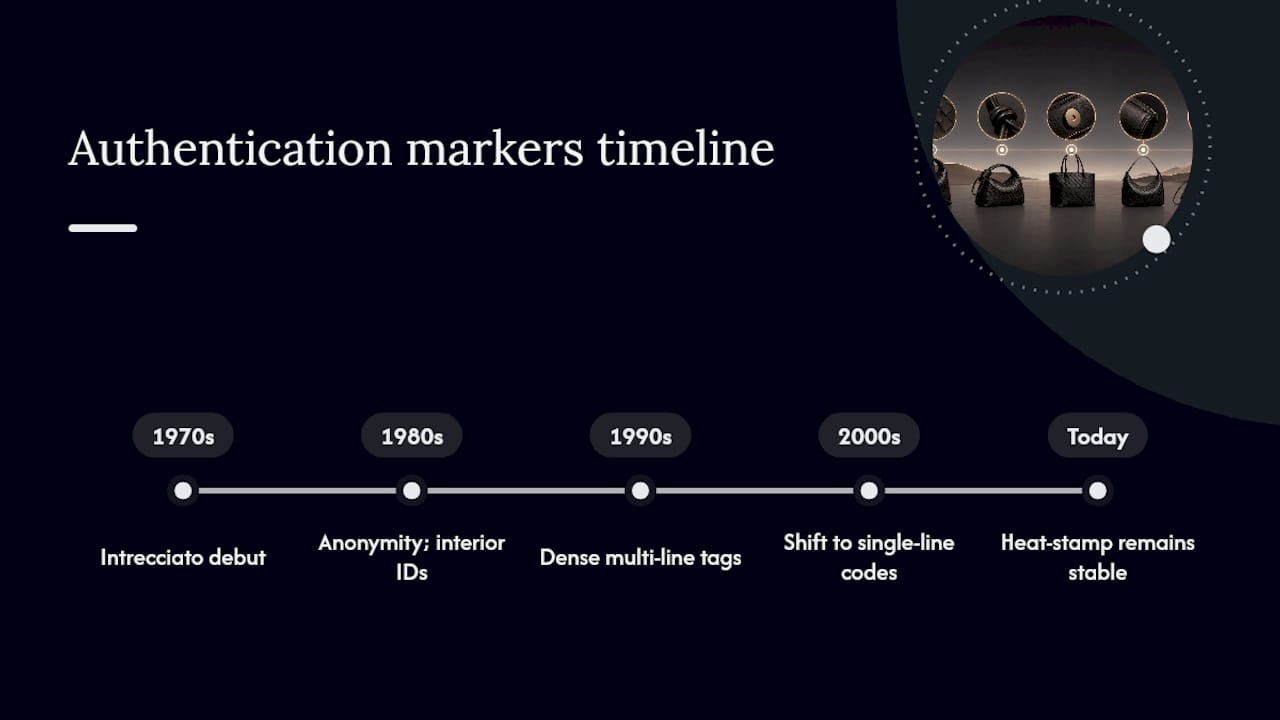
Serial tag formats evolved as the company scaled production and changed ownership over the years. Older tags used a denser, multi-line format packing in style number, leather type, color code, and a four-digit year, giving buyers and boutiques more to cross-reference. As manufacturing modernized, Bottega Veneta moved toward shorter, single-line codes that carry less obvious embedded information. That shift matters for anyone authenticating older versus newer pieces, since a vintage tag format on a bag claimed to be recent (or vice versa) is itself worth questioning.
The heat stamp wording and placement have stayed comparatively stable, which is part of why it remains one of the most dependable checks across eras. Counterfeiters have gotten better at copying logos over the decades, but reproducing the exact depth and spacing of a proper heat-stamped emboss remains one of the harder details to fake convincingly, especially on older production runs where the stamping equipment and process differed from today’s methods.
Do Authentication Checks Differ for Bags, Shoes, and Accessories?
The core principles hold across categories, but where you look shifts depending on what you’re inspecting. On bags, the weave panel and interior stamp carry the most weight, alongside hardware and zippers. Shoes shift the focus toward the insole stamp, sole construction, and stitching around the welt, since a shoe doesn’t offer the same expanse of Intrecciato to inspect and the weave (when present) is usually confined to smaller panels on the upper.
Small leather goods and accessories, like wallets or card holders, compress the same checks into a tighter space. There’s less surface area for weave inspection, so the interior stamp, stitching precision, and hardware on zippers or snaps carry proportionally more weight in your decision. A wallet’s card slots also reveal stitching quality fast, since cheap construction shows up quickly in a compartment that gets handled daily.
Jewelry and metal accessories drop the leather and weave checks almost entirely and lean on engraving quality, metal weight, and clasp mechanisms instead. If you’re authenticating a category outside handbags, treat the bag-specific checklist as a starting framework and adjust which checks carry the most weight for that product type. A broader accessory checklist can help fill in category-specific gaps the bag-focused checks don’t cover.
Where Can You Get Official Help With Authentication Questions?
Bottega Veneta boutiques can examine an item in person, and that remains the closest thing to an official verification channel since there’s no public database to check a serial code remotely. Customer service lines can answer general product questions, but don’t expect a definitive authenticity ruling over email or phone. Most brands, Bottega Veneta included, avoid making authentication calls without physically handling the piece.
That gap is exactly why third-party authentication services exist, and why photo quality matters so much when you use one. A grainy, poorly lit snapshot of a tag tells an authenticator almost nothing useful, while a sharp macro shot under natural light can settle a question in minutes. If you’re weighing a purchase and can’t get the seller to cooperate with detailed photo requests, treat that reluctance itself as information. Legitimate sellers, especially those with nothing to hide, are usually happy to oblige.
For collectors and resellers building a habit of documenting every purchase, a step-by-step authentication process applied consistently across every acquisition creates a paper trail that pays off the next time you decide to sell. Buyers increasingly ask for that history upfront, and having it ready shortens negotiations considerably.
Where Buyers Usually Go Wrong
The biggest mistake I see repeated is treating a serial number as the finish line instead of one data point among several. Buyers type a code into an online checker, get a result that looks plausible, and stop looking. That’s backwards. The weave and the leather tell you far more than a printed code ever will, and they’re much harder to fake convincingly.
The second mistake is skipping the leather feel entirely when shopping from photos, then being surprised when a piece arrives stiff or plasticky. If a seller won’t describe how the leather feels or won’t provide a flex photo, ask directly before you commit.
— Camila
Naise Shopper: A Guaranteed-Authentic Alternative to the Guesswork
All the checks above matter because private listings and resale marketplaces put the authentication burden entirely on you. Naise Shopper removes that burden by guaranteeing authenticity on every handbag it sells, including its Bottega Veneta pieces, so you’re not weighing weave photos against gut instinct before you buy.
Every listing ships with secure international delivery and shipping insurance included, and if you want a second set of expert eyes before committing to a specific style, Naise Shopper’s personal shopper assistance can source and verify pieces on your behalf across the US. Browse the current authenticated leather boot and shoe selection to see how listings are presented with full authentication backing, then reach out through personal shopper assistance if you want a specific Bottega Veneta piece sourced and verified before it ever reaches your door.
Sources
For deeper reference, the LegitGrails serial number guide covers tag formats in detail, while LegitCheck’s fake-spotting guide breaks down heat stamp inconsistencies. Naiseshopper’s own handbag authentication checklist rounds out the practical side for collectors building their own inspection routine.
- How to Authenticate Bottega Veneta: Real vs Fake (2026)
- REAL vs FAKE Bottega Veneta Bags (LegitCheck guide)
- How to Tell Real vs. Fake Bottega Veneta – LegitGrails