Purchase protection reimburses, repairs, or replaces items that get damaged or stolen within a set window after you buy them, usually 60 to 120 days. It will not help you if you were scammed or a seller never shipped your order, and it typically caps out around $500 to $10,000 per claim. If you kept your receipt and can document the loss quickly, there is a good chance your card has you covered.
TL;DR:
- Purchase protection generally covers items worth a few hundred dollars for 60 to 120 days, with limits typically around $500 but up to $10,000 on premium cards.
- Exclusions are common and include perishables, vehicles, software, collectibles, and items left unattended or lost without theft evidence.
- Card issuer policies, not network benefits, determine the actual coverages, including limits, windows, and eligible purchases, so verifying specific card benefits is essential.
- Filing a claim requires prompt police reports for theft, detailed documentation, photos, receipts, and possibly damage estimates, with claims often taking 30 to 60 days to resolve.
- Purchase protection is secondary to homeowner or renters insurance and should be used for smaller losses when primary policies do not apply or exceed their deductibles.
Table of Contents
- What Is Credit Card Purchase Protection, Exactly?
- How Much Does Purchase Protection Actually Cover?
- Does Your Card Issuer Matter More Than the Network?
- How Do You File a Purchase Protection Claim?
- Purchase Protection vs. Homeowners Insurance vs. Warranty vs. Chargeback
- Should Purchase Protection Influence Which Card You Choose?
- Does Purchase Protection Raise Your Annual Fee?
- Why Luxury Buyers Should Stack Card Protection With Retailer Coverage
- Extra Protection for High-Value Luxury Purchases
- Where to Verify Your Card’s Exact Terms
- Sources
What Is Credit Card Purchase Protection, Exactly?
Purchase protection is a card benefit, sometimes labeled “damage protection” or “short term protection” in a benefits guide, that reimburses you when something you bought is stolen or accidentally damaged shortly after purchase. Think of it as a mini insurance policy that rides along with certain credit cards, activated automatically the moment you pay with the right card.
It gets confused constantly with fraud protection, and the two do completely different jobs. Fraud protection, sometimes called zero-liability coverage, deals with charges you did not authorize, someone stealing your card number and going on a shopping spree. Purchase protection deals with a purchase you made on purpose that later goes wrong. If a scammer talks you into wiring money for a fake designer bag, that is a fraud or chargeback issue, not purchase protection, because purchase protection covers items you legitimately bought that are later stolen or damaged, while fraud coverage handles the unauthorized transaction itself.
The eligibility rule trips up a lot of cardholders. You generally have to charge the full purchase to the card offering the benefit or redeem the card’s rewards points for it. Split the tab across two cards, or pay partly in cash, and you may lose the protection entirely.
Here is how the four related benefits actually break down:
- Purchase protection: covers accidental damage or theft of a specific item shortly after buying it.
- Fraud/zero liability: covers charges you never made or authorized.
- Chargebacks: reverse a payment when a seller never delivered goods or misrepresented them.
- Extended warranty: covers mechanical or functional defects over a longer horizon, often doubling the manufacturer’s original warranty.
How Much Does Purchase Protection Actually Cover?
The dollar figures matter more than the marketing copy, and they vary enough between cards that assuming coverage is a mistake. Most cards set the coverage window within a range from about two to four months from the purchase date. Once that window closes, the item is on its own.
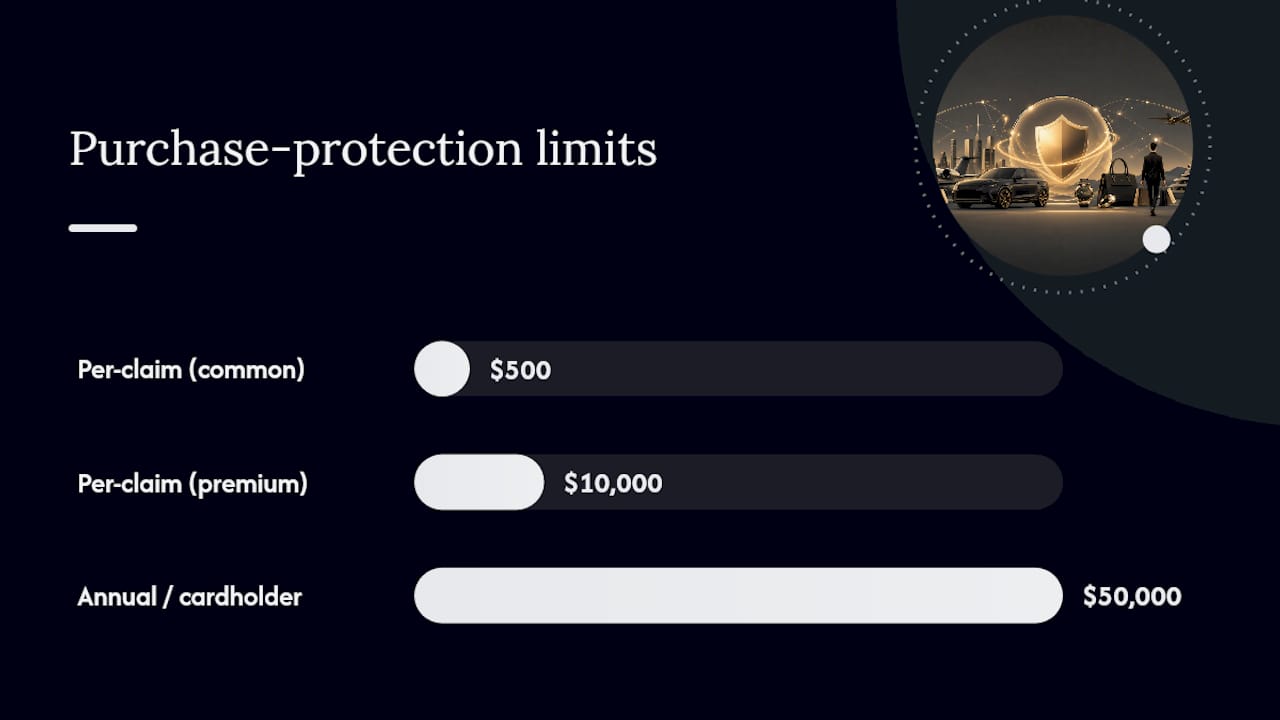
Per-claim limits cluster around $500 for a lot of general rewards cards. Premium travel and business cards push that ceiling much higher. Some card products list per-occurrence limits as high as $10,000, with annual caps around $50,000, which matters a great deal if you are buying a designer watch or a serious handbag rather than a coffee maker.
| Coverage detail | Typical range |
|---|---|
| Coverage window | 60 to 120 days after purchase |
| Per-claim limit | $500 common; up to $10,000 on some premium cards |
| Annual/cardholder limit | Often around $50,000 |
| Common exclusions | Perishables, collectibles, vehicles, software, items left unattended in plain sight |
| Claims process complexity | Moderate; documentation heavy, 30 to 60 day resolution typical |
Exclusions are where most people get surprised. Perishable goods, motorized vehicles and their parts, software, and collectibles like art or rare coins are routinely excluded across issuers. So is anything stolen from a place where it was left visible and unattended, a laptop bag on a car seat, for example. Issuers draw a sharp line between “stolen” and “lost.” A phone that fell out of your pocket at the beach is a loss, not a theft, and most benefit guides exclude simple misplacement. Some issuers make narrow exceptions for involuntary parting, like sunglasses swept off your face by a wave, but you need solid evidence to make that argument stick.
Two quick scenarios show how this plays out. A cardholder buys a $1,200 espresso machine that gets damaged in a move three weeks later; a $500 per-claim limit still leaves $700 uncovered. A shopper’s $3,800 handbag gets stolen from a locked car trunk within 45 days of purchase, well inside a 90-day window, and a card with a $10,000 per-claim limit covers it in full once the police report and receipt are submitted.
Does Your Card Issuer Matter More Than the Network?
Yes, and this is the part shoppers overlook most. Visa, Mastercard, and American Express each publish network-level benefit frameworks, but the bank that issued your specific card decides the real terms: the dollar limits, the time window, and which purchases qualify. The network page is a starting point, not the final word.
- Visa offers purchase protection mainly on Visa Signature and higher tiers, with terms set by the issuing bank rather than Visa itself.
- Mastercard bundles similar coverage into World and World Elite Mastercard products, again issuer-dependent.
- American Express tends to publish some of the higher per-occurrence caps in the market on select cards, along with clearer documentation checklists.
- Chase advertises a 120-day coverage window on many of its cards, longer than the 90-day standard many competitors use, alongside a documented claims process.
Visa’s consumer benefits page lays out general protections and security practices, but it explicitly defers to issuer terms for anything claim-specific. That is the pattern across all three networks: broad promises up top, real numbers buried in the cardmember agreement. Before you assume a benefit exists because you have a Visa Signature or World Elite Mastercard, pull up your card’s actual benefits guide and check the coverage table yourself.
How Do You File a Purchase Protection Claim?
Speed and paperwork decide most outcomes here. Documentation quality, more than the size of the loss, is what separates approved claims from denied ones.
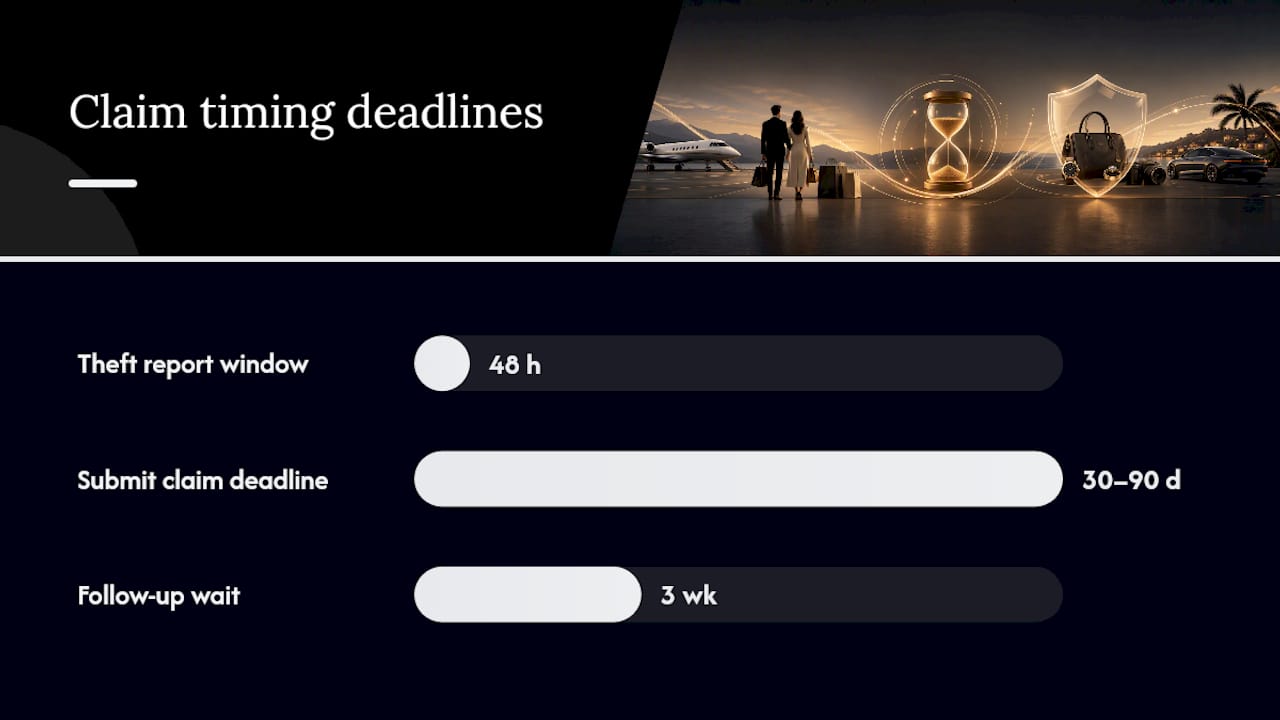
- Act within 48 hours for theft. File a police report immediately; most issuers require one to even open a claim.
- Photograph the damage or the scene before you clean up, move the item, or throw anything away.
- Pull your itemized receipt and the matching card statement showing the charge posted to the eligible card.
- Get a repair estimate from a certified vendor if the item is damaged rather than stolen.
- Call the benefit administrator listed in your cardmember agreement, not your card’s general customer service line, to open the claim officially.
- Submit the full packet (receipt, statement, photos, police report, repair estimate, and any primary insurance settlement) within the deadline the administrator gives you, typically 30 to 90 days.
- Follow up in writing if you have not heard back within three weeks.
If a claim gets denied, ask for the specific reason in writing before you do anything else. Missing documentation is the single most common cause of denial, so re-submit with the exact evidence the administrator flagged rather than resending the same packet. If that second attempt also stalls, escalate to the issuer’s card member dispute team, which sits above the benefit administrator and can override a bad initial call.
Pro Tip: Save a PDF of your card’s benefits guide the day you get approved. Issuers change perk lineups often, and having your own copy means you can prove what was covered when you made the purchase, not just what the current guide says.
Purchase Protection vs. Homeowners Insurance vs. Warranty vs. Chargeback
Choosing the wrong recovery path wastes time and sometimes forfeits your claim entirely. Each of these four tools is built for a different kind of loss, and the differences matter.
Purchase protection is typically secondary coverage. For a major loss, homeowners or renters insurance is usually the primary policy, and issuers generally expect you to file with your primary insurer first, with the card benefit picking up whatever the deductible or gap leaves behind. For a stolen $4,000 watch, that means your renters policy pays first and the card covers the deductible difference, not the other way around.
Extended warranties exist for a different timeline altogether. Purchase protection handles theft and accidental damage in a short window, while an extended warranty covers mechanical or functional defects for months or years after the original manufacturer warranty expires.
Chargebacks solve a third, unrelated problem: a seller who never shipped the item, sent a counterfeit, or charged you without authorization. None of that is purchase protection territory.
- Use purchase protection when: the loss is smaller than your insurance deductible, or the item isn’t covered by any policy you hold.
- Use primary insurance when: the loss is large and clearly exceeds your card’s per-claim limit.
- Use an extended warranty when: the item stopped working months after purchase, with no theft or accident involved.
- Use a chargeback when: the seller is the problem, not the product.
Should Purchase Protection Influence Which Card You Choose?
Purchase protection makes a reasonable tiebreaker between two similar cards, but it should rarely be the main reason you apply for one. Rewards rate, annual fee, and everyday usability still matter more for most cardholders.
Ask yourself a few honest questions first. How often do you actually buy items worth more than a few hundred dollars? Would you remember to charge that purchase to the right card and keep the receipt? Does the issuer publish clear per-claim and annual limits, or does the benefits guide bury the numbers in vague language?
When you do read a benefits guide, a few phrases carry real weight. “Secondary coverage” means your homeowners or renters policy has to go first. “Per-item” caps limit each individual object, while “per-year” caps limit your total claims across twelve months regardless of how many separate incidents you file. Fewer issuers now include purchase protection across their full card lineup than a few years ago, so never assume the benefit exists just because a card looks premium.
- Check the exact per-claim and annual limits, not just whether the benefit is “included.”
- Confirm the coverage window in days, since 60 versus 120 is a meaningful difference for slower-moving claims.
- Read the exclusions list before you buy anything the card is supposed to protect.
Pro Tip: If you regularly buy items over $1,000, a longer window and a higher per-claim limit are worth more than a slightly better cash back rate on groceries.
Does Purchase Protection Raise Your Annual Fee?
Not directly, and that surprises a lot of cardholders who assume every perk comes with a hidden price tag. Purchase protection is bundled into the card’s existing benefit package rather than sold as an add-on with its own separate charge. You will not see a line item for it on your statement or in your cardmember agreement.
That said, cards carrying richer benefit packages, longer coverage windows, higher per-claim limits, and broader eligible categories do tend to carry higher annual fees overall. The protection itself is not billed separately, but it is part of what justifies a $95 or $550 annual fee versus a $0 one. A no-annual-fee card might skip purchase protection entirely or cap it tightly at $500 per claim, while a premium card bundling it with travel insurance and lounge access explains part of why that card costs more to hold.
The practical takeaway: do not pay a higher annual fee purely to chase better purchase protection numbers unless you genuinely buy enough high-value items to use the benefit. For occasional big purchases, on the other hand, a card that already carries a fee you’re paying for other reasons, travel perks, cash back multipliers, becomes considerably more valuable once you realize the purchase protection riding along with it is functionally free.
Why Luxury Buyers Should Stack Card Protection With Retailer Coverage
Card benefits were never designed with a $3,000 handbag or a limited-edition watch in mind, and the gaps show up fast once you’re shopping at that price point. A $500 per-claim cap barely dents a designer bag’s replacement cost, and international shipping introduces theft and damage risk that a domestic-focused card benefit often handles poorly.
That’s a real gap Naiseshopper’s buyer protection services are built to close, combining authentication guarantees with shipping insurance so a loss in transit isn’t purely your card issuer’s problem to solve. For any luxury order, document the serial number and authentication certificate before it ships, choose insured shipping whenever it’s offered, and keep every receipt in one folder rather than scattered across email confirmations. Combining retailer protection with card benefits closes gaps that are notoriously hard to prove in a card claim alone, particularly for items lost or damaged in international transit.
To be clear, this is a complement, not a substitute. Your card’s purchase protection still matters for damage or theft that happens after delivery; Naiseshopper’s coverage is strongest at the checkout and shipping stage, before the item ever reaches your door.
— Camila
Extra Protection for High-Value Luxury Purchases
Naiseshopper gives you a coverage layer your credit card was never built to provide, one designed specifically around authenticated designer goods rather than generic retail purchases.
Every order ships with insured, secure international delivery, so a bag or watch lost or damaged in transit is covered before your card’s 60 to 120 day window even becomes relevant. Add the authenticity guarantee on every item, from a Prada floral heel to a Gucci G-Timeless watch, and you’re covered for exactly the risks that international luxury shopping introduces and that a standard card benefit tends to exclude or cap too low.
None of this replaces your card’s purchase protection, it works alongside it, covering the shipping and authentication gaps your issuer’s terms were never written to close. Browse Naiseshopper’s current luxury handbags, shoes, and watches to see the insured shipping and authentication guarantee applied at checkout on your next order.
Where to Verify Your Card’s Exact Terms
Check your issuer’s own claims portal for the fastest answers, Chase’s purchase protection page is a solid model, alongside your card’s cardmember agreement PDF. Network pages from Visa and Mastercard offer background, but the issuer’s terms always govern your actual claim.
Sources
- Credit Card Protection: Types & How They Work (2026) — WalletHub
- Chase purchase protection guide — Chase
- Purchase protection: Which credit cards cover your belongings — NerdWallet
- American Express: purchase protection details and documentation guidance — American Express
- How does credit card purchase protection work? — CNBC Select