TL;DR:
- Shopping insurance bridges the gap between luxury purchase and protection, covering loss, theft, or damage during transit. Its effectiveness depends on understanding specific coverage types, claim processes, and policy exclusions before buying or claiming. Proper documentation, timely reporting, and pre-knowledge of policy limits are essential to ensure claims are approved and benefits maximized.
You clicked “buy” on that authenticated Prada bag, tracked the shipment, and waited by the door. Then something went wrong. A package marked “delivered” that never arrived. A stunning Bottega Veneta clutch that arrived crushed. These moments reveal a gap that even the most careful luxury shoppers overlook: the space between purchase and protection. Shopping insurance fills that gap, but only if you understand exactly how it works, what it covers, and where it quietly falls short.
Table of Contents
- What is shopping insurance for luxury fashion?
- Types of shopping insurance: What’s available for designer fashion?
- How does shopping insurance work? Steps and requirements you should know
- Exclusions, documentation, and navigating claims for luxury purchases
- When is shopping insurance worth it? Weighing cost, risk, and benefit
- Why the real power of shopping insurance is reading the fine print
- Shop confidently: Authentic luxury protected and delivered
- Frequently asked questions
Key Takeaways
| Point | Details |
|---|---|
| Comprehensive coverage | Shopping insurance protects against loss, theft, damage, and delivery issues for luxury purchases. |
| Multiple types available | Coverage can be included with cards, added at checkout, or purchased as specialized luxury policies. |
| Claims need evidence | Successful claims require receipts, clear photos, and prompt action on eligible high-value items. |
| Know exclusions | Read what’s not covered and review fine print before assuming your designer fashion is fully insured. |
| Insurance isn’t always automatic | Always verify your purchase is covered before checking out—don’t assume every luxury item is insured by default. |
What is shopping insurance for luxury fashion?
Shopping insurance is broader than most people realize. As a concept, “shopping insurance” covers reimbursement when eligible items you buy are lost, stolen, damaged, misdelivered, or not delivered at all. It is not one single product. It is an umbrella category that includes several different types of coverage, each with its own rules, limits, and activation requirements.
For luxury fashion shoppers, this distinction matters enormously. A Chanel flap bag or a Gucci G-Timeless watch is not just a purchase. It is a significant financial commitment, and the risks involved in getting it from seller to wardrobe are real. Shipping mishaps, customs delays, courier mishandling, and even porch theft can all put a high-value item at risk.
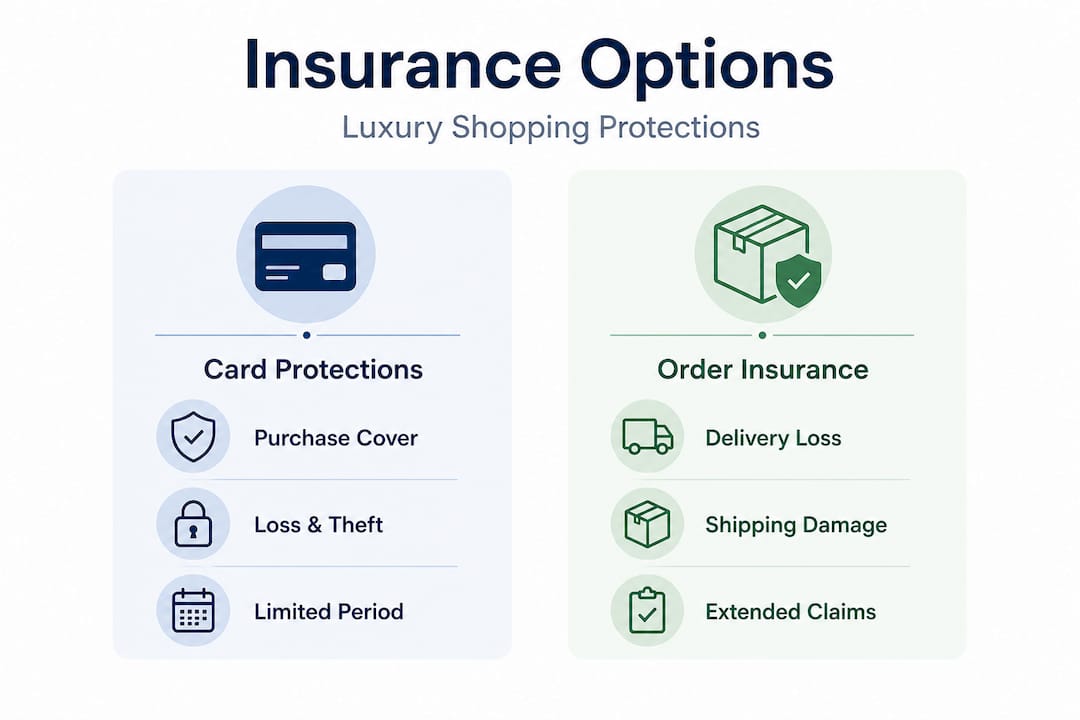
Here is a quick overview of what shopping insurance typically covers for designer fashion:
| Coverage type | What it protects | Common limit |
|---|---|---|
| Loss in transit | Package lost by carrier | Up to declared value |
| Theft | Stolen before or during delivery | Varies by policy |
| Damage | Item arrives broken or destroyed | Repair or replacement cost |
| Misdelivery | Sent to wrong address | Full item value |
| Non-delivery | Item never arrives | Refund or reship |
A few important caveats apply across all categories. Coverage always comes with conditions. You will need proof, and there are caps on what gets paid out. Understanding secure luxury shipping explained is a smart first step before adding any insurance layer to your purchase.
“Shopping insurance is not a blank check. Every policy defines eligible items, eligible events, and required documentation. Luxury shoppers who assume full coverage without reading the details often find themselves underprotected at the worst possible moment.”
The key takeaway: shopping insurance is a powerful tool, but it is only as strong as your understanding of what it actually promises.
Types of shopping insurance: What’s available for designer fashion?
Now that we know what shopping insurance covers, let us look at the major types you will actually encounter when buying luxury fashion online.
Shopping insurance is often delivered as card-based purchase protection, a checkout add-on called order protection, or a specialized insurance program for luxury goods and high-value shipping. Each type serves a different purpose and suits different shopping scenarios.
Here is how the three main types stack up:
| Type | How it activates | Best for | Typical cost |
|---|---|---|---|
| Card purchase protection | Automatic with eligible card | Theft, damage after delivery | Included in card benefits |
| Order protection (checkout) | Opt-in at checkout | Lost or damaged in transit | Small fee per order |
| Luxury goods insurance | Standalone policy | High-value collections, long-term | Monthly or annual premium |
-
Card purchase protection is the most commonly overlooked benefit. Many premium credit cards include coverage for items purchased with the card that are stolen or damaged within a set window, often 90 to 120 days. The catch is that coverage limits can be low for designer items, sometimes capped at $500 to $1,000 per claim.
-
Order protection at checkout is the add-on you see right before you confirm your purchase. It typically covers transit-specific risks like loss, wrong delivery, or damage during shipping. It is convenient and inexpensive, but it is narrower in scope than a full insurance policy.
-
Luxury goods insurance is a standalone policy designed specifically for high-value items. These programs cover authenticated designer handbags, watches, and apparel both during transit and after delivery. For serious collectors or frequent luxury buyers, this is often the most thorough option.
Pro Tip: Before paying for order protection at checkout, check whether your credit card already includes purchase protection. Doubling up on coverage for the same event is common and wasteful. Review your card benefits once and know exactly what is already in place.
For deeper context on how shipping insurance for luxury fashion works specifically for designer items, it is worth reading up before your next purchase. If you are also thinking about the long-term value of what you are buying, understanding investing in luxury handbags can help you decide how much protection is truly worth it.
How does shopping insurance work? Steps and requirements you should know
Understanding the types available, let us walk through how shopping insurance actually functions when you need it.
The mechanics are straightforward: you pay a premium or activate a card benefit, then make a claim with evidence, and the insurer reimburses you or arranges a reship or repair for approved claims. Simple in theory, but the details matter when a $2,000 Saint Laurent bag is on the line.
Here is the standard process from start to finish:
-
Select your coverage before or at the time of purchase. Card protection is already active if your card includes it. Order protection must be opted into at checkout. Standalone luxury policies require enrollment before the item ships.
-
Keep all purchase documentation. Save your order confirmation, payment receipt, and any authenticity certificates that come with designer items. These are non-negotiable for most claims.
-
Document the item before and after delivery. Take photos of the packaging when it arrives. If you film your unboxing, even better. Visual proof of condition at the moment of receipt is one of the most powerful tools in a claim.
-
Report the incident immediately. Whether it is a theft, a damaged delivery, or a missing package, contact the insurer as soon as possible. Many policies have strict reporting windows, sometimes as short as 48 to 72 hours after the event.
-
Submit your claim with all required evidence. This typically includes your purchase receipt, photos of the damage or evidence of loss, courier tracking records, and sometimes a police report for theft.
-
Follow up and track your claim status. Insurers may request additional documentation. Respond quickly to avoid delays or automatic denial.
Pro Tip: Submit claims the same day you discover an issue. Many luxury shoppers lose valid claims simply by waiting too long. Set a reminder the moment something goes wrong.
Understanding the safe luxury fashion buying process from the start makes every step of a potential claim much smoother, because you will already have the right documentation in place.
Exclusions, documentation, and navigating claims for luxury purchases
Now that you know the standard workflow, it pays to understand the fine print and tricky details when making a claim for luxury goods.
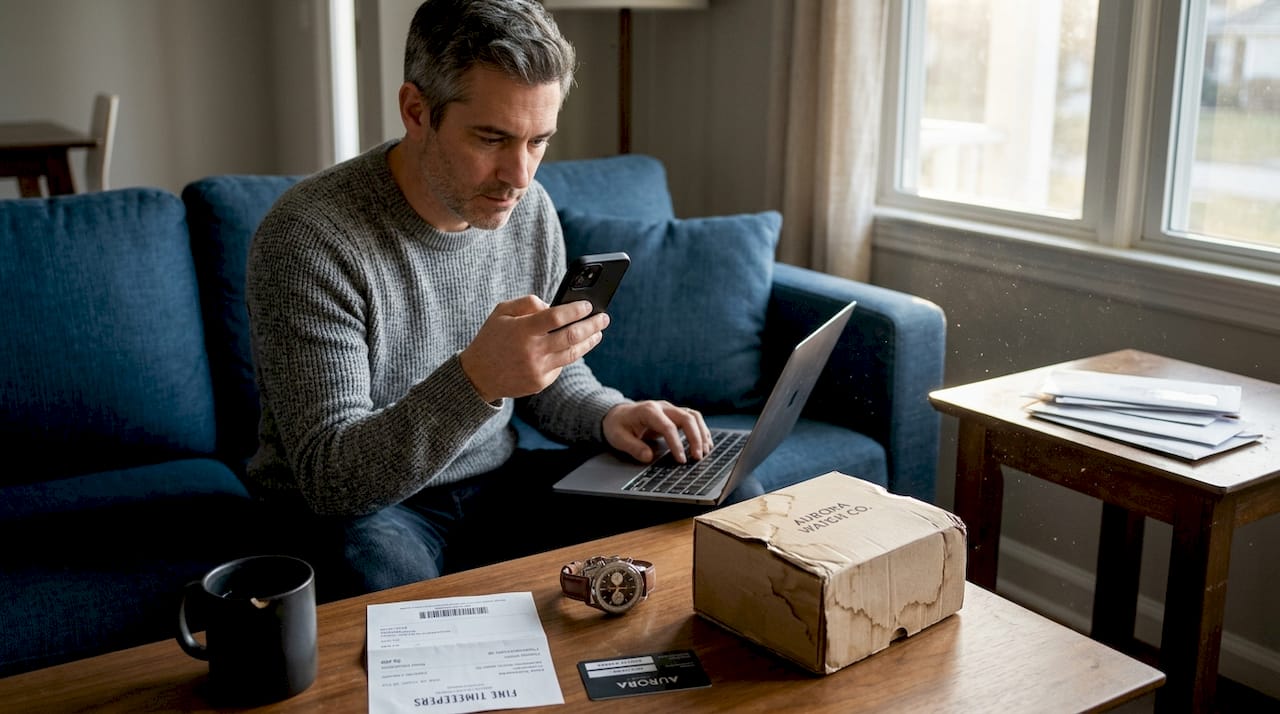
Edge cases that commonly matter for authenticated designer fashion include documentation and proof requirements such as receipts and condition photos, and disputes around what counts as an “eligible” loss. For example, a package marked “delivered” but stolen from a doorstep may fall into a gray zone between misdelivery and theft after delivery. The distinction can determine whether your claim is approved or denied.
Common exclusions to watch for:
- Post-delivery theft is often excluded from transit-only policies. Once the carrier marks a package delivered, your coverage window may close.
- Secondhand or resold items are frequently ineligible. Most shopping insurance products only cover new purchases from authorized sellers.
- Inadequate proof is the single most common reason claims are denied. No receipt, no unboxing photos, no courier documentation means no payout.
- Coverage caps can leave you underinsured. A policy with a $500 limit does not protect a $3,500 Balenciaga bag.
- Cosmetic damage is sometimes excluded if the item is still functional. A scuffed box or minor surface scratch may not qualify.
- Customs seizures are almost never covered under standard shopping insurance. International luxury purchases carry this additional risk.
“Authenticated designer fashion requires a higher standard of documentation than everyday purchases. The moment you invest in a Prada or Valentino piece, you should treat every receipt and photo as part of the item’s permanent record.”
Understanding designer shipping insurance details helps you anticipate these gaps before they become expensive surprises. And knowing why designer authentication matters is equally important, because insurers often require proof that the item is genuine before processing a claim.
When is shopping insurance worth it? Weighing cost, risk, and benefit
With a clear sense of coverage and limits, let us break down when it actually makes sense to pay for extra protection.
An order protection fee at checkout is conceptually similar to purchase protection: it covers defined shipping and fulfillment failure modes including wrong item, wrong address, lost in transit, damage, or stolen packages. The question is whether that coverage adds real value given what you are already protected by.
Ask yourself these questions before adding insurance at checkout:
- What is the item’s value? For purchases over $500, additional coverage is almost always worth considering. For a $200 accessory, your card protection may already be sufficient.
- How is the item shipping? International luxury shipments through customs carry more risk than domestic deliveries. The more complex the route, the stronger the case for dedicated coverage.
- What carrier is being used? Some carriers have better loss and damage records than others. A less reliable carrier increases the value of having insurance in place.
- Does your credit card already cover this? Many premium cards include purchase protection that overlaps significantly with checkout add-ons.
- What are the coverage limits? If the policy cap is lower than the item’s value, you may need a supplemental policy or a standalone luxury goods plan.
Pro Tip: Sometimes your credit card coverage makes checkout add-on insurance completely redundant. Before every luxury purchase, spend five minutes reviewing your card’s purchase protection terms. It could save you a small fee and avoid confusion during a claim.
Knowing where to find authentic designer fashion deals from trusted sources is the first layer of protection. The benefits of buying designer fashion from authenticated platforms extend well beyond style, they include the documentation trail that makes insurance claims far easier to win.
Why the real power of shopping insurance is reading the fine print
Here is what most luxury buyers overlook when it comes to protecting their investment.
Shopping insurance feels like a safety net. You pay a small fee, you get peace of mind, and you move on. But the uncomfortable truth is that a large share of luxury item claims are denied, not because the loss was not real, but because the shopper did not understand what they actually purchased. Missing a 48-hour reporting window. Failing to photograph packaging before opening. Assuming a card benefit covered an item it explicitly excluded. These are not rare mistakes. They are the norm.
The contrarian view worth taking seriously: paying for insurance is only half the battle. Knowing the claim process before you buy is what separates shoppers who get paid out from those who do not. Think of it like a fire drill. You do not practice after the fire starts.
Treat shopping insurance as a policy with boundaries, including eligible items, eligible events, coverage limits, and claim deadlines, not as a guarantee that the full declared value will always be paid. Read the exclusions and required proof steps for the exact product you are offered at checkout or via your card.
We have seen cases where luxury shoppers invested in a Chanel piece, added checkout order protection, and still had their claim denied because the policy only covered transit damage and the item was stolen post-delivery. The coverage was real. It just did not apply to that specific situation.
The lesson: read the exclusions first, not after something goes wrong. Understand the claim deadline. Know exactly what documentation you need before the package even leaves the warehouse. That preparation is what makes insurance actually work for you. For those buying across borders, understanding safe luxury shopping internationally is equally essential, since international purchases introduce additional risk layers that standard policies often do not address.
Shop confidently: Authentic luxury protected and delivered
At Naise Shopper, every item in our collection is authenticated before it reaches you. From a pair of Prada black floral heels to a Gucci G-Timeless watch, every piece ships with the documentation trail that makes insurance claims clean and straightforward. We pair that authenticity guarantee with secure international shipping and insurance options, so your investment is protected from the moment you click “buy” to the moment it arrives at your door.
Ready to shop with confidence? Explore our full collection of authenticated Gucci, Prada, Chanel, Balenciaga, Valentino, and more. Every purchase comes backed by our authenticity promise and secure delivery standards, giving you the peace of mind that luxury shopping deserves.
Frequently asked questions
What types of losses does shopping insurance for luxury items cover?
Most products cover theft, loss, damage, misdelivery, or non-delivery for eligible luxury purchases. As defined by leading providers, “shopping insurance” covers reimbursement when eligible items are lost, stolen, damaged, misdelivered, or not delivered.
Is my purchase automatically covered by shopping insurance?
Coverage may be automatic with certain premium cards or sellers, but always check details and exclusions before purchase. Shopping insurance is often delivered as card purchase protection, a checkout add-on, or a specialized insurance program, and each activates differently.
What proof do I need to make a claim on luxury shopping insurance?
You will typically need your purchase receipt, order documentation, and clear photos showing item condition and packaging. Documentation and proof requirements including receipts and condition photos are among the most common sticking points for authenticated designer fashion claims.
Does shopping insurance cover secondhand or resold designer goods?
Most standard policies only cover new items, so check whether secondhand or resold items are eligible in the specific policy details. Disputes around eligibility often center on whether an item qualifies as new versus secondhand or refurbished.
Is “order protection” at checkout different from insurance via my credit card?
Order protection at checkout is similar but typically limited to shipping or fulfillment issues, while card protection may be broader in scope. An order protection fee at checkout covers defined fulfillment issues like loss or damage in transit, which may overlap with but not fully replace card-level purchase protection.