Yes, your designer handbag can be dutiable, and under current rules, more shipments than ever require formal declaration. U.S. Customs and Border Protection (CBP) assesses duty based on the Harmonized Tariff Schedule (HTS) classification and declared value, and the Federal Register’s suspension of the de minimis exemption means the “just ship it, no paperwork” era is over. Declare every purchase, expect entry paperwork on shipped bags, and read on for the exact numbers.
TL;DR:
- Duty rates depend primarily on material composition, with leather typically around 8%, while textiles and synthetics often have higher ad valorem rates.
- Shipments valued under $800 no longer qualify for duty-free entry if arriving through courier, air freight, or commercial carriers, requiring more detailed paperwork.
- Accurate classification and detailed invoice descriptions are crucial to avoid misclassification penalties and delays at customs.
- Travelers should declare their handbags honestly, keep receipts, and register high-value items with Form 4457 to avoid additional duty costs upon return.
- Maintaining thorough documentation, including serial numbers and detailed invoices, is essential for smooth customs clearance and protecting resale value.
Table of Contents
- Handbag Import Duty USA: How Classification and Value Set Your Rate
- De Minimis Suspension: Why Low-Value Shipments Now Face Duty
- Declaring and Paying Duty: Travelers vs. Shipped Purchases
- Estimating Your Duty: A Step-by-Step Method With Two Examples
- Inspection, Seizure, and Penalties: What Happens If You Don’t Declare
- Don’t Forget State Use Tax on Top of Federal Duty
- Your Pre-Purchase and Import Checklist
- Why Documentation Is the Real Currency at the Border
- How Naiseshopper Keeps Your Import Paperwork Clean
- Sources
Handbag Import Duty USA: How Classification and Value Set Your Rate
The duty on your handbag comes down to two things: what it is made of, and what CBP thinks it is worth. Every handbag entering the U.S. gets sorted into the 4202 series of the Harmonized Tariff Schedule, the section covering trunks, cases, and bags, and the exact subheading depends almost entirely on the primary material. A quilted lambskin Chanel flap and a canvas tote from the same designer can land in completely different tariff lines with different rates attached.
That is the piece most first-time importers miss: material drives the number, not brand prestige. A $6,000 crocodile bag and a $600 nylon backpack are taxed by construction, not price tag alone.
- Leather handbags typically fall under HTS lines carrying rates commonly around 8% for many leather bags.
- Textile, canvas, and synthetic-material bags frequently draw noticeably higher ad valorem rates than their leather counterparts.
- Mixed-material bags get classified by whichever material makes up the majority of the exterior surface.
- The HTS search tool run by USITC is the only reliable place to confirm the exact percentage for your specific bag.
Get the invoice description wrong, list “handbag” with no material specified, or undervalue the item, and you risk misclassification. That is not a technicality CBP tends to shrug off, especially on luxury goods.
De Minimis Suspension: Why Low-Value Shipments Now Face Duty
If you have shipped anything into the U.S. under $800 in the last few years assuming it would sail through duty-free, that assumption no longer holds. The Federal Register published an indefinite suspension of the de minimis exemption for merchandise valued at $800 or less arriving through any mode other than the international postal network. The White House followed with an executive action continuing the suspension of duty-free de minimis treatment across all countries, directing CBP on how postal versus commercial-carrier shipments should be handled differently.
What this changes in practice:
- Shipments arriving by courier, air freight, or commercial carrier (not the postal network) generally lose the automatic $800 exemption.
- Many previously informal, paperwork-light shipments now require Entry Type 11 or standard informal/formal entry procedures.
- Sellers and buyers alike need richer invoice data. Vague descriptions that used to slide through now trigger holds.
Legal commentary from trade attorneys frames this as durable policy rather than a temporary blip, noting that courts have upheld the executive branch’s authority to eliminate the de minimis exemption. If you are buying a handbag from overseas and having it shipped, budget for duty and processing time you might not have needed two years ago.
Declaring and Paying Duty: Travelers vs. Shipped Purchases
The forms and timing differ sharply depending on whether you are carrying the bag home yourself or having it shipped.
If you are a traveler returning with a purchase:
- Complete CBP Form 6059B (or declare through Mobile Passport Control where available) and list the bag’s value honestly.
- Know your personal exemption tier. Above it, duty applies to the excess value at the applicable HTS rate.
- If the bag is something you already owned before the trip, register it with CBP Form 4457 before you leave the country so you are not charged duty on your own property when you return.
If the bag is being shipped to you:
- Confirm whether your carrier is filing an informal entry or a formal Entry Type 11, since the threshold and paperwork requirements differ.
- Understand that couriers like FedEx or UPS often collect duty on CBP’s behalf and bill you directly, or hold the package until you pay.
- For high-value or complex shipments, a licensed customs broker can prevent costly classification mistakes.
Pro Tip: Keep every receipt, appraisal, and shipping document in one folder, digital or physical, for at least a year after import. If CBP ever questions the valuation, that paper trail is your fastest way out of a dispute.
Estimating Your Duty: A Step-by-Step Method With Two Examples
Estimating what you will owe is a three-step process, and it takes about five minutes once you know where to look.
- Convert the purchase price to U.S. dollars, and include shipping and insurance costs in the customs value if the bag is being shipped rather than hand-carried.
- Find the exact HTS subheading for the bag’s primary material using the HTS search tool.
- Multiply the customs value by the ad valorem percentage listed for that subheading.
Here is how that plays out on two real purchase scenarios:
The leather bag’s math is straightforward: $2,500 multiplied by roughly 8 percent lands near $200 in duty. The canvas bag illustrates why material matters more than price. Even at half the value of the leather tote, its higher textile rate can close the gap between the two duty amounts considerably. Always confirm the live rate on the HTS lookup before you finalize a budget, since subheadings get revised.
Inspection, Seizure, and Penalties: What Happens If You Don’t Declare
CBP treats luxury goods as an inspection priority, not an afterthought. Designer handbags get pulled for secondary screening more often than ordinary retail merchandise, and undeclared items carry real consequences: seizure of the bag, monetary penalties, and in serious or repeated cases, criminal referral.
Certain patterns tend to draw extra scrutiny:
- Missing or inconsistent receipts for a high-value item.
- Multiple identical bags that look like commercial resale quantities rather than personal use.
- Invoice descriptions that downplay value or misstate material.
Pro Tip: Honesty at the border is not just an ethical position, it is the cheapest option available. A declared bag that turns out to owe duty costs you a modest percentage. An undeclared bag that gets flagged can cost you the entire item plus penalties.
Frequent travelers should register valuable bags on Form 4457 in advance, and everyone should hold on to serial numbers and original receipts as standard practice, not just for CBP but for insurance purposes too.
Don’t Forget State Use Tax on Top of Federal Duty
Federal customs duty is only part of your landed cost. Most states charge a use tax on goods brought in from outside the country, and that tax generally mirrors the state’s regular sales tax rate.
- Use tax can apply even after you have already paid federal duty in full, since it is a separate, state-level obligation.
- Some states offer a credit against use tax for customs duty already paid; many do not, so check your specific state revenue department’s website rather than assuming.
- Add your state’s use tax percentage on top of the federal duty estimate to get a realistic total landed cost before you commit to a purchase.
Your Pre-Purchase and Import Checklist
Run through this before you buy, before you ship, and before you land back in the U.S.
- Confirm the material in writing. Leather, canvas, coated textile, and exotic skins all carry different HTS rates.
- Ask for the country of origin and a detailed commercial invoice that itemizes material and value, not a vague “handbag, $X” line.
- Request the serial number and any authenticity documentation up front. For guidance on what to check before buying, a step-by-step purchase checklist covers the essentials.
- Insure the shipment and confirm which entity, you or the carrier, is responsible for filing entry paperwork.
- Declare on arrival, whether the bag traveled with you or arrived separately, and keep every receipt.
- Register repeat-travel items with Form 4457 before you leave, so returning with your own bag never triggers duty by mistake.
Buyers building a long-term collection may also find value in a designer bag investment checklist that pairs documentation habits with resale-value thinking.
Why Documentation Is the Real Currency at the Border
Here is what conventional advice gets backwards: shoppers obsess over the duty percentage when the bigger risk is almost always paperwork. A bag with a slightly higher rate but a clean, detailed invoice clears faster and with less friction than a “great deal” bag with a vague description and no proof of material or origin.
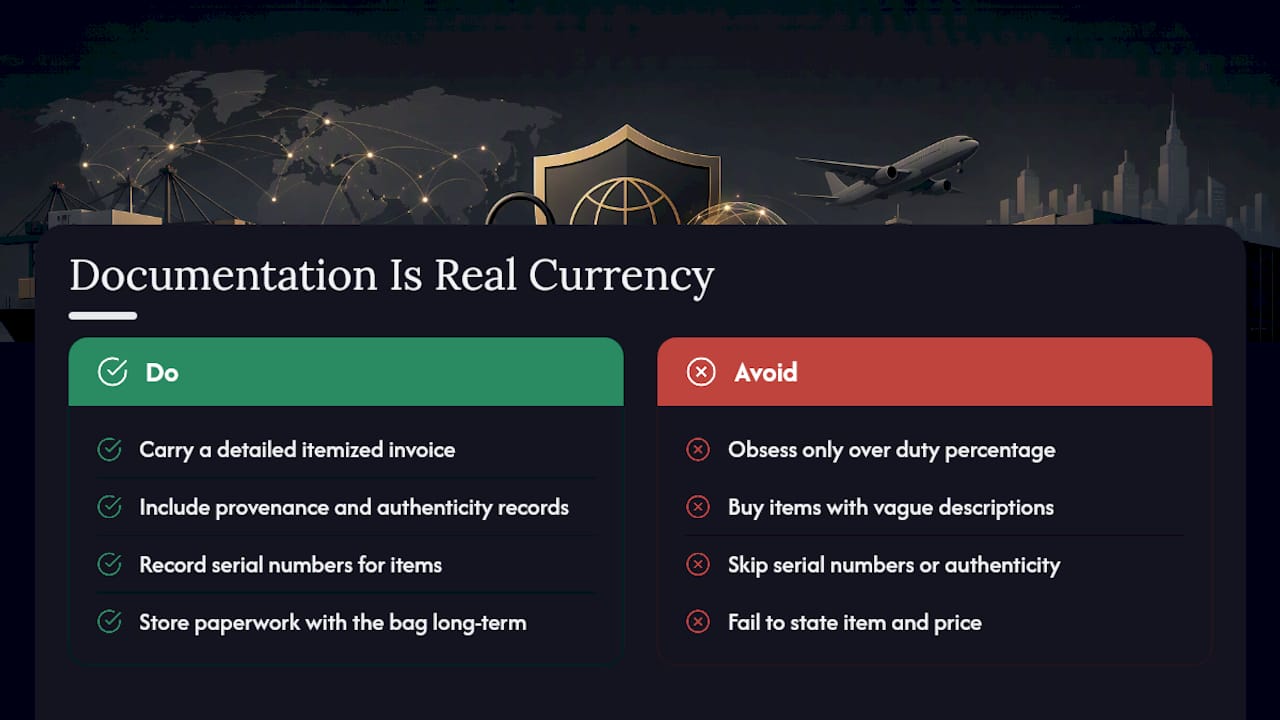
Provenance documentation is not bureaucratic overhead, it is your fastest path through inspection. Serial numbers, itemized invoices, and authenticity records do double duty: they protect you at customs and they protect the resale value of the bag for years afterward. If you are investing in pieces meant to last, pairing that paperwork discipline with proper long-term handbag storage keeps both the item and its documentation trail intact.
The buyers who get flagged are rarely the ones who owe the most duty. They are the ones who cannot answer a simple question: what is this, and what did you pay for it?
— Camila
How Naiseshopper Keeps Your Import Paperwork Clean
Naiseshopper is the alternative to guessing at customs risk when you buy designer handbags online. Every authenticated piece ships with a detailed invoice specifying material and declared value, the exact documentation CBP asks for, plus serial number records that double as proof of authenticity and origin.
Shipments come with insurance built in, so a bag held for inspection or lost in transit does not become a financial loss on top of a paperwork headache. If you are shipping in bulk or handling resale volume, resources like wholesale designer handbag lots are worth understanding, since commercial-quantity imports follow different entry rules than a single personal purchase. For everyone else, browse authenticated inventory now, or contact support before you buy if you have questions about the documentation a specific bag will arrive with.
This article is general information, not a substitute for advice from a qualified financial advisor. Consult a qualified financial professional about your own circumstances before acting on anything here.
Sources
- Customs Duty Information
- Indefinite suspension of the de minimis exemption for merchandise arriving through all modes other than the international postal network
- Continuing the suspension of duty-free de minimis treatment for all countries
- Harmonized Tariff Schedule (HTS) search
- The $800 Free Pass Is Gone: CIT Confirms President Can Eliminate De Minimis Tariff Exemption - Troutman Pepper Locke