TL;DR:
- A deep discount in luxury fashion typically means a 30% to 50% off the retail price on authentic designer products. Discounts beyond 60% often indicate outlet items, grey-market goods, or inflated original prices, requiring careful verification before purchase. Shopping from authorized retailers and checking authenticity ensures genuine deals within the legitimate discount range.
A deep discount in luxury fashion is defined as a price reduction of 30% to 50% off the manufacturer’s retail price on authentic designer goods. This is the standard industry term for a “markdown,” and understanding it protects both your wallet and your wardrobe. About 35–40% of luxury goods were sold at a discount in 2025, a five-point rise over the prior decade. That shift signals something real: luxury shoppers are questioning whether full price still reflects true value. Knowing the deep discount meaning in luxury gives you the confidence to spot a genuine deal on a Gucci bag or a Saint Laurent sneaker without second-guessing yourself.
What does “deep discount” actually mean in luxury fashion?
A deep discount in luxury is not simply any sale price. The term refers to a substantial markdown, typically 30% to 50% off, applied to first-line designer goods during end-of-season clearances or inventory rotations. This is the sweet spot for legitimate deals on current collections from brands like Prada, Valentino, Bottega Veneta, and Balenciaga.
The luxury discount definition matters because the word “deep” carries specific weight. A 10% or 15% reduction is a routine promotional adjustment. A 30% to 50% cut signals that a retailer is moving seasonal stock, not offloading defective or undesirable merchandise. That distinction shapes how you should read any sale tag on a designer piece.
Discounts beyond 50% enter riskier territory. Markdowns above 60% frequently involve failed designs, undesirable SKUs, or stock that never found a buyer at full price. That does not automatically mean the item is worthless, but it does mean you should ask why the price dropped so far.
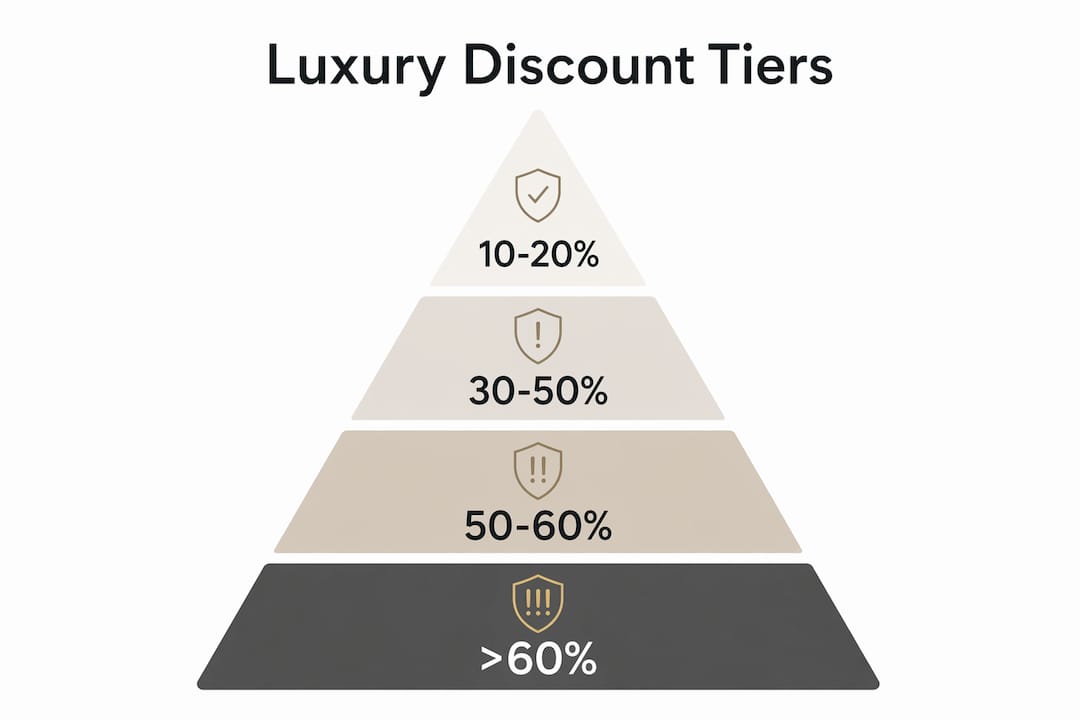
The table below maps discount tiers to their typical meaning and associated risk level.
| Discount range | What it usually signals | Risk level |
|---|---|---|
| 10–20% | Routine promotion or loyalty reward | Low |
| 30–50% | End-of-season clearance, legitimate markdown | Low to moderate |
| 51–60% | Slow-moving inventory, older collections | Moderate |
| 61–80% | Failed designs, outlet-only stock, grey market | High |
| 80%+ | Inflated original price or counterfeit risk | Very high |
Pro Tip: Always compare the sale price to the manufacturer’s current retail price, not the “was” price shown on the retailer’s site. Those two numbers are often very different.
How do luxury brands protect value, and what does discounting imply?
Heritage luxury brands treat their pricing as a core part of their identity. Brands like Hermès, Chanel, and Louis Vuitton maintain strict no-discount policies to protect brand equity. This is not stubbornness. It is a deliberate strategy to signal that their products hold value over time.

When a brand does allow markdowns, the financial consequences are real. Luxury sector operating profit margins dropped to roughly 15–16% in 2025, down from 23% in 2012. That decline tracks directly with the rise of discounting across the industry. Lower margins mean less investment in craftsmanship, materials, and the retail experience that makes luxury feel worth the price.
Discounting also affects the secondary market. A Chanel flap bag that has never been discounted holds its resale value far better than a piece from a brand that runs frequent sales. Buyers on the resale market factor in how often a brand discounts when setting prices for pre-owned pieces.
Consumer resistance to full price signals intrinsic value misalignment more than simple frugality. When shoppers push back on price, they are telling brands that years of aggressive price hikes have broken the price-to-value equation. Brands that respond with deep discounts risk confirming that their full prices were never justified.
The key takeaway: a deep discount on a heritage brand piece is rare precisely because those brands protect their pricing. When you do find one, it is worth investigating why it exists.
What are the risks of chasing extremely deep luxury discounts?
The biggest trap in luxury discount shopping is the inflated “original” price. Retailers sometimes set an artificially high “was” price to make a modest reduction look dramatic. Valid markdowns require that the “was” price falls within 10–15% of the manufacturer’s retail price. Anything beyond that gap is a manufactured illusion of savings.
Other common risks include:
- Outlet-specific products. Many luxury brands produce lower-quality items exclusively for outlet stores. These pieces carry the brand name but are not the same quality as mainline collections.
- Grey-market goods. Products imported outside official distribution channels may lack warranty coverage, authenticity cards, or proper documentation.
- Discontinued SKUs with no support. Deeply discounted luxury items frequently lose product line continuity. That means no future repairs, no matching accessories, and no exchanges if something goes wrong.
- Counterfeit risk at extreme discounts. An 80% discount on a Gucci or Prada piece from an unknown seller is almost never a genuine deal. Authentic designer goods have real production costs that set a floor on how low prices can go.
Pro Tip: Before buying any discounted luxury item, search the exact model name and colorway on the brand’s official website. If the item does not appear there or in archived collections, ask the seller for documentation of its origin.
The meaning of luxury markdowns shifts dramatically once you cross the 60% threshold. At that point, the discount is telling you something about the product, not just the season.
How can you safely shop for deep discounts on authentic luxury items?
Safe shopping for discounted luxury goods follows a clear process. Start with authorized retailers and verified dealers. These are the only sources where the discount is guaranteed to reflect a real reduction from a real retail price.
- Verify the retailer’s authorization. Check whether the seller is an official stockist for the brand. Authorized retailers are listed on most luxury brand websites. If a seller is not on that list, treat the discount with skepticism.
- Check the price history. Use price-tracking tools or check archived retail pages to confirm what the item actually sold for at full price. This is the only way to know whether a “50% off” claim is real.
- Compare to manufacturer retail. The manufacturer’s suggested retail price is your anchor. A legitimate luxury fashion discount should be measurable against that number, not against an inflated “original” price set by the retailer.
- Request authentication documentation. Authentic luxury pieces come with dust bags, authenticity cards, serial numbers, and original packaging. Ask for all of these before completing a purchase.
- Read the return and repair policy. A trustworthy seller offers a clear return window and can explain how to access brand repairs. If a seller cannot answer those questions, the discount is not worth the risk.
- Treat extreme discounts as a signal, not a gift. Genuine deals on discounted luxury products fall within the 30–50% range. A deal that looks too good almost always is.
Shoppers who follow these steps consistently find that the best deep savings on luxury come from patience and verification, not from chasing the largest percentage off.
Key Takeaways
Authentic deep discounts in luxury fashion fall within the 30–50% range, and anything beyond 60% demands serious scrutiny before you commit to a purchase.
| Point | Details |
|---|---|
| Define the discount correctly | A genuine luxury markdown is 30–50% off the manufacturer’s retail price, not an inflated “was” price. |
| Heritage brands rarely discount | Hermès, Chanel, and Louis Vuitton protect brand equity with strict no-discount policies. |
| Margins are under pressure | Luxury sector profit margins fell from 23% in 2012 to roughly 15–16% in 2025 due to discounting. |
| Extreme discounts carry real risks | Discounts above 60% often signal outlet-only stock, grey-market goods, or inflated original prices. |
| Verification is non-negotiable | Always confirm authorization, price history, and authentication documents before buying. |
My honest read on luxury discounts after years of watching this market
I have watched luxury shoppers make the same mistake repeatedly: they see a big percentage and stop thinking. A “70% off” label on a designer bag triggers excitement before the brain asks the obvious question. Seventy percent off what, exactly?
The shift I find most telling is the margin data. When an entire industry’s operating profits drop from 23% to roughly 15–16% in about a decade, that is not a blip. That is a structural change in how luxury goods are priced and sold. Brands that once held firm on price are quietly moving inventory through discount channels because consumer resistance to full price has become too strong to ignore.
What this means for you as a shopper is actually good news. The 30–50% discount band is more accessible now than it was five years ago. Legitimate deals on Bottega Veneta, Saint Laurent, and Valentino pieces appear more frequently at authorized retailers. The 7 essential luxury shopping tips that serious buyers follow have not changed, but the opportunities to apply them have grown.
My advice: treat every discount as a signal, not a reward. A 35% markdown at an authorized retailer on a current-season Prada piece is a signal that the season is turning. An 80% markdown from an unknown seller is a signal that something is wrong. The number alone means nothing. The context around it means everything.
— Camila
Authenticated luxury deals worth exploring on Naiseshopper
Naiseshopper curates authenticated designer pieces from brands like Gucci, Saint Laurent, Valentino, and Balenciaga, all priced within the legitimate discount range that signals real value.
Every item on Naiseshopper comes with verified authenticity, so you never have to guess whether the markdown is real. The platform’s personal shopper service and shipping insurance make the process straightforward for buyers worldwide. If you want to see what a genuine deep discount looks like on a designer piece, the Saint Laurent mid-top sneakers currently listed are a strong example of the 30–50% range done right. For classic footwear, the Jimmy Choo leather flats offer the same verified pricing on a timeless silhouette.
FAQ
What is the luxury discount definition in simple terms?
A luxury discount is a price reduction on an authentic designer item, measured against the manufacturer’s retail price. The standard range for a genuine markdown is 30–50% off.
Are deep discounts on luxury brands ever legitimate?
Yes. Legitimate deep discounts of 30–50% appear during end-of-season clearances at authorized retailers. Discounts above 60% require careful verification of the original price and product authenticity.
Why do some luxury brands never go on sale?
Heritage brands like Hermès, Chanel, and Louis Vuitton maintain strict no-discount policies to protect brand equity and secondary market value. Discounting signals that a price was not justified, which undermines long-term brand perception.
How do I know if a “70% off” luxury deal is real?
Compare the sale price to the manufacturer’s current retail price, not the retailer’s “was” price. Valid markdowns require the original price to fall within 10–15% of manufacturer retail. Anything beyond that gap is likely an inflated comparison price.
What affordable luxury items offer the best value at a discount?
End-of-season ready-to-wear, shoes, and accessories from brands like Valentino, Bottega Veneta, and Saint Laurent consistently offer the best value in the 30–50% discount range when purchased from authorized or verified retailers.