For most international shoppers, a protected credit card or a hosted buyer-protection flow like PayPal beats every other option for designer purchases. Confirm the full landed cost, including duties, taxes, and shipping, before you confirm any order. Use a multi-currency or travel-friendly card whenever possible, since it typically shaves the hidden foreign-transaction markup off your final price.
TL;DR:
- Credit cards and PayPal provide the best buyer protection, including dispute and chargeback rights, especially for high-value or cross-border luxury purchases.
- Always verify if duties and taxes are prepaid or payable upon arrival to avoid unexpected costs and delays after checkout.
- Using a no-foreign-transaction-fee card or opening a multi-currency account can significantly reduce currency conversion and foreign-transaction fees.
- Confirm that the merchant’s checkout page uses HTTPS, includes clear return policies, and offers authentication or shipping insurance for expensive items.
- Select payment options that support formal dispute resolution methods and avoid wire transfers to unfamiliar sellers, which offer almost no recourse if issues arise.
Table of Contents
- International Payment Methods Luxury Shoppers Rely On
- How to Choose the Right Payment Method for a Luxury Purchase
- Minimize Currency Conversion and Foreign-Transaction Fees
- Security and Buyer Protection for Designer Purchases
- What to Expect at Checkout: Duties, Taxes, and Timing
- What Seller-Side Experience Teaches Buyers About Safer Checkout
- A Smoother Checkout for International Designer Shopping
- Sources
- FAQ
International Payment Methods Luxury Shoppers Rely On
Every payment method behaves differently once you’re staring at a $2,400 handbag on a checkout screen instead of a $40 t-shirt. The stakes change what “convenient” actually means.
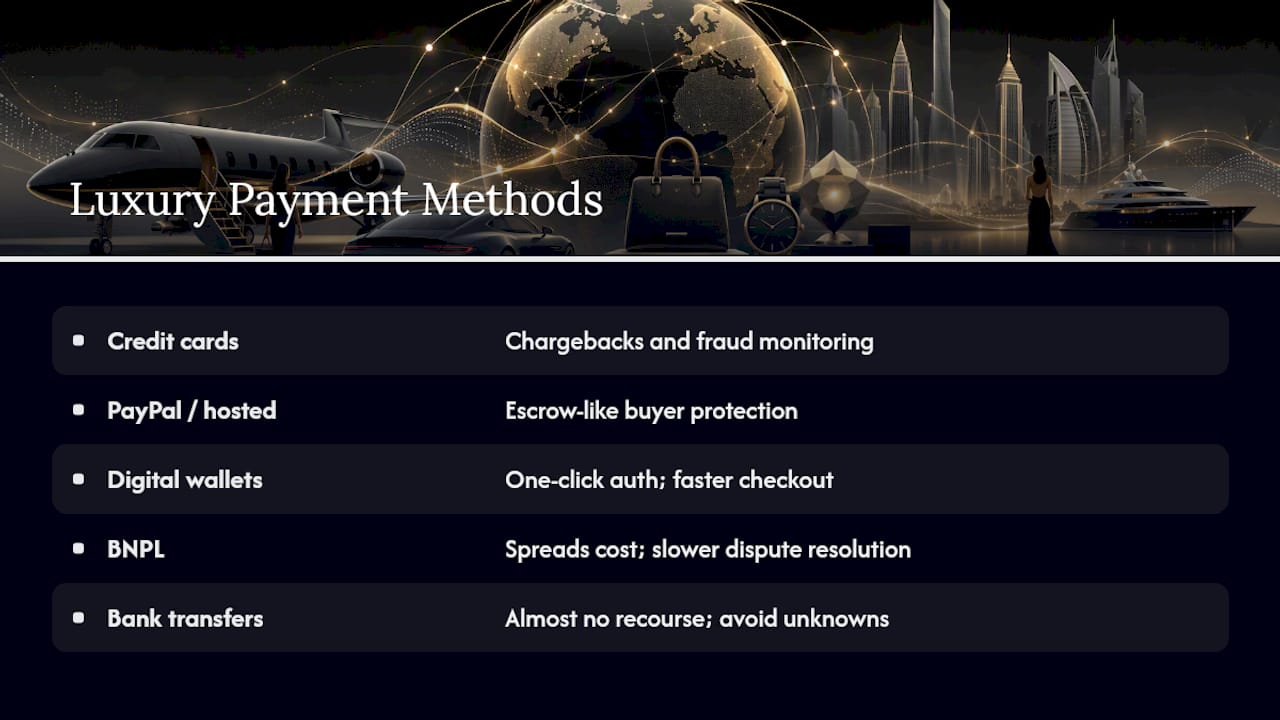
Credit cards remain the gold standard for high-ticket purchases because they come with chargeback rights and built-in fraud monitoring. If an item never arrives or turns out to be a fake, you have a formal dispute process backed by your bank, not just a hopeful email to customer service.
PayPal and similar hosted checkout flows add a layer of buyer protection that functions almost like an escrow arrangement. Funds route through the platform rather than straight into a stranger’s account, which matters enormously when you’re buying from a merchant outside your home country.
Digital wallets like Apple Pay and Google Pay speed up mobile checkout dramatically. One-click authentication is more than a convenience for luxury e-commerce, since faster checkout directly reduces cart abandonment on high-value purchases.
Buy now, pay later (BNPL) is gaining ground among affluent shoppers picking up designer bags, watches, and limited drops without draining cash flow in one hit, and luxury commerce is seeing real growth here. The catch: dispute resolution through BNPL providers is often slower and less standardized than a credit card chargeback.
Bank or wire transfers deserve real caution. They offer almost no recourse once the money leaves your account, which is exactly why you should avoid them with unfamiliar merchants or private sellers, no matter how good the deal looks.
How to Choose the Right Payment Method for a Luxury Purchase
Start with buyer protection, not convenience. A payment method that lets you dispute a charge if the item is fake, damaged, or never shipped should always outrank one that’s simply faster to use.
- Check who mediates disputes. Cards and PayPal-style platforms offer formal chargeback or claims processes; wire transfers do not.
- Confirm the return policy across borders. International returns often involve different timelines and shipping costs than domestic ones, so read the fine print before paying.
- Weigh speed against reversibility. A digital wallet clears instantly, which is great until something goes wrong and you need that transaction to be reversible.
- Ask direct questions before checkout: Is the price shown in your local currency? Who pays import duties? What’s the refund timeline? Is authentication documentation included with the item?
Pro Tip: Screenshot the checkout page before you confirm your order, including the total price, currency, and any duties shown. It becomes your reference point if the final charge doesn’t match what you agreed to.
Retailers that show local-currency pricing upfront aren’t just being polite. Research from PYMNTS found that 94% of cross-border shoppers expect local-currency pricing, and 57% choose which retailer to buy from based on the payment methods it accepts.
Minimize Currency Conversion and Foreign-Transaction Fees
The price tag on a designer bag is rarely the price you actually pay. Currency conversion spreads and foreign-transaction fees can quietly add several percentage points to your total, and on a $3,000 item, that difference is real money.
Card issuers and payment processors typically build in a spread of roughly 1.5% to 3% above the mid-market exchange rate, and some cards tack on a separate foreign-transaction fee on top of that. Two nearly identical cards can cost you very different amounts on the exact same purchase.
A few habits keep more of your money in your pocket:
- Use a card explicitly marketed as having no foreign-transaction fees, common with premium travel cards.
- Open a multi-currency account if you shop internationally often, so you’re not converting at the point of sale every time.
- Always decline dynamic currency conversion (DCC) at checkout. When a merchant offers to charge you in your home currency, they are usually inserting their own markup, and letting your card issuer handle the conversion is almost always cheaper.
- If you already hold a multi-currency balance and the exchange rate looks favorable, convert ahead of time instead of scrambling at checkout.
Specialty travel cards and multi-currency accounts can meaningfully cut conversion costs for anyone who shops across borders regularly, not just occasionally.
Security and Buyer Protection for Designer Purchases
Credit cards and PayPal give you the clearest path to a refund when something goes wrong, because both offer formal chargeback and claims processes that a bank transfer simply doesn’t provide. Wire transfers to unfamiliar sellers are effectively one-way transactions with almost no protection if the goods never show up or turn out to be counterfeit.
A few checks take seconds and save real headaches:
- Confirm the checkout page uses HTTPS and, ideally, 3-D Secure verification for card payments.
- Look for a working return policy, physical contact information, and verifiable seller history before you buy.
- Add shipping insurance on any item over a few hundred dollars. It’s inexpensive relative to the risk of loss or damage in transit.
- Favor sellers whose process includes authentication checks before an item ships, not after you’ve already accepted delivery.
Pro Tip: If a “designer” listing seems priced too far below market value, treat that as a red flag first, not a bargain. Combine it with an unprotected payment method and you’ve got the exact profile of most luxury resale scams.
What to Expect at Checkout: Duties, Taxes, and Timing
Confirm whether the merchant ships DDP (duties and taxes prepaid) or DDU (duties paid on arrival) before you pay. DDP means the price you see is the price you pay; DDU means a customs bill can show up at your door weeks later, which is exactly the kind of surprise fee that causes cart abandonment and, worse, buyer’s remorse after the fact.
Your payment method also shapes your refund timeline. A credit card chargeback window operates on its own clock, separate from whatever return policy the merchant advertises, so read both carefully.
A few habits reduce friction on high-value orders:
- Build in extra time for authentication checks on items over a few thousand dollars, since legitimate sellers often hold shipment until verification clears.
- Add shipping insurance and insist on tracking with signature confirmation.
- Read the merchant’s stated compliance around duties and landed cost, similar to the transparency outlined in ecommerce compliance guidance.
What Seller-Side Experience Teaches Buyers About Safer Checkout
Watching thousands of cross-border orders move through checkout teaches you where buyers actually get burned: unclear currency display, vague duty policies, and payment methods with no recourse. Naiseshopper’s approach to localized pricing and flexible payment options exists because those gaps are predictable and preventable.
A simple checklist holds up across almost every purchase: confirm the localized price shown matches your expectations, choose a payment method with real buyer protection, and add shipping insurance before you check out.
— Camila
A Smoother Checkout for International Designer Shopping
Buying designer goods across borders can be made easier with localized pricing and multiple payment options, which help reduce checkout surprises and offer better buyer protection for your purchase.
Some services include authenticity guarantees, optional shipping insurance, and personal shopper assistance for shoppers targeting specific pieces sold in the US, expanding available selections beyond what’s listed. Browse pieces like the Emporio Armani coat in blue or the Prada ski boot backpack to see localized pricing and payment options in action, then check out with the method that gives you the protection this guide recommends.
Sources
- Almost All Cross-Border Shoppers Want to Use Local Currency | PYMNTS
- In cross-border fashion, the sale is won or lost in the checkout experience | FashionUnited
- International online shopping guide: How to buy from global stores and actually save money | SavingsRush
- International payments for luxury fashion: How global buyers pay for designer goods | Transfi
FAQ
Is a Credit Card Safer Than PayPal for Luxury Purchases?
Both offer strong buyer protection through chargebacks or formal claims processes; the safer choice depends on which one the specific merchant supports and how quickly it resolves disputes.
Should I Ever Use a Bank Transfer for a Designer Item?
Avoid wire transfers to unfamiliar sellers, since they offer almost no recourse if the item never arrives or isn’t authentic.
How Much Do Foreign-Transaction Fees Typically Add to a Purchase?
Currency conversion spreads usually run 1.5% to 3% above the mid-market rate, and some cards add a separate foreign-transaction fee on top.
What Should I Check Before Paying for an International Luxury Order?
Confirm the currency displayed, who covers duties and taxes, the refund timeline, and whether the seller provides authentication documentation.
Does Naiseshopper Offer Buyer Protection on Payment?
Naiseshopper supports localized pricing and multiple payment options alongside shipping insurance and an authenticated-goods guarantee, which together reduce the checkout surprises that cause the most buyer hesitation.