Get the lug width wrong and the strap won’t even mount. Get the length wrong and you’ll either run out of holes or have excess tail flapping past the keeper. Everything else, taper, thickness, material, is styling on top of those two fixed numbers.
TL;DR:
- Accurate lug width measurement is essential, typically between 16mm and 24mm, with 18mm, 20mm, and 22mm covering most watches, and precise tools like calipers recommended.
- Strap length should be roughly 110% to 120% of your wrist circumference, with standard lengths ranging from 170mm to 200mm, and better to size up if in doubt.
- Proper wrist measurement involves snugly wrapping a tape or string around the wrist just past the wrist bone, adjusting for wrist shape, and verifying with a strap that fits well.
- Taper, thickness, and material impact fit and comfort, with leather straps loosening slightly over time, while nylon and rubber straps stay consistent, and thicker straps needing extra length.
- Smartwatch and luxury watch straps require matching case size or lug width precisely and may involve different sizing considerations beyond standard measurements.
Table of Contents
- Watch Strap Sizing Starts With Lug Width
- How Strap Length Works, and a Quick Length Chart
- How to Measure Your Wrist the Right Way
- Taper, Thickness, and Material Changes How a Strap Wears
- Apple Watch and Smartwatch Strap Compatibility
- Why Fit Matters More Than Trend When You’re Buying Luxury
- The Gap Between a “Standard” Size and Your Actual Wrist
- Sources
- FAQ
Watch Strap Sizing Starts With Lug Width
Lug width is the distance between the inside faces of the case lugs, the little arms that hold the spring bar. It’s usually stamped somewhere near the strap slot or listed on the product page, and it comes in even numbers, almost always between 16mm and 24mm, with 18mm, 20mm, and 22mm covering most watches you’ll ever own. This number has zero wiggle room. A 20mm strap will not seat properly in a 19mm gap, and forcing it risks a bent spring bar or a strap that shifts under the case.
Three ways to nail this measurement:
- Digital calipers give you the most accurate reading, down to a tenth of a millimeter, and are worth the ten-dollar investment if you replace straps often.
- A millimeter ruler works fine in a pinch. Lay it flat against the inside edges of the lugs and read straight across.
- Measure your current strap at the point where it meets the case. This sidesteps any lug-shape quirks entirely.
A reading that lands between standard sizes, say 19mm instead of 18 or 20, usually means the lugs are curved rather than straight, or you measured at a slight angle. Watches with integrated lug designs (some sport and dive pieces) often can’t accept a generic strap at all. If your case falls into that category, check the manufacturer’s spec sheet or a specialist strap maker rather than guessing.
How Strap Length Works, and a Quick Length Chart
Total strap length is measured with both halves laid flat, end to end, excluding the watch case itself. That’s a critical distinction: you’re measuring the leather or metal, not the wrist-to-wrist distance across your arm.
Most two-piece straps use a split notation like 120/70mm or 115/75mm. The first number is the buckle side (shorter), the second is the tail side (longer, with the holes). Reporting them separately matters because the split determines where the buckle actually sits on your wrist and whether the case ends up centered. A 120/70mm strap and a 115/75mm strap add up to the same total, but they wear differently.
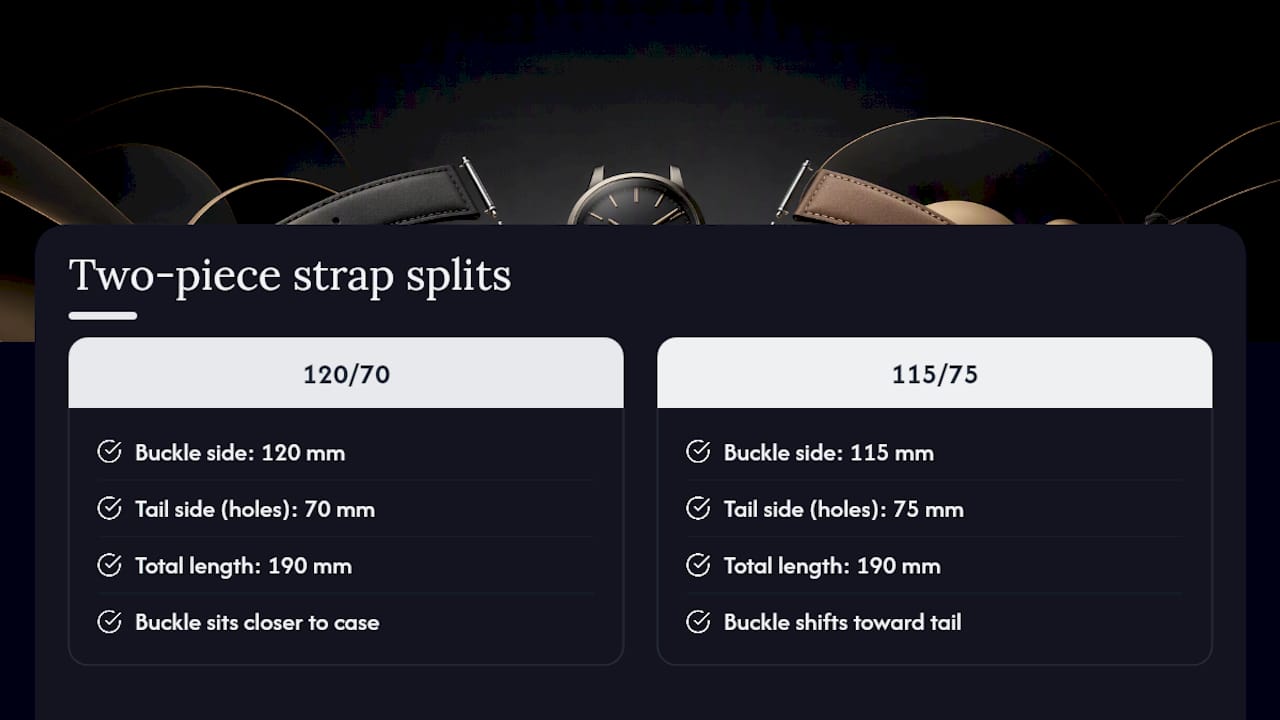
The formula that gets you close on the first try: wrist circumference × 1.15, rounded to the nearest standard length. A comfortable range runs roughly 110% to 120% of wrist size, so don’t panic if your math lands a few millimeters off a round number.
Standard straps generally run 170mm to 200mm total, short straps sit around 150 to 170mm, and long straps stretch to 200 to 220mm. Round up rather than down if you’re between sizes. A strap that’s a touch long still buckles comfortably with the keeper sliding to hide the tail. A strap that’s too short may not close at all.
How to Measure Your Wrist the Right Way
Get this measurement wrong and every formula above falls apart, so take a minute and do it properly.
- Wrap a soft tape measure around your wrist exactly where you’d normally wear a watch, just past the wrist bone.
- Pull it snug, not tight. You should be able to slide one finger between the tape and your skin, which is the standard comfort buffer strap makers build into their sizing.
- No tape on hand? Wrap a strip of paper or a piece of string around your wrist the same way, mark where it overlaps, then lay it flat against a ruler.
- Note the number in both millimeters and inches. Sizing charts mix units constantly, and converting once up front saves confusion later.
- Account for your wrist shape. Flatter wrists often sit better with a slightly longer strap, while rounder wrists can feel more secure with a shorter one to stop the watch from rotating on top of the wrist.
- Sanity-check the result. If you already own a strap that fits well, measure it and compare against your new calculation. The two numbers should be close.
Measure at the end of the day if your wrist tends to swell slightly with heat or activity. That gives you a size that still feels right during the times you’re most likely to notice discomfort.
Taper, Thickness, and Material Changes How a Strap Wears
A strap’s printed length is only half the story. Taper, the way a strap narrows from the lug end to the buckle end, and thickness both change how the fit feels in practice, even when the millimeter numbers are identical.
- Taper describes the width change along the strap, commonly 20mm tapering to 16mm or 22mm down to 20mm. A steeper taper visually slims the wrist and suits dressier pieces; a straight, untapered strap reads bolder and more sport-oriented.
- Thickness falls into rough bands: thin straps run about 2 to 3mm, medium straps 3.5 to 4.5mm, and thick padded straps 5 to 7mm. Thicker straps eat up more of the tail length once buckled, so a padded strap at the same printed length can sit tighter than a thin one.
- Leather needs a short break-in period and will loosen slightly with wear, so lean toward the longer end of your size range for thick, padded leather.
- Nylon and rubber stay flexible from day one and rarely stretch, making them the most predictable fit of the bunch.
- Metal bracelets get sized by removing individual links rather than choosing a different strap length entirely.
Pro Tip: If you’re torn between two lengths, buy the longer one whenever possible. An extra hole gets punched or the keeper repositioned in seconds; a strap that’s genuinely too short can’t be extended.
Apple Watch and Smartwatch Strap Compatibility
Smartwatch sizing runs on a different logic than lug width in millimeters. Apple Watch adapters key off the case size, typically 38mm, 40mm, 41mm, 44mm, 45mm, or 49mm, which is engraved on the case back or listed under your watch’s settings menu.
- Match the adapter to your exact case size; there’s no universal Apple Watch connector across generations.
- Some newer integrated-band designs don’t accept third-party adapters at all, so confirm compatibility before buying rather than after.
- Always check the vendor’s own sizing chart for connectors and accessories since adapter dimensions vary slightly between makers.
Why Fit Matters More Than Trend When You’re Buying Luxury
Some luxury retailers deal in authenticated designer watches, and the sizing questions we hear most aren’t about style, they’re about confidence that a strap will actually work once it arrives. A 38mm Gucci G-Timeless needs its lug width matched with the same precision as a vintage dress watch, and getting that number right before checkout saves the hassle of a return.
Personal shopper services exist partly for this reason: someone confirms measurements and specs before you commit, whether you’re buying direct or through a sourcing option. Services like localized pricing and shipping insurance can round out the purchase experience, but the sizing groundwork always comes first. If you’re comparing wrist and strap measurements to other accessories, our designer belt size conversion guide uses the same measuring logic, and our luxury watch buying guide covers what else to check before you buy.
The Gap Between a “Standard” Size and Your Actual Wrist
Most sizing charts treat wrist measurement like a fixed input, plug in a number, get a length back. That’s fine as a starting point, but it ignores something the charts rarely mention: two people with identical 7 inch wrists can need noticeably different straps depending on how flat or round that wrist is, and how much padding sits under the strap itself.
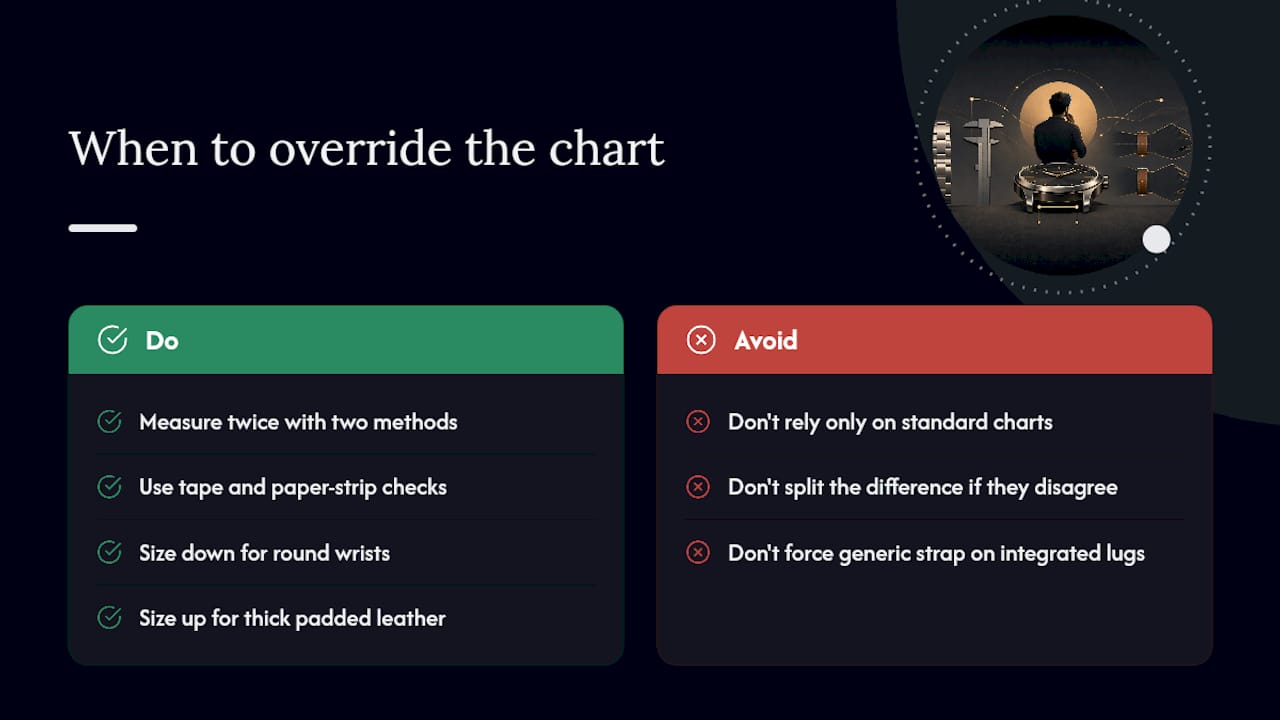
I’d argue the real skill in watch strap sizing isn’t the math. The formula is simple enough that anyone can do it in ten seconds. The skill is knowing when to override the formula, sizing down slightly for a round wrist so the case doesn’t roll, sizing up for thick padded leather that hasn’t broken in yet, or accepting that an integrated-lug sport watch just isn’t going to take a generic strap no matter how precisely you measure. Charts give you a defensible starting point. Your own wrist, and a little patience with trial holes, gives you the actual answer.
If there’s one habit worth building, it’s this: measure twice, using two different methods, before you order. A tape measurement and a paper-strip check that agree within a couple of millimeters means your number is solid. If they don’t agree, that’s the signal to slow down, not to split the difference and hope.
— Camila
Sources
- How to size your watch strap — RSM Watchstrap
- Sizing a Watch Strap: Everything Explained — The Slender Wrist
- How to measure watch strap — Sizely
- Wristsize
FAQ
What does 22mm mean on a watch band?
It refers to the lug width, the distance between the inside faces of the case lugs where the spring bar sits. A 22mm band needs a case with a 22mm lug gap; the two numbers must match exactly.
My wrist size is 7 inches. What size watch strap should I get?
A 7 inch wrist (about 178mm) works out to a target strap length of roughly 205mm using the wrist × 1.15 formula, which typically falls in the standard-to-long category with a two-piece split around 120/75mm.
What wrist size fits a 38mm or 42mm watch?
Case diameter and wrist size aren’t tied to a strict formula, but as a general guideline, 38mm cases suit wrists up to about 6.5 inches; strap length still needs to be calculated separately from case size.
Do I need a 20mm or 22mm watch band?
Check the gap between your watch’s lugs with calipers, a millimeter ruler, or by measuring your current strap where it meets the case. There’s no universal rule tying case size to lug width, so measure rather than guess.