Here’s the one-sentence protocol: always choose the seller’s local currency, pay with a card that carries no foreign transaction fee, and calculate the full landed cost, including shipping, duties, and any conversion spread, before you tap confirm. That’s it. Everything else in this guide is just the mechanics behind why that rule works and how to execute it without slowing down your checkout.
Before you buy your next bag, blazer, or pair of boots from an overseas seller, run this quick sequence:
- Confirm the charge currency. If a screen asks “Pay in USD or local currency?”, pick local currency every time.
- Decline dynamic currency conversion (DCC). It almost always hides a worse rate than your card’s network will give you.
- Pick a 0% foreign-transaction-fee card as your default for anything priced outside the US.
- Add up the real total before checking out, including shipping, duties, and any conversion spread your payment provider tacks on.
PayPal’s own fee schedule shows a 4.00% currency conversion spread on goods and services when the transaction currency doesn’t match the listing currency. That single fact should change how you pay for that Bottega Veneta clutch from a European boutique.
Key Takeaways
| Point | Details |
|---|---|
| Decline DCC every time | Merchant-offered currency conversion typically embeds a 3% to 7% markup over the network rate. |
| Default to a 0%-FTF card | Cards like Capital One Quicksilver, Capital One Venture X, and Chase Sapphire Preferred eliminate issuer conversion fees. |
| Watch PayPal’s spread | PayPal charges up to a 4.00% conversion spread when the payment currency differs from the listing currency. |
| Use ATM-refund accounts for cash | Schwab Bank High Yield Investor Checking and Fidelity Cash Management Account both refund ATM operator fees. |
| Naiseshopper shows landed cost upfront | Localized pricing, insured shipping, and a clear returns workflow reduce currency surprises on cross-border designer purchases. |
Table of Contents
- What Actually Creates Extra Cost When You Buy Across Currencies
- What’s Your Step-by-Step Protocol Before You Click Pay?
- Which Payment Methods Cost You the Least Across Borders?
- How Do You Manage Currency Choices at Foreign Checkout?
- Best Practices for ATM Withdrawals and Cash Abroad
- How Shipping, Duties, and Returns Affect Your Total Cost
- What Does a $1,000 Purchase Actually Cost You?
- Your Printable Pre-Purchase Checklist
- Why Discipline Beats Rate-Chasing
- How Naiseshopper Reduces Currency Surprises Before You Check Out
- Sources
What Actually Creates Extra Cost When You Buy Across Currencies
Four separate cost vectors can hit the same transaction, and most shoppers only notice one of them.
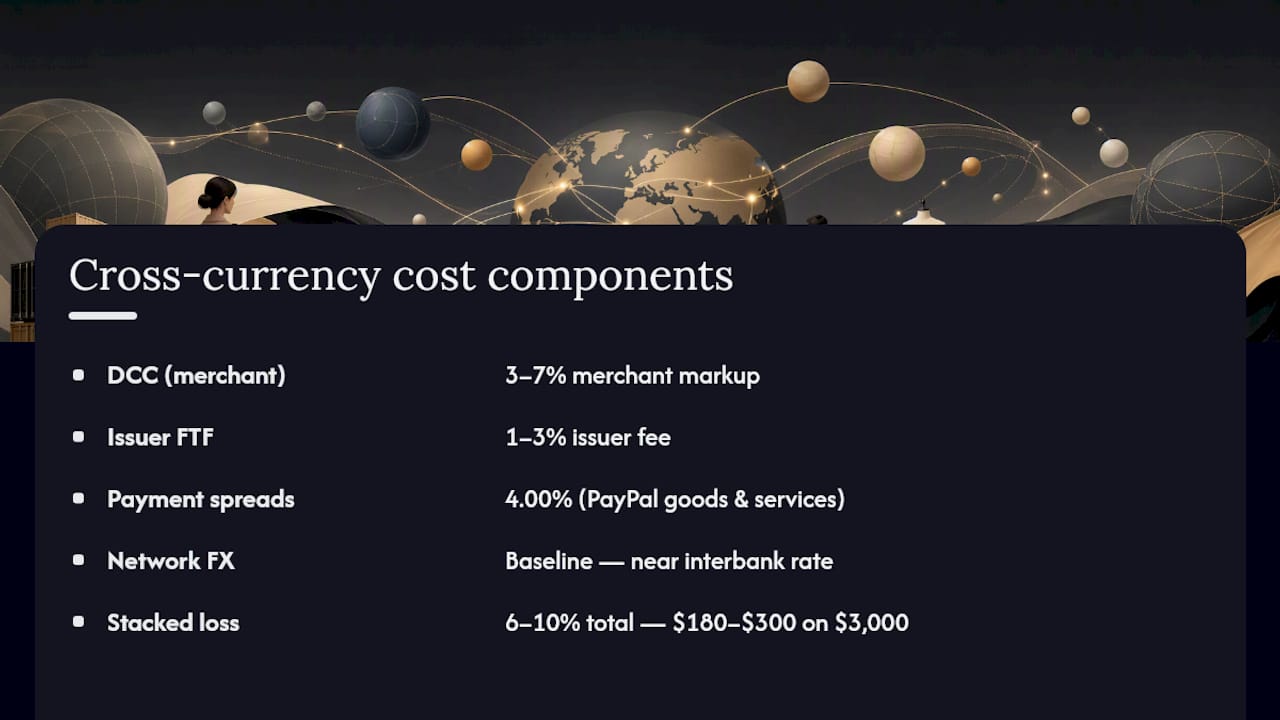
Dynamic Currency Conversion (DCC) happens when a merchant or terminal offers to bill you in your home currency instead of theirs. It sounds convenient. It isn’t. WalletHub’s breakdown of DCC confirms that merchant-controlled conversion typically uses a worse rate than your card issuer or payment network would apply, often padding the price by 3% to 7% before you’ve even paid a separate fee.
Issuer foreign transaction fees (FTF) sit on top of that. Most cards without a travel benefit charge 1% to 3% simply for processing a purchase in a foreign currency, regardless of whether DCC was involved.
Network wholesale FX is the “true” rate Visa or Mastercard uses to settle the transaction. It’s close to the interbank rate, and it’s the baseline every markup gets added to.
Payment-platform conversion spreads are their own animal. When you use PayPal to pay a foreign seller, PayPal applies its own markup on top of whatever the network charges, and its fee table lists that spread at 4.00% for goods and services when currencies don’t match.
Stack a merchant’s DCC markup with your issuer’s FTF and you can easily lose 6% to 10% on one purchase, according to a breakdown of how 3% becomes 5% or more abroad. On a $3,000 Chanel bag, that’s $180 to $300 gone before shipping and duties even enter the picture.
What’s Your Step-by-Step Protocol Before You Click Pay?
Run this sequence every time you’re buying from a foreign luxury seller, whether you’re at a physical counter in Milan or checking out on a European e-commerce site from your couch.
- Audit your wallet first. Identify which of your cards charge 0% FTF and mark that card as your international default. Don’t wait until you’re at the register to figure this out.
- At online checkout, look for a currency toggle. If the site lets you switch from USD to the seller’s local currency, switch it. If you can’t tell which currency you’re being charged in, that’s a red flag worth pausing on.
- In person, when a terminal asks “USD or local currency?”, always choose local currency. The DCC offer is designed to sound like a courtesy. It’s a markup.
- If DCC got applied anyway, ask the merchant to reverse and rerun the charge in local currency, or dispute it with your card issuer once you see the statement. Some merchants can fix this on the spot if you catch it before you walk away.
- At an ATM, choose the local currency prompt, not the “guaranteed” home-currency conversion. The same DCC logic applies to cash withdrawals.
Pro Tip: Screenshot your checkout confirmation before you pay. If a conversion spread shows up as a separate line item, you’ll have proof of the exact rate you were quoted, which speeds up any dispute later.
Which Payment Methods Cost You the Least Across Borders?
Not all payment rails are built the same, and the right choice depends on how often you’re buying and how much you’re spending.
For cash, Schwab and Fidelity accounts exist almost entirely to solve the ATM fee problem, and both refund fees charged by the ATM operator. For platform-based checkouts where PayPal is the only option, know going in that you’re absorbing a spread, and factor that into whether the deal is still worth it. A retailer like Naiseshopper that shows localized pricing before you commit, removes a layer of this guesswork by letting you see the real charge currency upfront.
How Do You Manage Currency Choices at Foreign Checkout?
Foreign checkout pages hide currency decisions in places you won’t expect, so run this sequence every time.
- Look for a currency selector, usually near the price or in account settings, and switch it to the seller’s local currency if USD isn’t the native listing currency.
- Check whether the displayed USD price is a live conversion or a “display-only” estimate. Some sites show USD for reference but still charge your card in the local currency.
- Watch for a conversion spread line item at the payment step, especially if you’re routed through PayPal or a similar wallet.
- Preview the shipping and duties estimate before you finalize. Many sellers show this at checkout, not after.
Refunds add a second layer of currency risk that most shoppers never think about until they’re mid-return. Most sellers refund to the currency they originally charged, which means if a conversion spread applied on the way in, that same spread may not fully unwind on the way out, since exchange rates move between purchase and return dates. This is exactly why a transparent returns workflow matters as much as the initial purchase price. Platforms that display localized pricing and offer shipping insurance reduce the odds you’ll eat an unpleasant surprise if a $2,000 dress doesn’t fit and needs to go back.
Best Practices for ATM Withdrawals and Cash Abroad
Cash still matters for boutique purchases where cards aren’t accepted or where a seller offers a discount for paying in local currency. The rules here are simple but easy to break under travel fatigue.
- Use an account built for this, like Schwab Bank High Yield Investor Checking or a Fidelity Cash Management Account, both of which refund ATM operator fees, though you should confirm current terms directly with each provider before relying on them.
- Withdraw larger amounts less often. Fixed per-transaction fees hit harder on five small withdrawals than one larger one, but don’t carry more cash than you’re comfortable losing.
- Always select local currency at the ATM prompt. The same DCC trap that hits card terminals shows up here too.
- Skip airport and hotel exchange counters entirely. Their posted rates are almost never competitive against a bank-linked ATM withdrawal.
Pro Tip: If you’re making a single high-value cash purchase, ask the boutique whether a wire transfer or card payment gets you a better effective rate than cash. Some sellers quote cash discounts that don’t actually beat card FTF savings once you do the math.
How Shipping, Duties, and Returns Affect Your Total Cost
The sticker price on a foreign luxury site is never the number you’ll actually pay. PayPal’s own guidance on cross-border shopping is direct about this: shipping, duties, customs processing, currency conversion, and potential return costs all layer onto the item price before you land on a true total.

Two shipping models matter here. DDP (delivered duties paid) means the seller collects duties and taxes upfront, so the price you see at checkout is close to the final cost. DDU (duties unpaid) means you’ll owe duties and possibly a customs processing fee when the package arrives, sometimes with a surprise invoice from the carrier. Always check which model a seller uses before you buy, since DDU can turn a $1,200 purchase into a $1,350 one after the courier bills you separately.
Duties themselves depend on the item’s declared value, its tariff category, and the destination country’s rules, so running a rough estimate through a duty calculator or checking the seller’s own import estimate before you buy saves you from guessing. A platform offering localized pricing and insured international shipping folds more of that math into the price you see upfront, which matters most on high-value items where a lost or damaged shipment would otherwise be a total loss.
Pro Tip: For anything over $500, always opt into insured shipping if it’s offered. The insurance cost is trivial next to the risk of an uninsured designer bag disappearing in transit.
What Does a $1,000 Purchase Actually Cost You?
Assume you’re buying a $1,000 (USD equivalent) handbag from a European boutique, paying with a US-issued card, and the wholesale network FX rate reflects the true market price with no markup.
- DCC accepted, standard card with 2% FTF: The merchant applies a 5% DCC markup, bringing the charge to $1,050. Your issuer then adds a 2% FTF on top of that inflated amount, adding $21. Total: $1,071.
- Local currency selected, standard card with 2% FTF: No DCC markup applies, so the base charge stays at $1,000. The 2% FTF adds $20. Total: $1,020.
- Local currency selected, 0%-FTF card (Capital One Quicksilver, Capital One Venture X, or Chase Sapphire Preferred): No DCC markup, no FTF. Total: $1,000.
- Paid via PayPal with a currency mismatch: PayPal’s 4.00% conversion spread applies to the full amount. Total: $1,040.
Scale that across a $5,000 handbag order or a season’s worth of designer buys, and the savings compound fast.
Your Printable Pre-Purchase Checklist
Save this list in your phone’s notes app or wallet before your next order, and run through it every single time, even on sellers you’ve bought from before.
- What currency will I actually be charged in?
- If DCC is offered, am I declining it?
- Am I paying with my 0%-FTF default card?
- Have I previewed the shipping and duties estimate?
- Does the seller’s return policy specify which currency refunds are issued in?
- Have I confirmed buyer protection coverage on this order?
Print it, screenshot it, or just keep this page bookmarked. The goal is to make these checks automatic, not something you’re reasoning through at 11 p.m. while trying to grab a limited restock.
Why Discipline Beats Rate-Chasing
The instinct among frequent cross-border shoppers is to obsess over finding the single best exchange rate on a given day. That’s the wrong fight. Interbank rates shift by fractions of a percent hour to hour, and the FCA has specifically warned that consumer-facing converter tools often display rates you’ll never actually receive, which makes rate-watching feel productive while accomplishing very little.
A collector spending five figures a year on designer pieces loses far more to inconsistent habits than to a slightly unfavorable rate on any single Tuesday. An occasional buyer making one or two purchases a year should focus on getting one card right and defaulting to it every time. A frequent traveler buying in person across multiple countries should treat the ATM protocol with the same rigor as the card protocol, since cash leakage is just as real as card leakage. The system matters more than the moment.
How Naiseshopper Reduces Currency Surprises Before You Check Out
Naiseshopper is built around the exact problem this guide addresses: the gap between the price you expect and the price you actually pay after conversion, shipping, and duties. Every order shows localized pricing so you see your charge currency upfront instead of guessing at checkout.
Insured international shipping protects high-value items in transit, and the returns workflow is designed to make refund currency handling predictable rather than a surprise. If you’d rather not manage any of this yourself, personal shopper assistance is available for US purchases, handling sourcing and paperwork on your behalf. Browse the current designer collections at Naiseshopper and see landed pricing before you commit to a purchase.
Sources
- Currency Conversion Fees: Cross-Border Shopping | PayPal US
- Foreign transaction fees + DCC — how 3% becomes 5% abroad — finbarrow
- The use of the interbank rate in online currency converter tools | FCA