TL;DR:
- Luxury watch grading systematically assesses a timepiece’s condition, originality, and documentation to determine its value.
- Understanding grading helps collectors verify authenticity and avoid costly mistakes during pre-owned watch purchases.
Luxury watch grading is defined as the systematic evaluation of a timepiece’s physical condition, mechanical health, originality, and completeness to establish a consistent standard for value and authenticity. If you collect or buy pre-owned watches, understanding what is luxury watch grading separates confident purchases from costly mistakes. The industry uses descriptive scales, from Mint to Fair, alongside technical checks like COSC certification and movement inspection, to assign grades that directly influence price. Naiseshopper curates authenticated luxury timepieces, so knowing how grading works gives you real power at the point of purchase.
What is luxury watch grading and why does it matter?
Luxury watch grading is a structured condition assessment that covers five core areas: case integrity, dial originality, bracelet wear, movement health, and completeness of documentation. Each area contributes to a final grade that tells buyers what they are actually getting. A grade without evidence behind it is just an opinion, and the difference between a Grade A and a Grade C watch can mean thousands of dollars in resale value.
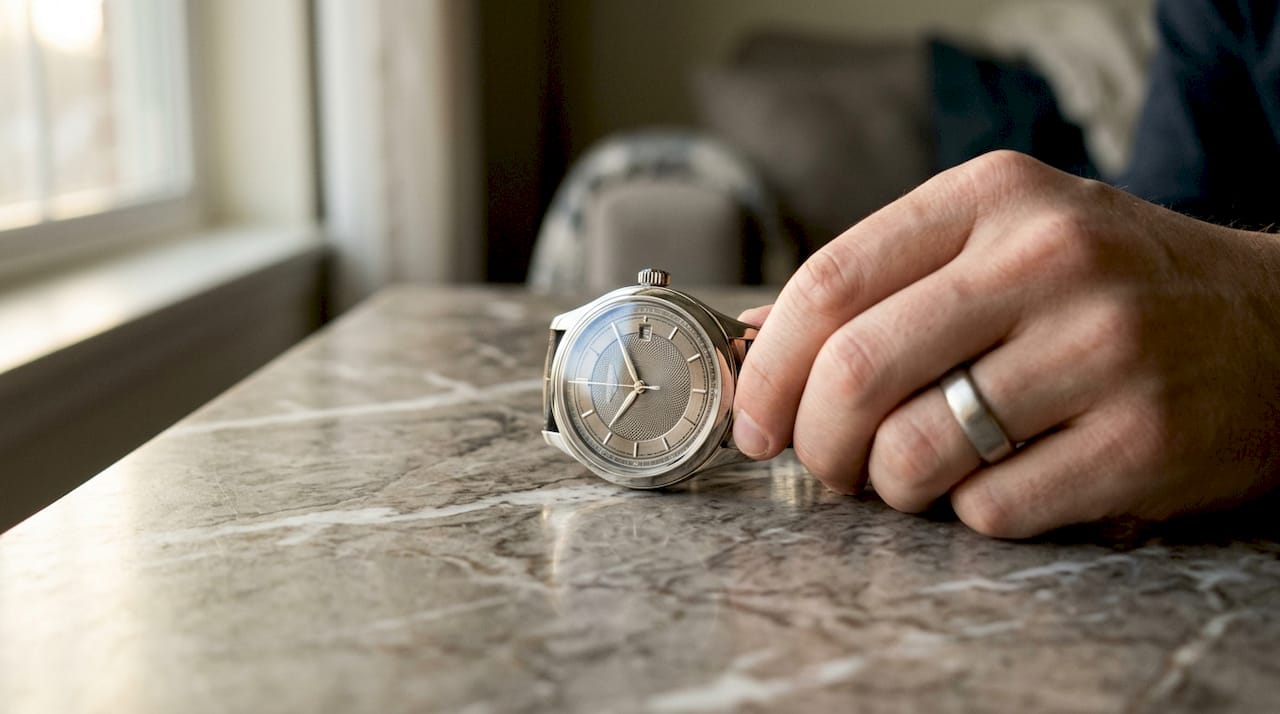
Grading matters because luxury watches are financial assets as much as they are style statements. A Rolex Submariner in unpolished, original condition with full box and papers commands a dramatically different price than the same reference with a relumed dial and missing documentation. The grade is the shorthand for all of that complexity, compressed into a single label that collectors can act on quickly.
The concept borrows from established appraisal disciplines. The GIA diamond grading model, for example, shows how trained technicians and reference databases create reliable, repeatable assessments. Watch grading aspires to the same consistency, even if the industry has not yet achieved a universal standard.
What are the primary criteria considered in luxury watch grading?
A thorough luxury watch evaluation examines five distinct components, and each one carries real weight in the final grade.
- Case and bezel condition. Experts look for sharp edges, original brushed or polished surfaces, and the absence of deep scratches. The lugs are especially telling. Polishing that softens lug edges signals that the case has been altered from its factory geometry, which reduces collector value significantly.
- Dial and crystal originality. A dial should show age-appropriate patina, not damage. Restored or refinished dials lose their originality and drop the grade. Tropical dials on vintage Rolex models, for instance, are prized precisely because their color change is natural, not manufactured.
- Bracelet and clasp wear. Stretched links, replaced end links, and worn clasps all indicate heavy use. Original bracelets in good condition add value; aftermarket replacements subtract from it.
- Movement health and accuracy. A movement that keeps time within COSC standards of -4/+6 seconds per day signals strong mechanical health. Tool marks on screw heads inside the movement often reveal how frequently and how carefully the watch has been serviced.
- Completeness of set. Original box, papers, hang tags, and service receipts can add thousands of dollars to resale value. Missing documentation creates immediate doubt about authenticity and ownership history.
Pro Tip: Request macro photographs of the lug area before buying any pre-owned watch. Softened lug edges are nearly impossible to reverse and are the clearest sign of heavy polishing.
Understanding these criteria also connects to what makes a watch luxury in the first place. Construction quality, finishing standards, and movement precision are the same qualities graders assess.
How do industry grading scales classify luxury watch condition?
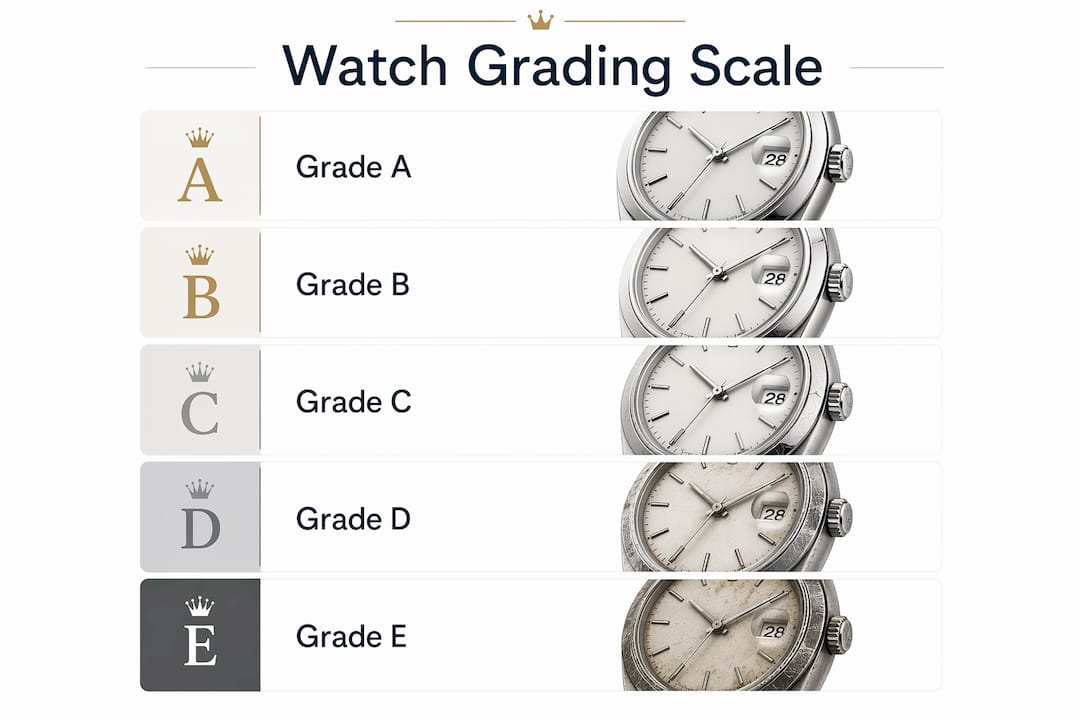
The most widely used system in luxury timepiece assessment runs from Grade A through Grade E, with each level describing a specific combination of wear, originality, and completeness.
| Grade | Label | What it typically means |
|---|---|---|
| A | Mint / New | Unworn or nearly new; full original set; no visible wear |
| B | Excellent | Light wear consistent with careful use; original parts intact |
| C | Very Good | Moderate wear; may have minor scratches; mostly original |
| D | Good | Noticeable wear; possible replaced parts; incomplete set |
| E | Fair | Heavy wear; non-original components; significant marks |
Grade A represents unworn watches with complete original sets, while Grade E covers heavily worn pieces with non-original parts. That five-step range sounds simple, but the real complexity lives between the grades.
Some sellers use percentage-based systems, rating a watch at “90%” or “95%” condition. Others use purely descriptive labels like “lightly worn” or “honest wear.” Neither approach maps cleanly onto the A-to-E scale, which is exactly why collectors must ask for supporting evidence rather than accepting a label at face value. A watch described as “excellent” by one seller may be “very good” by another’s standard.
The absence of a universal grading authority means that no single accepted system governs the entire market. Auction houses, dealers, and private sellers each apply their own interpretation. Knowing the scale is useful. Knowing its limits is more useful.
What challenges and nuances affect the reliability of watch grading?
Grading reliability depends on transparency, and transparency is inconsistent across the market. Several specific factors create real risk for collectors.
- No universal standard. Grading remains subjective and varies by seller. Collectors should treat grades as opinions and verify the evidence behind any assigned grade rather than accepting the label alone.
- Polishing and restoration. Over-polishing removes original sharp bevels and proportions, reducing long-term value even when the watch looks cosmetically clean. A watch that appears pristine may actually be graded lower by a knowledgeable buyer who spots softened case geometry.
- Replaced parts and non-original components. Aftermarket dials, hands, or crowns drop a watch’s grade and its value. Confirming originality requires reference knowledge, not just visual inspection.
- Insufficient documentation. A reliable grade is backed by high-resolution photos, service history disclosures, and documentation of any replacement parts. Without these, the grade is opinion-based and less reliable.
- Inconsistent movement assessment. Tool marks on screw heads inside the movement reveal service quality. A watch graded “excellent” externally may have a movement showing signs of careless servicing.
Jonathon Burford of Sotheby’s advises assessing the watch as a whole before examining details, so that the overall condition reads as consistent and logical. A watch where the case looks pristine but the bracelet shows heavy stretch tells a contradictory story, and that contradiction is a red flag.
Pro Tip: Cross-reference any grade with at least three high-resolution images: the dial straight-on, the case side profile showing the lugs, and the movement through the caseback if visible.
How can collectors use watch grading to make smarter buying decisions?
Grading labels are starting points, not guarantees. Collectors who use them well follow a clear process.
- Request a full condition report. Ask for written disclosure of every known flaw, replaced part, and service event. A seller confident in their grade will provide this without hesitation.
- Prioritize originality over cosmetic perfection. Collectors prize authenticity and appropriate wear over surface-level shine. An “honest” watch with natural aging and original parts often holds value better than a polished example with replaced components.
- Check completeness. Original box and papers are not just nice to have. They confirm provenance and ownership history, and they add measurable resale value. A complete set is always worth paying a premium for.
- Verify movement performance independently. If possible, have the movement tested by a qualified watchmaker before purchase. Timekeeping accuracy and service condition are not visible in photographs.
- Understand that luxury watch value depends on combined factors. Condition, originality, movement quality, market demand, and provenance all contribute. Brand prestige alone does not determine price.
- Use reputable sources. Established auction houses, certified dealers, and platforms with authentication guarantees reduce the risk of misrepresented grades. A detailed luxury watch authentication guide can help you understand what verification actually looks like in practice.
The most experienced collectors treat grading as a conversation starter. They use the grade to frame their questions, not to end their research.
Key Takeaways
Luxury watch grading is only as reliable as the evidence supporting it. Originality, documentation, and movement health matter more than the grade label alone.
| Point | Details |
|---|---|
| Five core criteria | Case, dial, bracelet, movement, and documentation each contribute to the final grade. |
| Grade A to E scale | Grades run from Mint/New to Fair, but no universal standard governs the entire market. |
| Polishing reduces value | Over-polished cases lose original geometry and score lower with knowledgeable collectors. |
| Completeness adds value | Original box and papers can add thousands of dollars to resale price and confirm provenance. |
| Grades are opinions | Treat any grade as a starting point and always request supporting photos and service history. |
Why I think most collectors focus on the wrong part of a grade
The most common mistake I see is collectors fixating on the letter grade and ignoring the story behind it. A “B” from a reputable auction house with full photographic disclosure is worth more than an “A” from an anonymous seller with two blurry images. The grade is not the product. The evidence is.
What I have found over years of watching the pre-owned market is that the watches that hold value longest are the ones collectors describe as “honest.” Natural patina, original parts, appropriate wear for the age. These pieces have character that a freshly polished, over-restored watch simply cannot replicate. Collectors who chase cosmetic perfection often end up with watches that look great in photos but disappoint in person and underperform at resale.
The other thing worth saying plainly: grading is a skill, not a formula. The GIA model works for diamonds because the variables are controlled. Watches are worn, serviced, modified, and passed between owners over decades. That history creates nuance that no letter grade fully captures. The collectors who thrive are the ones who learn to read that nuance directly, not just the label on top of it. Patience and research are not optional extras. They are the whole practice.
— Camila
Authenticated luxury watches, graded and ready to wear
Knowing how to read a luxury watch grade is one thing. Finding a timepiece that actually meets the standard is another.
Naiseshopper carries a curated selection of authenticated luxury watches, each evaluated for condition, originality, and completeness before listing. The Gucci G-Timeless Quartz Black Watch 38mm is a strong example of a graded luxury timepiece available at a genuine discount, with authentication built into every transaction. For collectors ready to apply what they know about grading, Naiseshopper’s watch collection offers a confident starting point. Explore the full range and shop with the assurance that condition standards are taken seriously from the first click.
FAQ
What is the standard grading scale for luxury watches?
The most common scale runs from Grade A (Mint/New) to Grade E (Fair), covering unworn to heavily worn condition. No universal authority enforces this scale, so grades vary by seller.
Does polishing a luxury watch affect its grade?
Yes. Over-polishing softens the original case geometry, particularly the lug edges, and reduces collector value. Unpolished cases with original factory finishing consistently grade higher with experienced buyers.
Why do box and papers matter so much in watch grading?
Original box, papers, and service receipts confirm provenance and ownership history. Their presence can add thousands of dollars to resale value and significantly increases buyer confidence in authenticity.
How can I verify a watch grade before buying?
Request high-resolution photos of the case, dial, and movement, along with a written condition report disclosing any replaced parts or service history. A trustworthy seller will provide all of this without hesitation.
What does COSC certification mean for a watch’s grade?
COSC certification confirms that a movement keeps accuracy within -4/+6 seconds per day. Its presence supports stronger grading and adds to collector confidence in the watch’s mechanical integrity.