A Prada authenticity card is a white plastic card, usually tucked in a black envelope, that lists the article code, model, color, and purchase details. It’s a helpful reference, not a stamp of legitimacy. Your first move on any Prada bag: match the card’s code to the internal factory tag, then inspect the hardware, stitching, and logo before you trust the paperwork.
TL;DR:
- The authenticity card is helpful but not definitive, so always verify the internal factory tag and hardware features first.
- Match the article code, model name, and purchase details on the card with the interior tag and hologram, ensuring all identifiers are consistent.
- Genuine Prada bags have a stitched-in factory tag with numbers aligning with the card; mismatched codes are a major red flag.
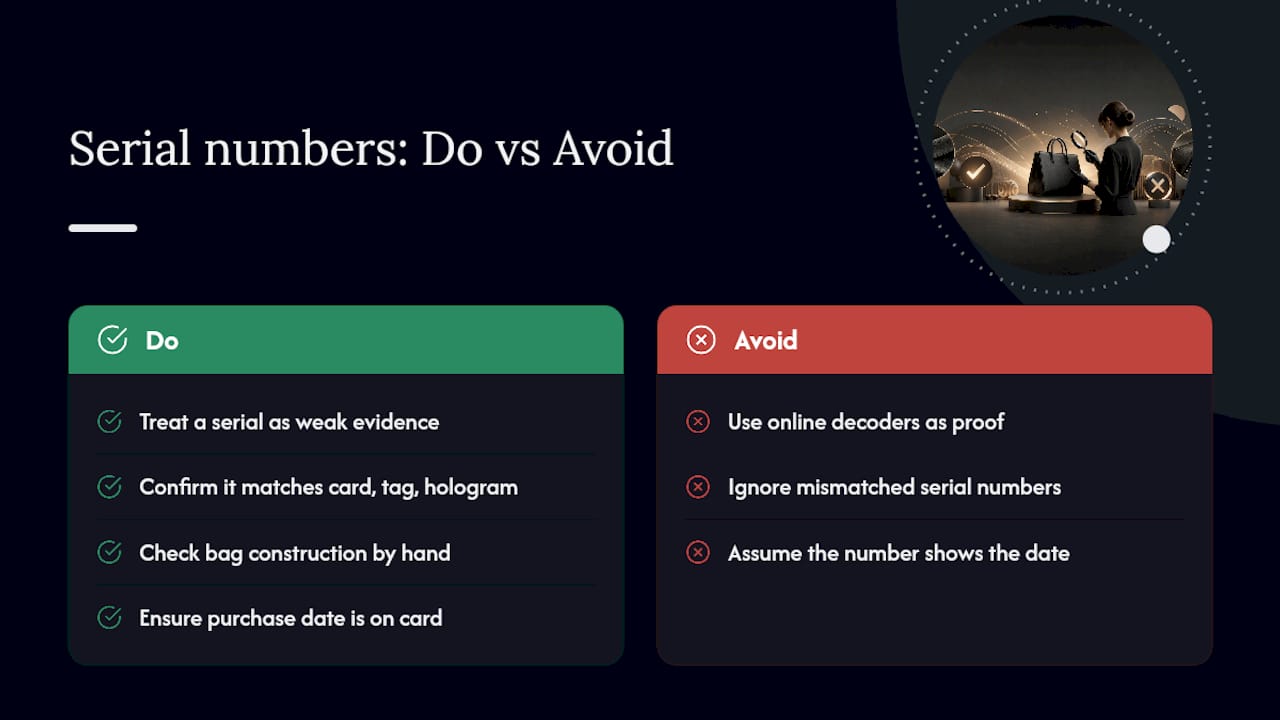
- Prada’s serial numbers do not encode manufacturing dates, so avoid relying on third-party decoding tools that are often inaccurate.
- Official Prada verification may involve NFC chips or blockchain records, but this applies only to some newer pieces; always combine physical checks with digital confirmation.
Table of Contents
- What Does a Prada Authenticity Card Look Like?
- Finding the Internal Tag and Hologram Sticker
- The Step-by-Step Verification Checklist
- Why Serial Numbers Don’t Tell You the Manufacturing Date
- Using Prada’s Official Verification Channels
- Buying Pre-Owned Prada Without a Card
- How Naiseshopper Verifies Every Prada Piece
- What Buyers Consistently Get Wrong About Authentication
- Buy Prada With the Verification Already Done
- Sources
- FAQ
What Does a Prada Authenticity Card Look Like?
The card itself is rigid white plastic, roughly credit-card size, printed with the Prada logo and wording in both English and Italian. It ships inside a black paper envelope stamped with the same logo, and that envelope usually holds a matching care instruction card as well, according to LuxeDetect’s authentication guide.
A sales associate typically fills in five fields at checkout:
- Article or style code
- Serial or factory number
- Model name
- Color and material
- Date and location of purchase
You’ll find the card and envelope tucked into a zip pocket inside the bag, in the dust bag, or loose in the original box if the set survived intact. Here’s the part buyers rarely expect: a blank card from an authorized retailer isn’t automatically a warning sign. Some non-boutique authorized sellers skip filling it in entirely, so a blank card only tells you where the bag was bought, not whether it’s real.
Finding the Internal Tag and Hologram Sticker
The authenticity card is only half the puzzle. Every genuine Prada bag carries a small white factory tag sewn into the interior, and that tag has to agree with whatever the card says. Here’s where to look and what each marker tells you:
- Check the interior seams first. The factory tag is typically stitched into a side seam, along the bottom lining, or inside an interior pocket, depending on the bag’s construction.
- Read the numbers on the tag. They identify the style, material, and production lot, information that should line up with the article code on the authenticity card.
- Look for a hologram or foil sticker. Some Prada pieces carry this on the interior tag or near the zipper pull, and it should be crisp, evenly adhered, and consistent with the rest of the identifiers.
- Compare handbags against small leather goods. Wallets, cardholders, and pouches often place the factory tag differently, sometimes stamped directly into the leather rather than sewn on a separate fabric tag.
If the factory tag number doesn’t resemble the article code on the card, or the hologram looks smudged or misaligned, stop and reassess before you go further.
The Step-by-Step Verification Checklist
Authentication works best as a process of elimination, not a single test. Run through these steps in order, and don’t skip ahead just because the first one checks out.
- Match the three identifiers. Line up the authenticity card’s article code, the internal factory tag, and any hologram sticker. All three should tell a consistent story. A mismatch between the card number and the tag number is one of the clearest red flags you’ll encounter, and it should end the transaction on its own.
- Study the logo shape. Prada’s wordmark has a specific curve on the leg of the “R” that counterfeiters consistently botch. Experts flag this detail as one of the most reliable visual tells, alongside consistent enamel and metal finish across every hardware piece on the bag, according to Times Now’s guide on spotting fake Prada bags.
- Inspect the hardware tone. Zippers, buckles, and feet should all match in color and finish. Counterfeiters often source hardware from different suppliers, so a zipper pull that’s a shade warmer or cooler than the buckle is a giveaway.
- Run your fingers along the stitching. Genuine Prada stitching is tight, even, and free of loose threads. Check the lining pattern too. It should be consistent throughout the bag, not patchy or mismatched between panels.
- Look at the zipper branding. Many Prada bags use zippers stamped with the Prada name or a recognized zipper manufacturer’s mark (Lampo and Riri are common on genuine pieces). A generic, unbranded zipper on a bag that should have one is worth questioning.
- Ask for proof of purchase on “new” pieces. If a seller claims the bag is new but can’t produce a receipt, the authenticity card, or any purchase record, that’s a legitimate reason to request boutique verification before you commit.
- Escalate when anything disagrees. If any two of your checks contradict each other, card versus tag, hardware tone versus logo quality, that’s your signal to bring in a professional authenticator or walk away from the deal.
Pro Tip: Photograph the card, the interior tag, and the hologram side by side before you buy. Sending those three images to a professional authenticator takes minutes and settles disagreements that arguing over a listing never will.
This sequence mirrors what designer handbag authentication professionals use as their baseline process, and it’s the same logic that separates a five-minute confirmation from a costly mistake.
Why Serial Numbers Don’t Tell You the Manufacturing Date
A Prada serial number identifies the style, material, and production lot. It does not encode when the bag was made, and Prada has never published a public system for decoding dates from those digits, according to LegitGrails’ serial number guide.
That distinction matters because a cottage industry of “Prada date decoder” tools has sprung up online, promising to tell you a bag’s exact manufacturing month from its serial number alone. None of them draw on official Prada records. They’re guesswork dressed up as data, and counterfeiters have learned to copy plausible-looking numbers onto fake tags precisely because buyers trust them.
A serial number on its own is weak evidence. It only becomes meaningful when it agrees with the card, the hologram, and what your hands tell you about the bag’s construction.
Treat any online date lookup with skepticism, no matter how official the site design looks. And if the card’s serial number and the internal tag’s number don’t match, that’s not a minor inconsistency to explain away. It’s one of the strongest signals you’ll get that something is wrong with the item.
The purchase date belongs on the authenticity card itself, written by hand or printed at the point of sale, not buried in a code you need a third-party tool to interpret.
Using Prada’s Official Verification Channels
Prada backs some of its authenticity program with technology beyond paper cards. The brand’s own FAQ references the Aura Blockchain Consortium and mentions electronic tags, including NFC chips embedded in certain pieces, as part of how it verifies products.
Here’s what that looks like in practice:
- Some newer Prada items carry an embedded NFC tag or hologram tied to Aura’s blockchain record, which a boutique associate can scan to confirm authenticity.
- Prada boutiques and customer service can check purchase records against their internal systems, particularly if you have a receipt or the original order number.
- Expect a boutique to ask for photos of the card, tag, and hologram, plus any proof of purchase, before they’ll offer confirmation.
- Digital verification supplements a physical inspection. It doesn’t replace one, since not every Prada bag, especially older or discontinued styles, carries an NFC tag at all.
If you’re buying from a private seller and want brand-level reassurance, ask them to request Aura or NFC confirmation before you finalize the purchase. A seller unwilling to try this step is telling you something.
Buying Pre-Owned Prada Without a Card
A missing authenticity card is one of the most common situations in the resale market, and on its own it proves nothing either way. Cards get separated from bags during moves, resales, and years of ownership. What matters more is everything else about the bag.
Prioritize these checks instead:
- Provenance. Ask how long the seller owned the bag and whether they have any original paperwork, even a bank statement showing the purchase.
- Tag agreement. Without a card to check against, the internal factory tag and hologram need to make sense together and match the bag’s actual model and hardware.
- Construction quality. Stitching, lining, and hardware finish carry more weight when there’s no card to lean on.
- Seller protections. Favor sellers who offer authenticated pre-loved guarantees, return windows, or third-party escrow over private sales with no recourse.
Pro Tip: Walk away from any pre-owned listing where the seller refuses photos of the interior tag, gets defensive about authentication questions, or pressures you to skip verification because “it’s obviously real.”
Red flags worth refusing outright include mismatched hardware tone, a logo that looks slightly off in proportion, and a seller who can’t explain basic details about where or when they bought the bag.
How Naiseshopper Verifies Every Prada Piece
The platform backs every listing with an authenticity guarantee, applying a layered approach involving matching the card, tag, and physical construction before any Prada item is listed for sale.
That process is supported by buyer protections designed to reduce risk, such as personal shopper assistance, shipping insurance for transit coverage, and a returns process for items that don’t meet expectations.
For readers who want to go deeper on the mechanics, Naiseshopper’s guides on the luxury handbag authentication process and spotting authentic designer bags cover the same checklist logic applied across other houses, not just Prada.
What Buyers Consistently Get Wrong About Authentication
Most guidance on this topic treats the authenticity card like a golden ticket: find it, read it, done. That’s backwards. The card is the weakest link in the chain precisely because it’s the easiest thing for a counterfeiter to replicate convincingly. A printed card and a black envelope cost nothing to fake. A perfectly consistent hardware finish across six metal pieces, on the other hand, takes real manufacturing discipline that most counterfeit operations still can’t match.
The habit worth building isn’t “check the card.” It’s “make the identifiers argue with each other.” Card against tag, tag against hologram, hologram against the bag’s actual construction. When all four tell the same story, you’ve got something close to certainty. When even one disagrees, no amount of confidence from the seller should override that.
This is also why a missing card gets treated as a minor obstacle rather than a dealbreaker in Naiseshopper’s own process. A card was never going to be the deciding factor. Construction always was.
— Camila
Buy Prada With the Verification Already Done
Running your own authentication checklist is worth knowing how to do, but not every buyer wants to photograph hologram stickers and compare logo curves before checkout. Naiseshopper’s advantage is straightforward: every Prada piece in its collection has already cleared the authentication process this article just walked you through, at a meaningfully lower price than boutique retail.
Beyond the authenticity guarantee, the platform offers shipping insurance and personal shopper assistance for buyers seeking guidance on specific pieces before purchase. If you’d rather browse verified inventory than chase down a private seller’s paperwork, check current authenticated Prada listings and shop with the verification step already handled.
Sources
- FAQs - Authenticity | PRADA - United States
- Authenticate a Prada Bag: 7 Expert Checks | LuxeDetect
- Prada Serial Number Checker & Authenticity Card Guide – LegitGrails
- How to spot a fake Prada bag like a fashion expert | Times Now News
FAQ
How Do I Check a Prada Authenticity Card?
Compare the article code, model, and purchase details on the card against the bag’s internal factory tag. If the codes don’t match, treat that as a strong warning sign rather than a minor discrepancy.
Do All Prada Bags Come With Authenticity Cards?
Most bags purchased new from boutiques include one, but authorized retailers sometimes leave the card blank, and pre-owned bags frequently lack one entirely since cards get separated over years of ownership.
How Do I Check Prada’s NFC or Aura Verification?
Some newer Prada pieces carry an embedded NFC tag or hologram linked to the Aura Blockchain Consortium, which a boutique associate can scan directly to confirm the item’s record.
How Can I Authenticate a Prada Bag Without Professional Help?
Run through the card, tag, and hologram comparison first, then check the logo’s “R” curve, hardware tone consistency, and stitching quality. If any two checks disagree, escalate to a professional authenticator or a seller that authenticates before listing.