A personal shopper in the United States typically runs within a broad hourly range, with one-time sessions and full wardrobe overhauls varying widely depending on service and location. Department store shoppers are often complimentary since they earn commission on what you buy, while independent stylists charge directly. Budget roughly $200 for a quick edit, or upward of $1,000 for a top-to-bottom refresh.
TL;DR:
- Independent stylists charge between $25 and $200 per hour, with full wardrobe overhauls typically costing $500 to $3,000, depending on scope and location.
- Flat package fees, including closet edits and fittings, generally range from $150 to $800 for single sessions, with per-outfit costs decreasing for larger wardrobe projects.
- Retail store shoppers are usually free or included in store commissions, but they only access a store’s inventory, whereas independent stylists shop across multiple brands.
- Costs vary significantly based on city and experience, with metropolitan areas charging twice as much as smaller markets, and senior stylists demanding higher fees.
- For luxury purchases, retailer-assisted services often offer faster, cheaper, and more authenticated access to specific items than hiring individual stylists.
Table of Contents
- US Personal Shopper Cost at a Glance: Hourly, Package, and Subscription Rates
- How Personal Shopper Pricing Models Actually Work
- What Actually Moves Your Quote Up or Down
- Three US Personal Shopper Budget Scenarios
- What to Ask Before You Book a Personal Shopper
- Why Retailer-Backed Shopping Often Beats Hiring a Stylist Solo
- Get Personal Shopper Help Through Naise Shopper
- Sources
- FAQ
US Personal Shopper Cost at a Glance: Hourly, Package, and Subscription Rates
The median hourly rate for personal shoppers sits at $15.46, with most falling between $12.59 and $19.22. That figure reflects retail-employed shoppers on salary or commission, not the independent stylists most people picture when they search for personal shopping rates. Once you move to freelance and boutique stylists, the math changes fast.
A broader pricing guide covering the personal shopper market puts typical US hourly rates at $25 to $200, one-time sessions at $150 to $800, wardrobe overhauls at $500 to $3,000, and monthly styling subscriptions at $40 to $350. Marketplace listings back this up. Thumbtack’s personal shopper directory shows plenty of independent stylists charging $75 to $250 per hour, depending on market and specialty.
| Service Type | Typical Low | Typical High | Notes |
|---|---|---|---|
| Retail-employed shopper | Complimentary | Complimentary | Store commission covers cost |
| Independent hourly rate | $25 | $200 | Wide range by market and experience |
| One-time styling session | $150 | $800 | Usually 2 to 4 hours |
| Wardrobe overhaul package | $500 | $3,000 | Multi-session, includes shopping |
| Monthly subscription styling | $40 | $350 | Virtual or box-based services |
Some forwarding and shopping services structure fees differently. Selectido’s US personal shopper model bills $75 per hour in half-hour increments with no markup on items, plus a flat forwarding fee around $14.99 per package. That structure matters if you’re buying at retail price and just need someone to source or ship the item.
How Personal Shopper Pricing Models Actually Work
An hourly booking usually covers only the stylist’s time in the store or on a video call. It rarely includes the clothes themselves, alterations, or shipping. A flat package typically bundles more.
- Hourly bookings cover shopping time only; items, tax, and shipping are billed separately.
- Flat packages often include a pre-shopping consultation, a set number of hours, and sometimes a follow-up fitting.
- Commission-based (store) shoppers are free to you because the retailer pays them, but they can only pull from that store’s own inventory.
- Subscription and virtual styling services send curated boxes or digital lookbooks for a flat monthly fee, trading in-person fitting for convenience and lower cost.
The trade-off with a free department store shopper is real: they have every incentive to upsell within their own racks. An independent stylist charges you directly but can shop across brands and stores, which matters if you’re chasing a specific silhouette or a discontinued piece.
What Actually Moves Your Quote Up or Down
Where you live changes the number more than almost any other factor. A stylist in Manhattan or Los Angeles routinely charges double what a comparable stylist in a mid-sized suburb would ask, purely on cost of living and client expectations.
- Location: Major metro stylists often charge $100 to $250 per hour; suburban and smaller-market stylists frequently land at $50 to $100.
- Experience: Senior stylists with retail buying backgrounds or celebrity clients charge a premium because they source faster and get preferred access to store staff.
- Scope: A single closet edit costs far less than a full wardrobe overhaul or event styling package that includes multiple fittings.
- Logistics: Travel outside a stylist’s base radius, rush shipping, and return handling frequently show up as separate line items.
Pro Tip: Ask upfront whether the quote separates “shopping time” from “fulfillment costs” like shipping and returns. Vague, all-in quotes are where surprise charges hide after a multi-store trip.
Three US Personal Shopper Budget Scenarios
Numbers help more than ranges when you’re actually trying to plan a purchase. Here’s how the math plays out at three different service levels, based on typical scenario cost breakdowns from current pricing data.
| Scenario | Time/Package | Estimated Cost | Per-Outfit Cost |
|---|---|---|---|
| Basic (quick session) | 2 hours, single occasion outfit | $150 to $800 | Not applicable |
| Mid-range (closet edit + shopping) | Half-day package | $600 to $1,200 | $30 to $90 |
| Premium (full overhaul) | Multi-session with fittings, follow-ups, shipping | $500 to $3,000 | $120 to $250 |
The per-outfit figure is the most useful number for comparing offers. A mid-range wardrobe edit that produces eight to twelve wearable outfits for $600 to $1,200 often beats piecemeal shopping trips, once you count the time you’d otherwise spend guessing at fit and trends. Premium overhauls run $120 to $250 per outfit, but that figure usually includes tailoring coordination and multiple fitting rounds, not just the shopping hours.
What to Ask Before You Book a Personal Shopper
Getting comparable quotes means asking every stylist the same set of questions before you sign anything.
- Confirm the rate structure. Is it hourly, flat package, or commission based, and does the quote include a cap on hours?
- Ask what’s included. Pre-shopping research, in-person fitting, follow-up adjustments, and travel should all be spelled out.
- Clarify shipping and returns. Who pays for expedited shipping, and what’s the return policy if an item doesn’t work?
- Ask about conflicts of interest. A shopper who earns commission from specific brands may steer you toward them.
- Get the total estimate in writing, including cancellation terms, before the first session starts.
Tipping isn’t standard for independent stylists, though it’s occasionally offered for exceptional service. Department store shoppers typically work on salary or commission, so a tip isn’t expected, and treating their time as “free” can lead to over-relying on limited in-store stock instead of exploring better options elsewhere.
Why Retailer-Backed Shopping Often Beats Hiring a Stylist Solo
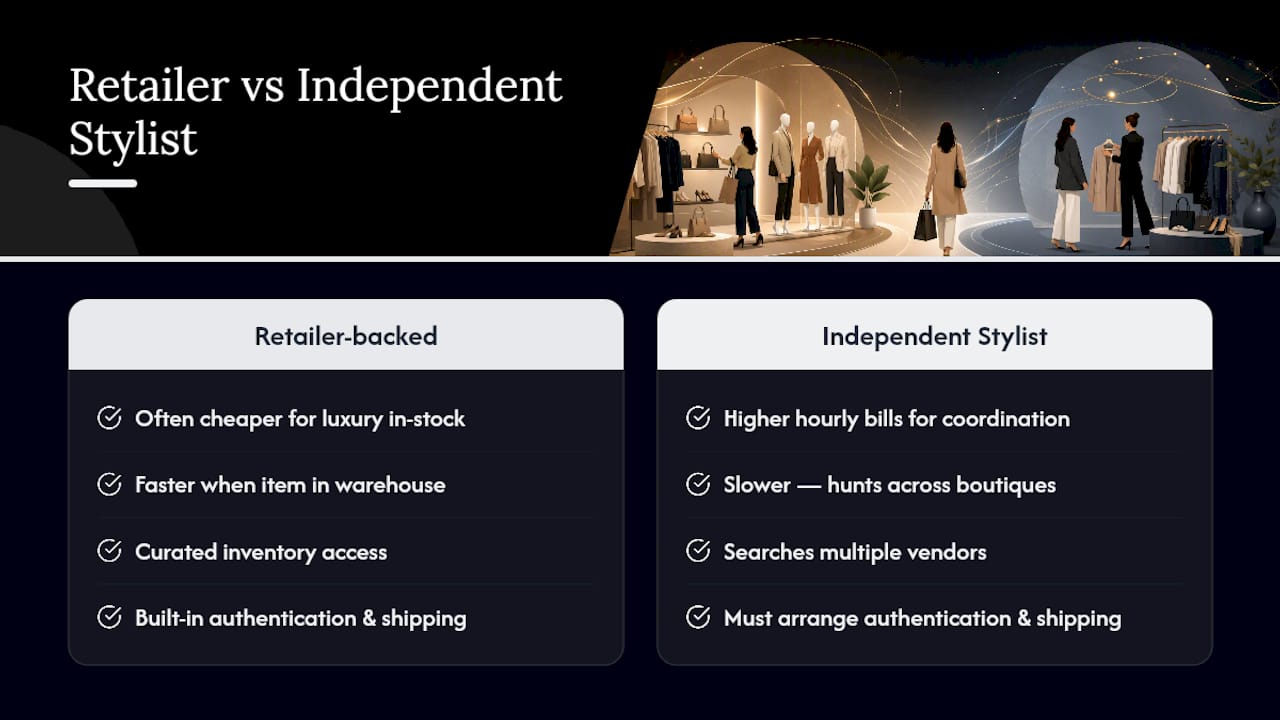
Independent stylists earn their premium fairly. They bring speed, taste, and store relationships you can’t buy on your own. But for luxury purchases specifically, the math tilts differently.
An online retailer-assisted personal shopper bundles inventory access, authentication, and shipping into one workflow, which is exactly the trio an independent stylist has to coordinate separately across multiple vendors. That coordination is where hourly bills balloon. When you’re chasing a specific Chanel bag or a pair of Valentino heels in your size, a retailer with curated stock and built-in authenticity guarantees often gets you there faster and cheaper than paying a stylist to hunt across boutiques. This isn’t an argument against independent stylists. It’s a case for matching the model to the purchase, especially when what you want already exists in someone’s warehouse.
— Camila
Get Personal Shopper Help Through Naise Shopper
If you already know the exact bag, shoe, or watch you want, Naiseshopper skips the hourly clock entirely. Our personal shopper assistance works against a curated, authenticated inventory from Gucci, Chanel, Prada, Valentino, Bottega Veneta, Saint Laurent, and Balenciaga, so you’re not paying someone to search cold across stores you may never find in stock.
Pricing stays transparent because you’re shopping the piece, not billing hours against an open-ended invoice. Browse a piece like the Prada black leather floral heel or the Valentino Garavani stiletto sandal to see how authenticated luxury inventory is priced before you request shopper assistance. Reach out through the request page to get a straightforward quote on the exact item you’re after.
Sources
- Personal Shopper Hourly Rate — Payscale
- Personal Shopper Pricing Guide 2026 — Selector (pricing table)
- The 10 Best Personal Shoppers Near Me — Thumbtack (market examples)
FAQ
How much does it cost to get a personal shopper?
Expect $25 to $200 per hour for independent stylists, $150 to $800 for a one-time session, and $500 to $3,000 for a full wardrobe overhaul, while department store shoppers are typically free.
What is the 70/30 rule for wardrobe?
Definitions vary, but the most common version suggests wearing 70% of your closet as versatile staples and reserving 30% for statement or trend pieces, a ratio some stylists use when planning a shopping session.
Which clothing subscription box is the best?
The right subscription depends on budget and style goals rather than one universal winner; most run $40 to $350 monthly, and it’s worth comparing what’s included, such as styling notes versus curated boxes, before committing.
How much does a personal shopper stylist cost?
Independent stylist rates commonly fall between $75 and $250 per hour based on marketplace listings, though senior stylists with retail buying experience often charge toward the top of that range.
Is it cheaper to use a retailer’s personal shopper than hire independently?
For luxury purchases where the item already exists in a retailer’s authenticated inventory, retailer-assisted shopping through a service like Naiseshopper often costs less than paying an independent stylist to source, authenticate, and ship the same piece separately.