A matching serial number and interior label are the fastest way to spot an obvious fake, but they will not settle a close call. Read the last four digits of the serial as a date, compare that era to the label wording, then move to hardware and construction before you trust your gut. If two or more details feel off, stop debating with yourself and send clear photos to a professional authenticator.
TL;DR:
- Authentic Saint Laurent bags require matching serial numbers and interior labels that are consistent with the production era, especially regarding serial format and wording.
- Each check, from serial number decoding to hardware weight and stitching quality, must align; a failure in any area indicates a potential fake.
- Serial numbers are usually on interior tabs or directly stamped into the lining, with formats that decode to production month and year, but counterfeiters often copy these details.
- The Cassandre logo’s geometry and the hardware’s weight, plating, and finish are difficult to replicate precisely, making them reliable authenticity indicators.
- Professional authentication is recommended for high-value or suspicious bags, especially when multiple signs of fake are present or if the buyer needs definitive proof.
Table of Contents
- What Does Saint Laurent Authenticity Actually Require?
- Quick 6-Point Authentication Checklist
- Serial Numbers and Internal Tags: Where and What to Check
- Interior Blind Stamp and Label Typography Checks
- Hardware and Logo (Cassandre) Inspection
- Construction, Materials, Stitching, and Lining
- Packaging, Paperwork, and Provenance: What They Add (and Don’t)
- When to Use a Professional Authenticator
- How to Photograph a Saint Laurent Bag for Remote Authentication
- Common Counterfeit Tells and Quick Red Flags
- Why a Checklist Beats a Gut Feeling
- Shop Authenticated Saint Laurent With Naiseshopper
- Primary Sources and Brand Documents
- Sources
- FAQ
What Does Saint Laurent Authenticity Actually Require?
Confirming Saint Laurent authenticity is never a single-step process, and treating it that way is how experienced resale buyers still get burned. The bag needs to pass on at least three independent fronts: the serial and label have to belong to the same production era, the Cassandre hardware has to sit at the right proportions and weight, and the stitching and lining have to match how Saint Laurent’s ateliers actually build a bag. A counterfeit that nails one of these can still fail badly on another.
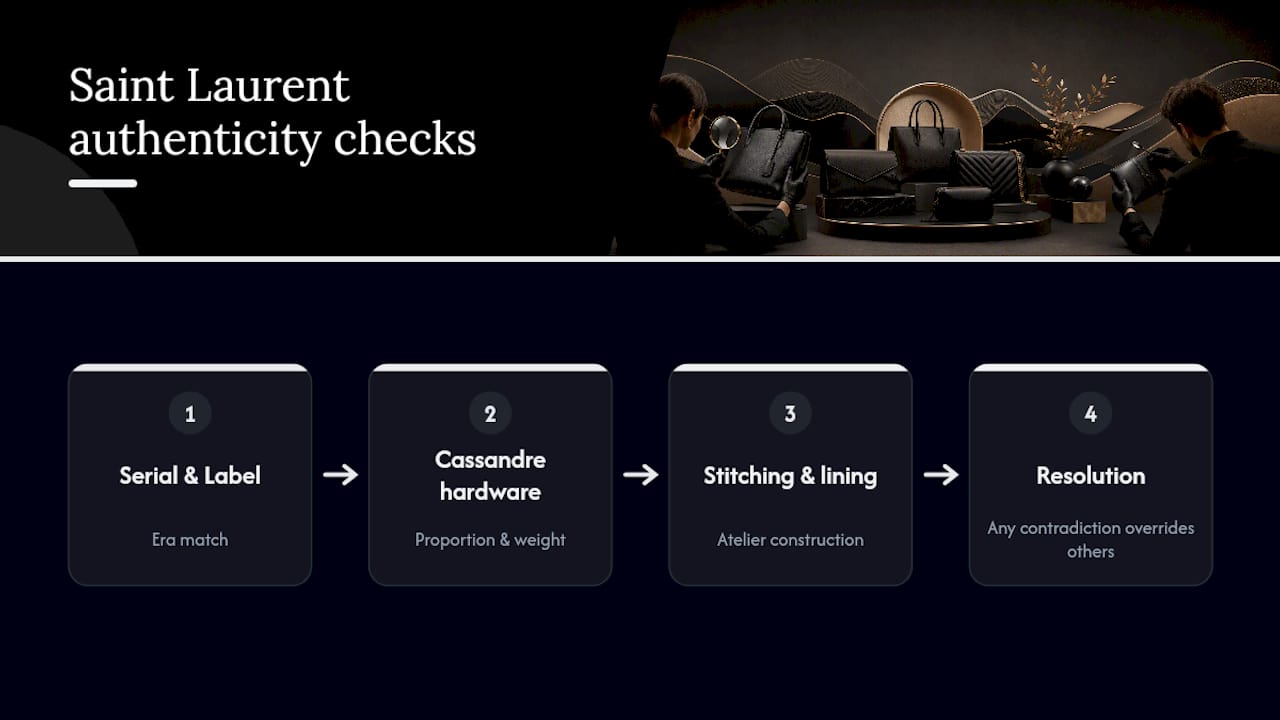
That’s the real definition of a Saint Laurent authenticity guide worth following. It’s not a single trick or a magic serial checker. It’s a layered read where each check either confirms or contradicts the others, and where a contradiction anywhere in the chain is worth more than five things that look fine.
Quick 6-Point Authentication Checklist
Run through this sequence before you buy, sell, or consign a Saint Laurent bag. It works whether you’re standing in front of the bag or scrolling through a resale listing’s photos.
- Find the serial tab and read the last four digits. On modern bags, those digits typically decode as MMYY, so a tag ending in 0324 points to March 2024.
- Check the interior blind stamp wording. It should say “Saint Laurent Paris” or “Saint Laurent,” never a mismatched or oddly translated phrase.
- Look at the Cassandre logo geometry. The interlocking letters should sit flush and symmetrical, not rounded, warped, or crowded together.
- Run your fingers along the stitching and quilting. Stitches should be even in length and spacing, and quilted panels should line up across seams.
- Inspect the lining, zipper pulls, and the “MADE IN” stamp. Fabric should feel substantial, zippers should glide, and the country stamp should be crisp, not smudged.
- If two or more of these raise questions, stop guessing. Order a professional authentication before you commit money either way.
None of these checks works in isolation. A perfect serial on a bag with sloppy quilting is still a fake, and a slightly worn blind stamp on an otherwise flawless bag is often just age. For a broader gut check across brands, Naiseshopper’s authenticity checklist for bags walks through the same layered logic.
Serial Numbers and Internal Tags: Where and What to Check
The serial is where most buyers start, and for good reason. It’s fast, it’s visible, and it gives you a concrete data point instead of a vague impression. But where you find it, and what format it takes, varies more than most buyers expect.
On most Saint Laurent handbags, the serial sits on a small leather tab stitched into an interior pocket or along a side seam. Some models skip the tab entirely and heat-stamp the serial directly into the lining fabric, which means a missing tab isn’t automatically a red flag. Placement varies by model, so a tab showing up in an unusual spot for a specific style is worth more suspicion than a tab that’s simply absent on a model known to skip it.
Modern serials generally follow a recognizable structure:
- A workshop prefix made of one or two letters
- A six-digit style number
- A dot
- A final four digits that read as MMYY (month, then year)
That last four-digit block is the part worth memorizing. On most current Saint Laurent tags, those digits decode directly to a production month and year, so a serial ending in .0921 points to September 2021. Older, pre-rebrand serials often don’t follow this pattern at all and won’t decode cleanly, which is expected rather than alarming on a genuinely vintage bag.
Statistic callout: Serial-format references used by professional authenticators show that a large share of Saint Laurent pieces made over the past decade can be dated confidently this way, which makes era contradictions one of the easiest fakes to catch, according to LegitGrails’ date-code breakdown.
This is where the 2012 rebrand under Hedi Slimane matters more than most buyers realize. Before that shift, interior labels read “Yves Saint Laurent.” After it, the label switched to “Saint Laurent” or “Saint Laurent Paris,” and the serial format shifted alongside it. Authentication guides consistently flag that matching the label wording to the serial-era format is one of the strongest single checks available to a non-expert. A bag with a modern MMYY-format serial and an “Yves Saint Laurent” label wasn’t made by the house that way, full stop.
Here’s the catch, though. A correctly formatted serial doesn’t prove anything on its own. Counterfeiters copy real serial numbers directly onto fake bags, sometimes lifting them from genuine listings or from bags they’ve inspected in person. The format check tells you whether something is obviously wrong. It never tells you the bag is definitely right.
When you’re photographing a serial tab, angle your phone slightly rather than shooting flat on. Heat-stamped numerals sit slightly recessed into the leather, and a direct flash tends to wash out that depth, making a shallow fake stamp look identical to a properly pressed genuine one. Natural light from a window, with the tab tilted at roughly 30 degrees, shows the actual depth of the stamp far better than an overhead ceiling light ever will.
Interior Blind Stamp and Label Typography Checks
The blind stamp sits right next to the serial, and it deserves just as much attention, because typography is genuinely hard for counterfeiters to nail across every detail at once.
Expect these variants depending on era and model:
- Pre-2012 bags: “Yves Saint Laurent” in a serif or slightly rounded font, often paired with “Paris” underneath.
- Post-2012 bags: “Saint Laurent” or “Saint Laurent Paris” in a cleaner, more geometric sans-serif style, reflecting the house’s broader rebrand.
- Rive Gauche era pieces: Occasionally carry “Rive Gauche” alongside the main stamp, a detail specific to that sub-line.
Look closely at letter spacing and weight. Genuine stamps have consistent gaps between letters and uniform stroke thickness throughout the word. On fakes, you’ll often see letters that lean into each other, uneven pressure across the stamp (some letters deep, others barely visible), or a font weight that’s slightly too bold or too thin compared to reference images of the same era.
Placement matters too. Saint Laurent doesn’t randomly position its blind stamps. A specific model typically has the stamp in a consistent spot, whether that’s centered on an interior wall pocket or stamped near the zipper track. A stamp that’s crooked, off center for that model, or positioned somewhere Saint Laurent doesn’t typically place it on that style is a meaningful signal, not a coincidence.
Pro Tip: Minor unevenness from natural leather grain is normal and expected. What you’re hunting for is a systematic typographic error: a letter shape that’s genuinely wrong, not just a slightly soft impression on one corner of the stamp.
Saint Laurent’s own brand documentation reinforces how deliberately controlled this labeling is. The house’s official letter of authorization defines exactly how the brand’s name and marks are meant to appear in authorized communications, and that same precision carries through to how labels are stamped inside the bags themselves. A single wrong letterform isn’t a rounding error. It’s a manufacturing impossibility on a genuine piece.
Hardware and Logo (Cassandre) Inspection
The Cassandre, that interlocking YSL monogram, is arguably the single hardest detail for counterfeiters to replicate at a glance, and it rewards close inspection more than almost any other feature on the bag.
Check these details in order:
- Letter interlock geometry. The letters should meet at sharp, precise points. Rounded or blurred overlaps where the letters should intersect cleanly are one of the most reliable tells on the market.
- Weight and heft. Genuine hardware is solid metal and feels noticeably heavy for its size. Thin, hollow-feeling hardware that flexes under light pressure is a strong warning sign.
- Plating uniformity. Look at the edges and undersides of clasps and rings, not just the visible front. Authentic plating covers the entire piece evenly; cheap plating often thins out or shows brassy undertones at edges and corners.
- Reverse-side finishing. Turn hardware over. Saint Laurent finishes the backs of clasps and buckles cleanly, without rough casting marks or visible seams from the mold.
- Zipper pulls and branding. Zipper pulls and sliders often carry a small engraved logo or brand name. The font should match the house’s typography exactly, and the engraving should be crisp, not shallow or blurred.
Plating that flakes, discolors, or shows a different metal underneath after light wear is one of the fastest ways a fake reveals itself over time, since real hardware ages more gracefully. If you’re evaluating a used bag and the hardware already looks patchy despite light overall wear, that mismatch between the bag’s condition and the hardware’s condition is worth flagging on its own. For general logo and hardware comparisons across other designer houses, Naiseshopper’s guide on how to spot authentic designer bags covers similar principles that apply well beyond Saint Laurent.
Construction, Materials, Stitching, and Lining
This is where the most convincing fakes usually fall apart, because replicating Saint Laurent’s actual construction standards costs money counterfeiters aren’t willing to spend.
Saint Laurent works primarily in calfskin and lambskin, and each has a distinct feel. Calfskin has more structure and a slightly firmer hand, while lambskin is noticeably softer and more supple, sometimes with a subtle sheen. A bag marketed as lambskin that feels stiff and plasticky, or calfskin that feels thin and papery, is telling you something before you’ve even checked a single logo.
Stitch quality is one of the most reliable physical checks available:
- Stitches should be uniform in length and evenly spaced along every seam, not just the visible front panels.
- Quilted sections, common on models like the Loulou and the Cassandre bag itself, should align symmetrically across the entire panel, with diamond or chevron patterns matching from one side to the other.
- Edges should be cleanly finished, either painted, folded, or bound, without visible glue seeping out from under the leather.
- The lining should be securely attached at every seam, with no loose threads or gaps where fabric meets leather.
Zippers deserve their own look. Genuine Saint Laurent bags typically use branded zipper pulls from established zipper manufacturers, and the zipper action itself should feel smooth with zero snagging, even on a bag that’s seen real use. A zipper that catches constantly, feels gritty, or has visible plastic teeth on a bag marketed as premium hardware is inconsistent with how these bags are actually built.
Pro Tip: Smell the interior lining on an older bag. Genuine leather goods develop a specific, rich leather scent over time. A strong chemical or plastic smell, especially on a bag claimed to be several years old, often points to synthetic materials standing in for real leather.
For a broader walk-through of these physical checks across handbag brands generally, the step-by-step guide to spotting fake handbags covers construction red flags that apply just as well here.
Packaging, Paperwork, and Provenance: What They Add (and Don’t)
Dust bags, care booklets, and authenticity cards feel reassuring, but they carry less weight than most buyers assume. Counterfeit operations have gotten good at reproducing packaging, sometimes better than they reproduce the actual bag.
A few things still matter:
- Dust bag quality. Genuine dust bags use a specific weight of cotton with clean, even stitching around the drawstring channel. Thin, see-through fabric or crooked stitching on the bag itself is a mismatch worth noting.
- Receipts as provenance, not proof. A receipt from an authorized retailer helps establish where and when a bag was purchased, but check that the item description, date, and store location are internally consistent. A receipt alone proves a transaction happened, not that this specific bag is the one described.
- Care booklets and authenticity cards. These are easy to photocopy or reprint, so treat them as a minor supporting detail rather than a deciding factor.
- Seller and channel reputation. Buying through a trusted consignment platform, an authorized retailer, or a reseller with a verified authentication process reduces risk far more than any single paper document can.
Saint Laurent’s own customer support confirms that buyers can generate a digital authenticity certificate using an NFC reader and the Saint Laurent app, but that feature is tied to items purchased through the brand’s own channels. It doesn’t extend to secondhand pieces bought elsewhere, which is exactly why resale buyers still need independent verification methods rather than relying on brand-issued documentation alone. Consignment sellers who prepare paperwork properly, the kind of documentation practices outlined in standard consignment intake guides, tend to be a better sign of a trustworthy channel than any single card or receipt.
When to Use a Professional Authenticator
Professional authentication earns its cost fastest in a few specific situations: a high-value bag where a wrong call is expensive, a dispute between buyer and seller that needs a neutral third opinion, or an insurance claim that requires documented proof of authenticity.
Two broad service types exist. Photo-based remote authentication is faster and cheaper, working from a defined set of images you submit. In-person authentication, offered by some consignment shops and specialty services, allows a physical inspection of weight, smell, and material feel that photos simply can’t capture. Authentication services commonly advertise both models, often with AI-assisted screening as a first pass before a human reviewer weighs in, and pricing varies widely depending on turnaround speed and service depth.
What should you expect to receive back? A legitimate service typically delivers one of three things: a written certificate stating the verdict, a set of annotated photos marking specific details that informed the decision, or a detailed written explanation of what was checked and why the bag passed or failed. Vague, one-word verdicts with no supporting detail are a sign of a low-effort service, not a thorough one.
Before you pay for authentication, check a few things about the service itself:
- Ask whether they’ll show a sample report so you know what output to expect.
- Confirm turnaround time upfront, especially if you’re on a return deadline for the purchase.
- Look for references or a track record specific to Saint Laurent, not just general designer handbags.
- Be wary of any service promising a guaranteed result before they’ve even seen a single photo.
No brand issues a blanket authentication guarantee for items bought secondhand outside its own boutiques, which is precisely why third-party experts fill that gap. For collectors managing multiple pieces or building a resale inventory, Naiseshopper’s designer handbag authentication checklist for collectors offers a useful framework for deciding when professional review is worth the spend versus when your own checklist is enough.
How to Photograph a Saint Laurent Bag for Remote Authentication
Clear photos are the difference between a same-day answer and a week of back-and-forth requests for better images. Work through these shots in order:
- Full front and back exterior shots, in even lighting, showing the overall shape and proportions.
- The serial tab or heat-stamped area, angled slightly to show depth, not flat under direct flash.
- The interior blind stamp, close enough to read every letter clearly.
- Hardware close-ups, including the Cassandre logo, zipper pulls, and the underside of any clasps.
- Quilting or stitching seams, especially any area where panels meet.
- The interior lining, showing fabric texture and how it’s attached at the seams.
- Zipper teeth and sliders, pulled fully open to show the branding on the pull tab.
Shoot in natural daylight near a window rather than under artificial ceiling lighting, which tends to flatten texture and hide the depth details authenticators actually need. Use a plain, neutral background, a white sheet or a solid-color table, so nothing distracts from the bag itself.
Send full-resolution images rather than screenshots or heavily compressed files, since compression is exactly what destroys the fine texture detail on stitching and stamping. Most authentication services accept images through their own upload portal or secure email rather than public messaging apps, which also protects your privacy.
Pro Tip: Take one photo holding a coin or a common object next to the hardware for scale. It sounds unnecessary until you realize photos alone often make hardware look larger or smaller than it actually is, which can throw off a remote read.
The most common mistake that delays a response is submitting blurry serial photos. If an authenticator can’t read every digit clearly, the whole review stalls until you resend better images, so get that shot right the first time.
Common Counterfeit Tells and Quick Red Flags
Some signals are reliable enough on their own to end the debate immediately. Others only matter once you’ve spotted two or three together.
- Era and label mismatch. A modern MMYY-format serial paired with an “Yves Saint Laurent” label, or the reverse, is close to an automatic fail.
- Shallow or uneven heat stamps. A serial that looks printed on rather than pressed in, or one with inconsistent depth across the digits, points to a rushed production process.
- Glue visible at seams. Any glue bleeding out from under leather edges, especially near the lining, is inconsistent with how these bags are finished.
- Rounded Cassandre overlaps. Soft, blurred intersections where the letters should meet sharply are one of the most consistent tells across counterfeit batches.
- Thin plating or soft hardware. Hardware that flexes, feels light, or shows a different metal color underneath light wear fails the weight test almost immediately.
- Asymmetric quilting. Diamond or chevron patterns that don’t align across a panel, or stitch lengths that vary noticeably along the same seam.
Statistic callout: Authentication guides consistently note that modern counterfeits increasingly copy correct serial formats and packaging, which means a single passing check no longer settles the question the way it once did. A layered read across serial, label, hardware, and construction remains the most reliable approach available before involving an expert.
One flag alone is worth investigating further. Two or more flags together are usually enough reason to walk away from a purchase or send the bag for professional review before spending any real money. For a wider view of counterfeit patterns across luxury categories, Naiseshopper’s tips to spot counterfeit luxury goods online covers several of these same tells in a broader market context.
Why a Checklist Beats a Gut Feeling
The biggest mistake I see buyers make isn’t missing a detail. It’s trusting a single strong signal, usually a clean serial number, and skipping everything else because the first check felt convincing enough. That instinct is understandable, and it’s also exactly how experienced collectors get fooled by the better fakes now circulating in resale markets.
A checklist works because it forces you to treat each detail as independent evidence rather than a final verdict. Serial format, label era, Cassandre geometry, stitch quality: none of these alone proves anything, but stacked together they build a case a single check never could. That’s also the logic behind how Naiseshopper handles inventory. Every Saint Laurent piece listed goes through this same layered review before it reaches a buyer, which is a very different standard from a marketplace that simply takes a seller’s word for it.
Trust your own assessment for the obvious cases, a wildly mismatched label and serial, hardware that feels like a toy. Save professional authentication for the close calls, the high-value purchases, and anything where a wrong guess costs more than the authentication fee itself.
— Camila
Shop Authenticated Saint Laurent With Naiseshopper
Skip the guesswork entirely. The seller provides authenticity checks on Saint Laurent handbags it lists, offering confidence through multiple verification steps without requiring personal inspection.
Listings typically undergo serial, label, hardware, and construction reviews before being offered, supplemented by insured international shipping and localized pricing details. Some sellers offer personal shopper services to assist in locating and acquiring specific bag styles or eras for buyers. Browse the current authenticated Saint Laurent selection to see what’s available now, or request a personal shopper if you want help sourcing a piece that isn’t listed yet.
Primary Sources and Brand Documents
For readers who want to go straight to the source, a few documents are worth bookmarking. Saint Laurent’s own customer support FAQ covers the NFC-based digital authenticity certificate available on boutique purchases. The brand’s 2024 letter of authorization shows how official label wording and authorized communications are defined. For independent serial-format references, LegitGrails’ date code checker and LuxeDetect’s serial number guide both offer detailed breakdowns worth cross-referencing against any bag you’re evaluating.
Sources
- FAQ | Orders, Returns, Sustainability & Support | YSL US
- YSL Letter of authorization US 2024 (Kering asset)
- YSL Serial Number Checker | Saint Laurent Date Code – LegitGrails
- Saint Laurent serial number guide | LuxeDetect
- Saint Laurent serial number checker | Libas Collective
FAQ
How Do You Check a Saint Laurent Serial Number?
Locate the serial on the interior leather tab or heat-stamped lining, then read the final four digits as MMYY on most modern bags. Cross-check that the label wording, “Saint Laurent Paris” versus “Yves Saint Laurent”, matches the era that serial format implies, since a mismatch between the two is one of the strongest single red flags available to a non-expert.
How Do I Know if My Saint Laurent Bag Is Authentic?
No single check proves authenticity on its own. Run the full sequence: serial format and era, label typography, Cassandre hardware geometry, stitching and quilting alignment, and lining quality, then treat two or more inconsistencies as a reason to consult a professional authenticator rather than a coin flip.
How Can You Tell a Saint Laurent Replica From a Real One?
The most reliable tells are era and label mismatches, rounded or blurred Cassandre logo overlaps, thin or hollow-feeling hardware, and asymmetric quilting patterns. Since counterfeiters increasingly copy correct serial formats and packaging, construction quality and hardware weight now matter more than the serial alone.
Do All Saint Laurent Bags Have a Serial Number?
Most Saint Laurent bags carry a serial, either on an interior leather tab or heat-stamped directly into the lining depending on the model. Placement varies by style, so a serial in an unexpected location for a given model is worth more scrutiny than a serial that’s simply hard to find.
Does Naiseshopper Guarantee Saint Laurent Authenticity?
Yes. Naiseshopper authenticates every Saint Laurent handbag before listing it, applying the same layered review of serial, label, hardware, and construction detailed throughout this guide. Current inventory and pricing are available directly on the Naiseshopper site.