Signature on delivery requires a physical sign-off before a carrier hands over a package, and that single step turns a shipment into a documented handoff instead of a guess. FedEx, UPS, and USPS all offer several signature tiers, from a basic adult signature to a strict direct-only requirement, and fees shift depending on whether you buy it at a retail counter or add it electronically. For anything irreplaceable, the small cost buys real proof of custody.
TL;DR:
- Signature tiers vary by carrier, with direct signatures requiring the recipient’s physical presence and adult signatures requiring ID for age verification.
- Signature confirmation costs are lower when purchased online and must be added at mailing; retroactive upgrades are not possible once shipped.
- Proof of delivery stores signatures, timestamps, and location data for about a year, providing stronger dispute evidence than simple delivery scans.
- Signature requirements can delay first delivery attempts, especially for direct signatures, increasing the risk of parcels being held or rescheduled.
- For high-value or high-risk shipments, signature confirmation combined with photo proof and insurance offers crucial protection against loss, theft, or disputes.
Table of Contents
- What Are the Different Types of Signature Confirmation?
- How Does the Signature-on-Delivery Process Actually Work?
- What Does Signature on Delivery Cost, and When Do You Pay?
- What Proof of Delivery Do Carriers Actually Keep?
- When Is Signature on Delivery Actually Worth Paying For?
- How Do Merchants Configure Signature Requirements at Scale?
- How Do Carriers Guard Against Signature Fraud or Discrepancies?
- Does Signature on Delivery Slow Down Delivery Times?
- How Does a Signature Affect Liability if a Package Is Lost or Damaged?
- What Happens if the Recipient Refuses to Sign?
- Why Naise Shopper Treats Signature Confirmation as Non-Optional for Designer Goods
- Shipping a Designer Piece? Here’s How Naise Shopper Protects It
- Where to Check Current Carrier and Technical Details
- Sources
What Are the Different Types of Signature Confirmation?
Every major carrier splits signature service into tiers, and the names change slightly from one to the next, which trips up more shippers than you’d expect. Here’s what each level actually means in practice:
- No signature / delivery confirmation: The carrier scans the package at the door or drop point and logs a timestamp, but nobody has to be home. This proves when a package arrived, not who took it.
- Signature required: Any adult present at the address can sign, including a neighbor or building manager in some setups.
- Adult signature: The signer must be 21 or older and show ID, standard practice for wine, spirits, and other age-restricted goods.
- Direct signature (FedEx calls this “Direct Signature Required”): Only the named recipient can sign. No neighbor, no coworker, no exceptions.
- Indirect signature: A neighbor, doorman, or someone at the address can accept on the recipient’s behalf, common on residential UPS deliveries.
FedEx documents these tiers, including direct and adult signature, and lets the shipper pick the exact requirement when the label is created. UPS runs a comparable structure through its signature required and adult signature options, and USPS folds similar logic into its Signature Confirmation service. The naming differences matter because a driver enforcing “indirect” at one carrier might refuse to accept a substitute signer under another carrier’s “direct” rule for the identical package.
How Does the Signature-on-Delivery Process Actually Work?
Requesting a signature is a choice you make before the package ever leaves your hands, and the steps look slightly different depending on how you’re shipping.
- Select the confirmation type when you create the label. At a retail counter, you tell the clerk. Online, you check a box during checkout. Through a shipping API, you set a confirmation field in the shipment payload.
- The carrier flags the package in its system, which changes how the driver is instructed to handle the drop-off.
- At delivery, the driver attempts the sign-off according to the tier you chose. Direct signature means the driver waits for the named person only. Adult signature means the driver checks ID. Indirect signature allows a neighbor or doorman to step in.
- If nobody eligible is available, the carrier leaves a notice and tries again, typically for one to three attempts depending on the service, before holding the package for pickup or returning it to sender.
- Recipients can often redirect delivery to a nearby retail location or schedule a specific redelivery window through the carrier’s tracking tool.
FedEx explains this shipper-selects-first structure clearly in its signature requirements and delivery options documentation, and the same logic holds whether you’re a single online shopper or a warehouse processing hundreds of labels a day.
What Does Signature on Delivery Cost, and When Do You Pay?
Pricing follows a predictable pattern across carriers: buying signature service at a retail counter costs more than adding it electronically before you print a label.
- USPS Signature Confirmation runs cheaper when purchased online through Click-N-Ship or a shipping platform than when added at the post office counter, according to USPS’s own Signature Confirmation FAQ.
- The service must be added at the time of mailing, not after the package is already in transit. There’s no retroactive upgrade once a truck has left the dock.
- Fees are generally non-refundable once the package ships, even if delivery ends up unattended for other reasons.
- Signature Confirmation only applies to certain USPS classes, including Priority Mail and Ground Advantage, so check eligibility before assuming it’s available on every service tier.
Rates change often enough that quoting a specific number here would go stale fast. Check the current USPS Signature Confirmation page or your carrier’s rate calculator before you ship anything time-sensitive.
What Proof of Delivery Do Carriers Actually Keep?
A completed signature capture typically includes the signer’s name or image, the exact date and time, and the delivery ZIP code, bundled together as what USPS calls Proof of Delivery.
USPS keeps that signature record on file for approximately one year, and customers can request a copy through the tracking tool online, by phone, or through a formal written request for older records. That retention window is the practical reason signature confirmation beats basic tracking for anything you might need to dispute later: a delivery scan tells you a package arrived somewhere, but a signature image tells you who accepted it. That distinction is exactly what separates delivery confirmation from signature confirmation, and it’s why claims departments treat the two so differently when a customer says a package never showed up.
For merchants, that signature record becomes the first document you pull when a buyer opens a “not received” dispute on a marketplace or through a card issuer’s chargeback process.
When Is Signature on Delivery Actually Worth Paying For?
Not every shipment needs it, but a few scenarios make the fee an easy call rather than a maybe.
- High-value items where replacement cost or resale value makes an unattended porch drop a real financial risk (generally items above a few hundred dollars).
- Age-restricted goods like alcohol, where adult signature isn’t optional, it’s a legal requirement.
- High-risk delivery addresses, including apartment buildings with shared lobbies, vacation rentals, or areas with a history of porch theft.
- Business-to-business shipments where a signed receipt closes out a purchase order or triggers an invoice.
If none of those apply, cheaper alternatives often cover you well enough: photo proof of delivery, a scheduled delivery window, redirecting to a staffed pickup location, or restricted delivery paired with shipping insurance for the dollar value at stake.
Pro Tip: Consider the item’s replacement cost and delivery environment; signature service is often worthwhile for higher-value or unsupervised deliveries.
Readers shipping or receiving international luxury purchases tend to land firmly in the “worth it” category, given both the value at risk and the customs handling involved.
How Do Merchants Configure Signature Requirements at Scale?
Retailers and marketplace sellers don’t set confirmation type one label at a time. Carrier account dashboards, marketplace shipping settings, and shipping platforms all expose a confirmation field you configure once and apply by rule.
Developer-facing tools make this explicit. ShipEngine’s documentation shows a confirmation property accepting values like none, delivery, signature, and adult_signature, which platforms pass directly in the shipment payload when a label is generated. That standardization matters more than it sounds: merchants running orders across multiple marketplaces can automatically flag high-value or high-risk orders and force signature service, rather than relying on someone remembering to check a box. Full field definitions and examples live in ShipEngine’s delivery confirmation docs.
A solid operational checklist for high-value shipments: pair signature service with declared-value insurance, default to restricted or direct signature (never indirect) for expensive items, and follow best practices detailed in Discreet Card Packaging: What Collectors Need to Know to keep a backup pickup-location option ready for failed delivery attempts.
How Do Carriers Guard Against Signature Fraud or Discrepancies?
Carriers build several checks into the signature process specifically because a forged or mismatched signature undermines the entire point of the service.
Drivers scanning a delivery capture a digital signature tied to a specific device, timestamp, and GPS location, which creates a harder-to-dispute record than a paper slip ever could. For adult signature service, drivers are required to check government-issued ID and confirm the signer meets the age threshold, not just ask verbally. If a signer’s name doesn’t match the recipient on a direct-signature package, drivers are trained to refuse the handoff rather than accept it anyway, which is precisely why direct signature exists for high-security shipments.
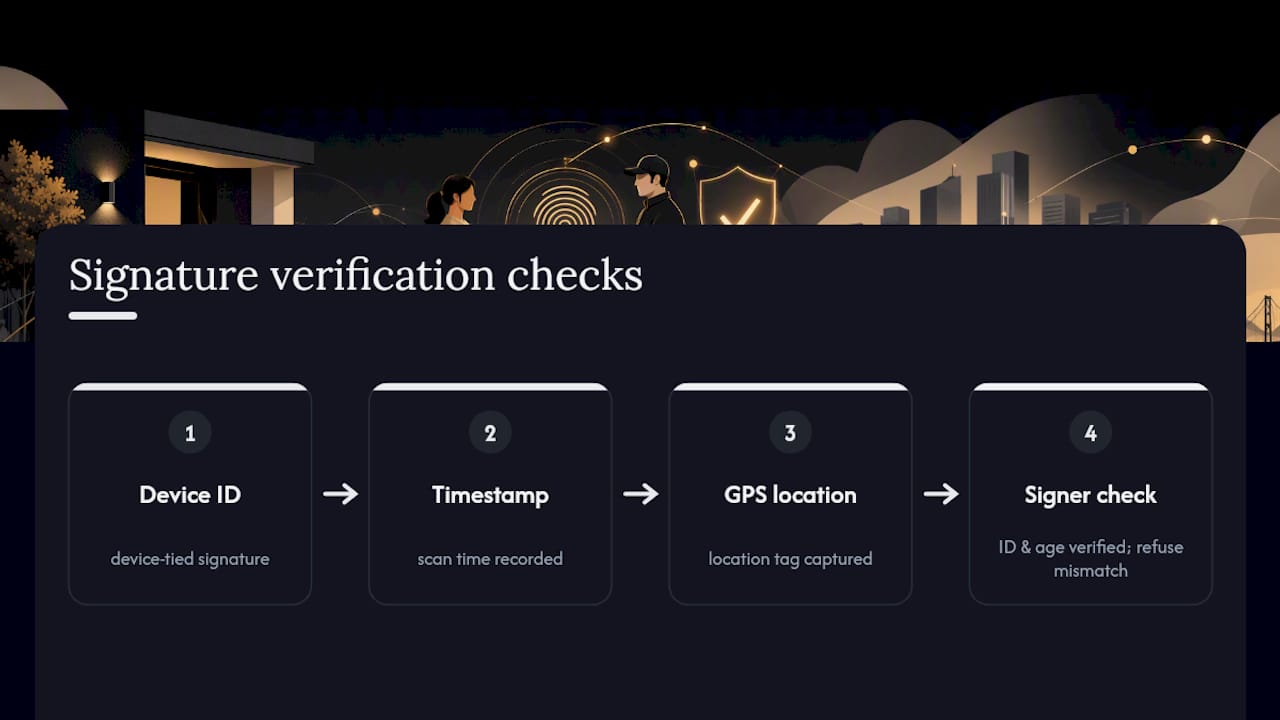
When a dispute arises, disagreeing with who actually signed is one of the more common contested-delivery complaints, and carriers investigate those cases against their own driver scan records and signature images rather than taking either party’s word for it. That’s the practical value of the signature capture itself: it’s a timestamped, location-tagged record the carrier controls, not something either the buyer or seller can easily dispute after the fact. Choosing the correct tier upfront, meaning direct signature at a genuinely high-risk address instead of indirect, is the single biggest lever a shipper has over fraud exposure, since an indirect signature legally allows a neighbor or building employee to accept a package the intended recipient never sees.
Does Signature on Delivery Slow Down Delivery Times?
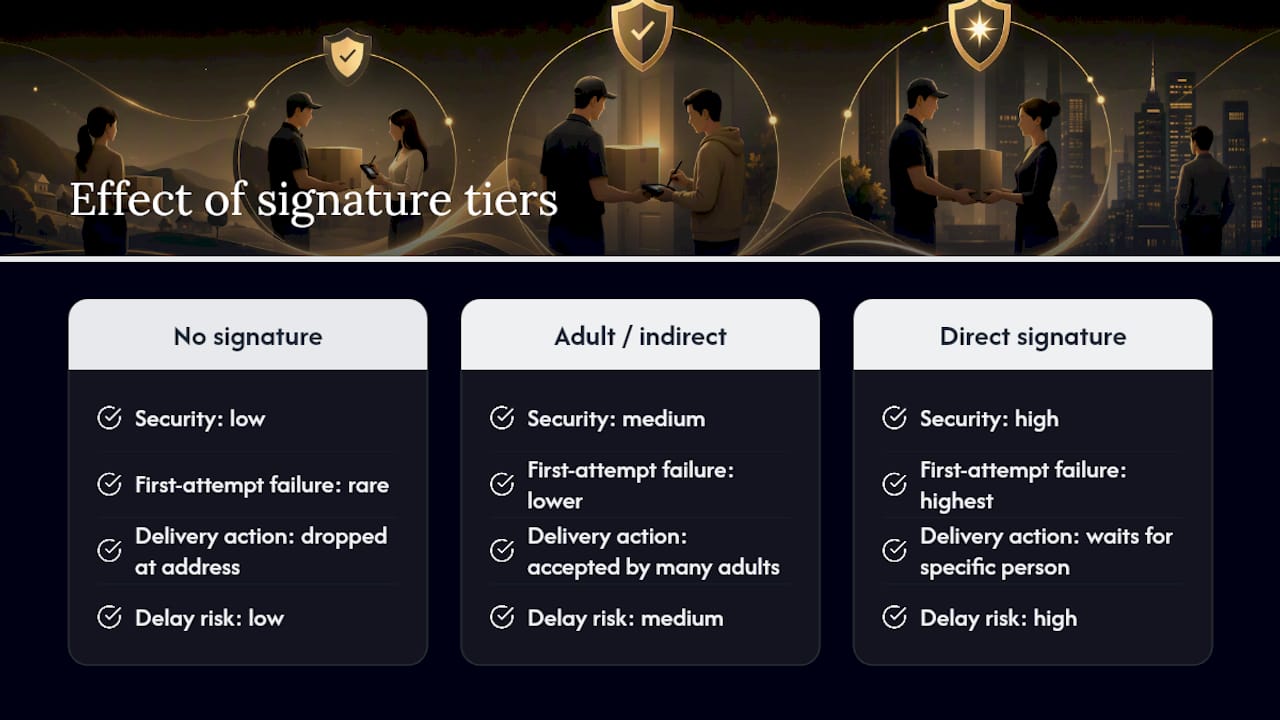
Signature requirements rarely change a carrier’s transit time, but they absolutely change the chance of a delivery attempt failing on the first try.
A package with no signature requirement gets dropped the moment the driver reaches the address, no matter who’s home. A package requiring direct signature waits on one specific person being physically present, and if that person is at work or traveling, the driver leaves a notice and tries again the next business day. Multiply that across a few missed attempts and a package that could have arrived Tuesday sits in carrier limbo until Thursday or Friday, then possibly gets held at a local facility for pickup.
Adult signature and indirect signature requirements fail less often simply because more people at an address qualify to accept the package. Direct signature is the tier most likely to cause a delay, precisely because it’s also the tier offering the strongest protection. That tradeoff is the real decision point for shippers: tighter security almost always means a higher chance of a missed first attempt, so if timing matters as much as security, scheduling delivery for a day you know the recipient will be home solves most of the problem without downgrading the signature tier.
How Does a Signature Affect Liability if a Package Is Lost or Damaged?
A recorded signature shifts the burden of proof dramatically once a claim gets filed, because it establishes exactly who accepted the package and when.
Without a signature, a “package never arrived” claim often comes down to competing statements. With a signature on file, including the signer’s name or image and a timestamped location, the carrier has documented that a specific person accepted the shipment in good condition. Delivery confirmation shows a package reached a location; signature confirmation shows a person accepted it, and that distinction matters directly for insurance claims, since most carrier and third-party insurance policies require solid proof of delivery before paying out on a loss claim.
For damage claims, the signature record establishes the last moment the carrier had custody, which matters when a dispute turns on whether damage happened in transit or after handoff. Sellers processing chargebacks or marketplace disputes rely heavily on this record too. A signature image dated and timestamped at the buyer’s address is far stronger evidence in a dispute than a scan showing only that a truck passed through the ZIP code that day.
What Happens if the Recipient Refuses to Sign?
A refused signature doesn’t mean the package disappears into limbo. Carriers have a defined process for exactly this situation.
The driver typically notes the refusal, does not leave the package, and returns it to the local facility. Depending on the carrier and service level, the sender is notified and the package may be held for a set number of days awaiting instructions, redirected to a nearby retail pickup location, or returned to sender if no resolution happens within the window. Recipients who refuse because they weren’t expecting a package, or because they’re wary of an unexpected COD charge, usually have the option to call the carrier and either reschedule for a day they’re prepared to accept it or authorize pickup at a staffed location instead.
For merchants, a pattern of refused signatures on the same address is worth flagging internally. It can signal a fraudulent order, a wrong address, or a buyer trying to dispute a charge after claiming non-delivery. Documented refusal, tied to the driver’s scan and notes, protects the shipper in exactly that dispute scenario, since it shows the carrier attempted delivery in good faith and the recipient declined it rather than the package simply going missing.
Why Naise Shopper Treats Signature Confirmation as Non-Optional for Designer Goods
For anything with real resale value, a bare tracking scan isn’t proof enough. That’s why Naise Shopper pairs signature confirmation with photo proof of delivery and shipping insurance on every high-value order, and our personal shopper service applies the same discipline to US-based purchases made on a client’s behalf. A signed, photographed handoff is the closest thing to a paper trail a designer bag can get.
— Camila
Shipping a Designer Piece? Here’s How Naise Shopper Protects It
A retail signature fee only gets you a name on a screen. The full chain of custody is built around every authenticated handbag, watch, or ready-to-wear piece shipped: signature confirmation, photo proof of delivery, and shipping insurance bundled into the order rather than tacked on as an afterthought you have to remember to request.
That matters most on the pieces where a missed handoff is genuinely expensive, a Chanel flap, a Bottega Veneta tote, a Saint Laurent bag you’ve been eyeing for months. Our personal shopper service extends the same secure handling to US purchases made on your behalf, so the protection follows the item from checkout to your door, not just from the warehouse to a courier’s van. Browse the current authenticated collections and see the delivery protections applied automatically at Naiseshopper.
Where to Check Current Carrier and Technical Details
For the latest fees and rules, go straight to the source: USPS’s Signature Confirmation FAQ covers retention and fees, FedEx’s signature services page covers tier selection, and ShipEngine’s docs cover API confirmation values for merchants building automated shipping rules.
Sources
- What is Signature Confirmation™?
- FedEx signature requirements and delivery options
- Delivery confirmation | ShipEngine docs
- What Is Delivery Confirmation and How Does It Work? - LegalClarity