Checking Balenciaga bag authenticity comes down to four spots: the interior label and serial code, the leather’s feel and grain, the hardware’s weight and engraving, and the stitching’s density and consistency. Each Balenciaga model has its own code formats and era quirks worth cross-checking. Photograph those exact four areas up close, and you’ll have most of what a professional authenticator would want to see anyway.
TL;DR:
- Serial codes and interior tags must match the model, era, and production year, with clear, correctly formatted lettering and no glue residue.
- Authentic leather feels natural, compresses under pressure, and displays random, organic distressing, unlike stiff, uniform fake materials.
- Hardware should be heavy, with deep engraved markings and correctly placed branded zippers, with finish details matching the bag’s production era.
- Stitching must be dense, even, and free of skipped stitches, especially on curved seams, with interior linings and edges following specific model standards.
- Multiple authenticity markers such as serial codes, leather feel, hardware, and stitching must all align; a single discrepancy indicates a counterfeit.
Table of Contents
- Balenciaga Bag Authenticity Checklist: What to Inspect First
- Where Are the Balenciaga Serial Number and Date Code Located?
- What Does Authentic Balenciaga Leather Feel Like?
- How Can You Tell If Balenciaga Hardware Is Real?
- What Stitching and Construction Details Reveal a Fake
- What Photos Do You Need for Remote Balenciaga Authentication?
- Why Multiple Markers Matter More Than Any Single Detail
- Browse Naiseshopper’s Authenticated Balenciaga Collection
- Sources
Balenciaga Bag Authenticity Checklist: What to Inspect First
Whether you’re standing over a bag on a folding table at a resale meetup or scrolling through a seller’s photos at midnight, run through the same sequence every time. Consistency is what catches counterfeits, not gut feeling.
- Flip the interior tag and check both the front lettering and the reverse serial code.
- Match the seasonal letter on the code to the claimed production year.
- Check the zipper pull for a Lampo or matching brand stamp.
- Look for deep, clean engraving on every hardware piece, not just the visible ones.
- Press the leather. Lambskin should give and spring back; it shouldn’t feel like stiff plastic.
- Flip the tassel and inspect the underside stitching and leather grain.
- Check the front pocket lining. Leather, not canvas, on most City models.
- Run a finger along the edge paint. It should be smooth, not chalky or flaking.
- Treat the dust bag, box, and receipt as supporting evidence only, never proof on their own.
On a City bag, the distressed lambskin and tassel underside carry the most weight, since the City is the model counterfeiters copy most often. On an Hourglass, focus on the box calf structure and hardware finish instead, since that leather doesn’t distress the same way.
Pro Tip: If a seller won’t photograph the reverse side of the interior tag, walk away. That single refusal is one of the most common signals of a listing hiding a mismatched or missing serial code.
Where Are the Balenciaga Serial Number and Date Code Located?
Balenciaga sews a white leather tag inside the bag, usually near the top of the lining, stamped with the Balenciaga name and a printed alphanumeric serial number on the reverse. On City, Hourglass, and Le Cagole bags, that tag sits in roughly the same interior pocket or seam, though exact placement shifts slightly by model and production year, and format details vary by era.
The front of the tag should show crisp lettering with no glue residue or crooked stitching around its edges. Flip it over and you’ll find the serial code, which typically includes a seasonal letter tied to the collection it was made for. A mismatch between that letter and the year a seller claims the bag is from is one of the clearest red flags you’ll encounter.
Small typography shifts matter more than most buyers realize. Balenciaga used an underscore style, “Balenciaga_Paris,” on labels through the early 2000s before shifting to a period, “Balenciaga.Paris,” in later years, and a label showing the wrong style for its claimed era is a near-automatic disqualifier.
- Sewn white leather tag with printed serial code: standard across most City, Hourglass, and Le Cagole bags.
- Metal plaque variants: seen on select limited editions and collaborations.
- Hologram stickers or QR elements: appear mainly on newer releases and should scan or link back to a verifiable product page.
If anything about the code format looks unfamiliar, cross-check it against known references for that specific model and year before assuming it’s wrong. Balenciaga has changed labeling conventions more than once, and an unusual format isn’t automatically fake, it’s just a reason to dig further.
What Does Authentic Balenciaga Leather Feel Like?
Authentic Balenciaga leather has texture and give that synthetic materials simply can’t fake convincingly. City bags use lambskin that feels soft, slightly wrinkled, and almost powdery to the touch. Press it gently and it should compress, then spring back within a second or two. Stiff, plastic-like resistance is your first warning sign.
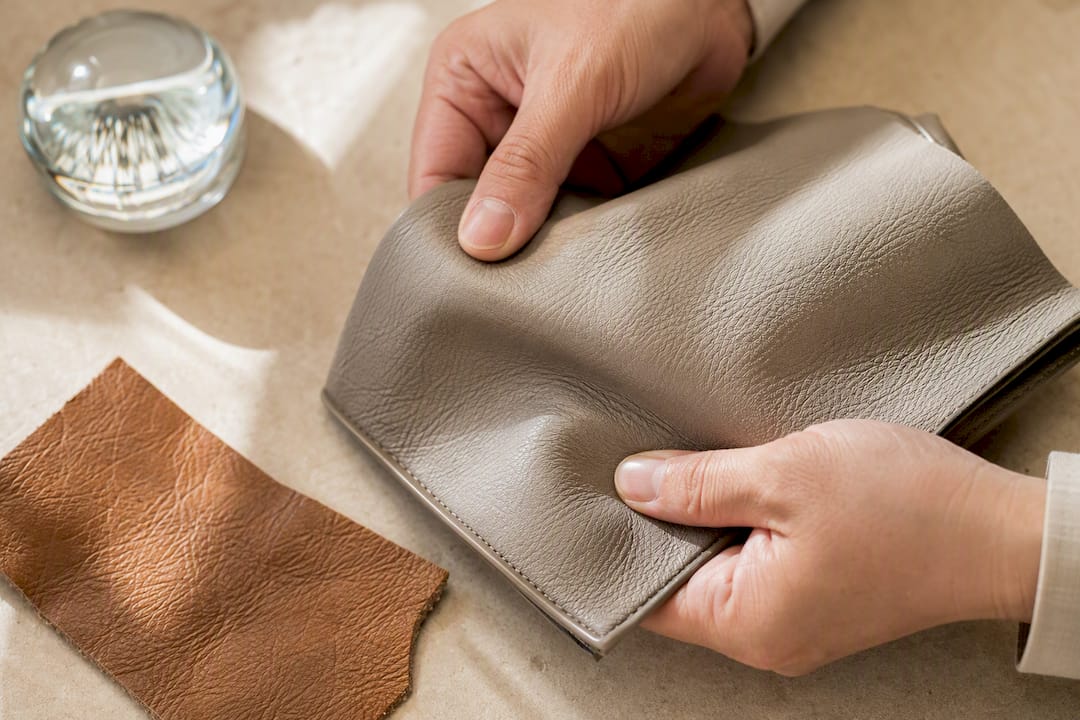
Hourglass bags use a firmer box calf or structured calfskin instead, built to hold the bag’s signature shape without slouching. That structure comes from the leather itself, not a stiff lining underneath, so a bag that feels rigid because of an inserted cardboard shape rather than the leather’s own body is worth a second look.
Some models use goatskin, which sits between the two: less delicate than lambskin, but softer than box calf.
- Genuine lambskin: soft, matte, slightly grainy, compresses under light pressure.
- Genuine box calf: firm, smooth, structured, holds its shape without external support.
- Common fakes: shiny or overly uniform surface, resists pressure, smells faintly of chemicals rather than tanned hide.
Natural wear is expected on lambskin City bags and isn’t a defect. What counterfeiters can’t replicate is organic patina. Real distressing looks random and clusters where a bag actually gets handled, corners, the base, the handle drop. Fake distressing often looks stamped, repeating the same texture pattern evenly across the whole panel. That distinction between organic wear and mechanical stamping is one of the more reliable tactile checks you can run without any special equipment.
How Can You Tell If Balenciaga Hardware Is Real?
Genuine Balenciaga hardware carries noticeable weight and shows deep, clean engraving on every piece, not just the ones facing the camera. Pick up an authentic zipper pull or stud and you’ll feel actual metal heft. Counterfeits routinely use lighter alloys that feel hollow, paired with shallow or blurry engraving that looks stamped rather than cut.
- Check every visible engraving, including the back of buckles and the underside of studs, for consistent depth and clarity.
- Look for loose or wobbly studs, a common counterfeit tell since authentic hardware is fixed with far more precision.
- Confirm the zipper pull carries a Lampo brand mark and glides smoothly with no snagging or grinding.
- On City bags, check the front plate’s stud placement and flathead screw slots. Uneven spacing or missing slots point to a fake.
Finish also shifted across eras. Balenciaga used sterling silver hardware on some earlier production runs before moving to nickel finishes later on, and era-specific finish mismatches are another detail counterfeiters tend to get wrong. If a bag’s hardware finish doesn’t match what’s typical for its claimed production year, treat that as a flag worth investigating further before anything else.
What Stitching and Construction Details Reveal a Fake
Authentic Balenciaga stitching runs dense and even, with matching thread color and zero skipped stitches, even along curved seams that are harder to sew consistently. Uneven stitch density paired with loose hardware is one of the most repeatable counterfeit signals across models.
On certain City bags, the front pocket should be lined in leather, not canvas. A canvas lining inside that pocket is a fast, decisive red flag, since it’s rarely a cost-cutting measure Balenciaga’s own production allows.
Edge paint, or glazing, should look smooth and slightly glossy without chalky buildup or flaking at the corners. Base feet should sit evenly and symmetrically, and the front plate on City bags should be centered rather than skewed to one side. Small proportion errors like an off-center plate or uneven base feet often mean the bag was built on a mold that doesn’t match Balenciaga’s actual pattern specifications.

What Photos Do You Need for Remote Balenciaga Authentication?
Remote checks work best with sharp, well-lit macro shots. No filters, no low-resolution phone compressions that blur engraving detail.
- Full bag, front and back, in natural light.
- Interior tag, front and reverse, close enough to read the serial code.
- Hardware close-ups: zipper pulls, studs, buckles, and any engraved plates.
- Tassel underside and stitching.
- Corners and base feet for wear and proportion.
- Receipt, box, or dust bag if included, though these don’t prove authenticity on their own.
Send those images to a step-by-step handbag authentication guide or a paid authenticator when you’re dealing with a high-value piece, a rare seasonal release, or a listing where the signals don’t agree with each other. Paid remote services typically turn results around within a day or two, and that modest cost is worth it against the price of a five-figure mistake.
Pro Tip: Send photos through a platform that keeps the seller’s identity and your payment separate until authentication clears. Never wire funds before you’ve confirmed every marker lines up.
Why Multiple Markers Matter More Than Any Single Detail
Buyers love shortcuts. A receipt, a nice dust bag, a confident seller who “got it as a gift.” None of that holds up against a mismatched serial code or hollow-feeling hardware. What experience actually teaches you is that Balenciaga authentication rewards patience over instinct, because the label, the leather, the hardware, and the stitching almost always agree with each other on a genuine bag. When even one of those signals contradicts the others, that’s the bag talking, not paranoia.
The industry’s obsession with the City bag’s “flaws” as proof of realness cuts both ways, too. Yes, organic distressing is a good sign. But sellers have caught onto that, and some now deliberately age fakes to mimic it. Don’t let expected wear lower your guard on the label and hardware checks just because the leather looks convincingly lived in. Cross-referencing every marker against known model and era specifics, rather than trusting a single reassuring detail, remains the most defensible way to buy with confidence.
— Camila
Browse Naiseshopper’s Authenticated Balenciaga Collection
Running your own checklist is worth doing, but if you’d rather skip the risk entirely, This platform offers authenticated listings, removing much of the guesswork involved in private sales.
Each listing includes detailed photos covering tag, hardware, and stitching areas similar to those this guide describes, with authenticity assurance and international shipping options. Personal shopper assistance may also be available to help locate specific models. For extremely high-value or rare pieces, an independent authentication opinion is still a smart extra step even on a vetted platform. Start by browsing Naiseshopper’s curated designer collection or check out a piece like the Versace leather logo plaque pumps to see how a fully vetted listing looks before you commit to a purchase.
Sources
- How To Authenticate A Balenciaga Bag - Reetzy Authentication
- How to authenticate a Balenciaga bag — Libas Collective
- How To Spot A FAKE Balenciaga Bag: The Ultimate Fashion Girl’s Guide — Times Now
- 9 Ways To Tell FAKE Balenciaga Bags (With Pictures) — LegitCheck