TL;DR:
- Luxury brands rely on events to build trust, exclusivity, and emotional bonds that drive long-term sales.
- These gatherings, especially for Very Important Customers, serve as confidence accelerators and emotional connectors beyond digital marketing.
Events are the most direct mechanism luxury brands have to convert aspiration into conviction. The role of events in luxury sales goes far beyond product showcases. Luxury brand-hosted events increased by 54% since 2019, and that number reflects a deliberate shift away from digital-only marketing toward physical, trust-building experiences. Very Important Customers (VICs), who represent less than 2% of clients yet generate approximately 40% of revenue, are the clearest proof that events are not optional extras. They are the engine of luxury sales strategy.
How do luxury events build emotional connection and exclusivity to drive sales?
Events function as confidence accelerators. A curated dinner, a private viewing, or a bespoke atelier tour does something no Instagram campaign can replicate: it removes the psychological distance between a consumer and a purchase. Luxury events demonstrate authentic attention that digital channels simply cannot match, and that attention directly reduces barriers to purchase.
Exclusivity is the currency that makes events work in luxury. Brands that curate their guest lists carefully create a form of social capital. Being invited signals status. That signal reinforces the brand’s prestige and makes the guest feel seen, not sold to. Gatekeeping techniques such as invitation-only access and limited attendance numbers are not just logistical choices. They are deliberate brand positioning tools.
The most effective luxury events are not the most spectacular ones. Curated, immersive gatherings consistently outperform spectacle-driven shows in building lasting emotional bonds. A Gucci private dinner for twenty clients in a restored Florentine palazzo creates a memory that a runway show for five hundred cannot. Intimacy scales emotional impact in ways that spectacle cannot.
Events also serve as brand storytelling platforms. When a client holds a Bottega Veneta piece in a setting designed to reflect the brand’s craft heritage, the product’s features become emotionally charged. The object stops being a bag and becomes a chapter in a story the client wants to be part of.
- Events remove purchase hesitation by creating personal, face-to-face brand encounters.
- Curated guest lists generate social currency that reinforces brand prestige.
- Intimate formats outperform large spectacles in building lasting emotional bonds.
- Storytelling through physical environments connects product features to emotional meaning.
Pro Tip: Design your event guest list before your event concept. The right room of people creates the experience. The concept only frames it.
What evidence shows the growing importance of events in luxury marketing?
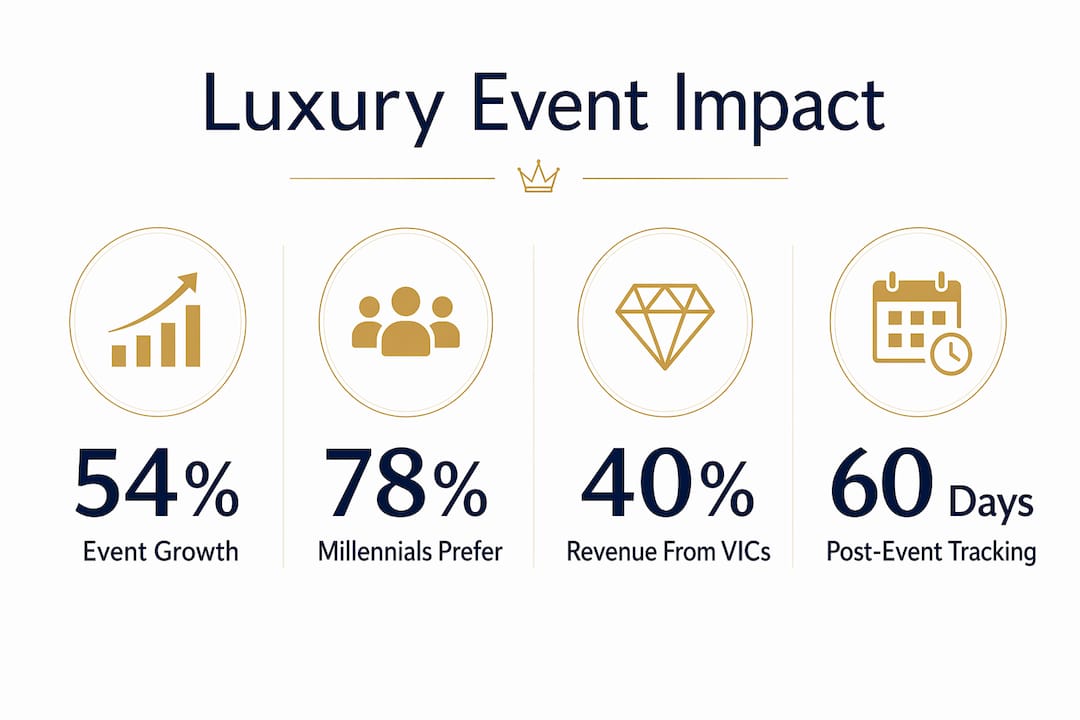
The data is unambiguous. Brand-hosted events grew 54% since 2019, driven by screen fatigue and a consumer appetite for tangible, real-world experiences. That growth is not a post-pandemic rebound. It reflects a structural shift in how luxury brands build relationships.
Generational preference data reinforces this shift. 78% of millennials prefer spending on luxury experiences over material goods. That preference makes experiential marketing not just appealing but necessary for brands targeting younger affluent consumers. Brands that ignore this preference cede ground to those that do not.
Events also function as the connective tissue in multi-channel luxury marketing. A well-designed event generates press coverage, feeds CRM data, creates social content, and drives e-commerce traffic. The event itself is one touchpoint. The ecosystem it activates is the real asset. Understanding the role of marketing in luxury retail means recognizing that events sit at the center of that ecosystem, not at the edge.
| Trend | What it means for brand managers |
|---|---|
| 54% growth in brand events since 2019 | Events are now a core channel, not a supplemental one |
| 78% of millennials prefer experiences over goods | Experiential formats are required to engage the next generation of luxury buyers |
| VICs generate ~40% of revenue | High-touch, exclusive events for top clients deliver outsized returns |
| Events integrate press, CRM, and e-commerce | A single event can activate multiple revenue and relationship channels simultaneously |
The VIC concentration effect deserves particular attention. When fewer than 2% of your clients generate 40% of your revenue, the economics of a private, high-cost event for that group become obvious. The cost per guest is high. The return per guest is higher.
How should luxury brands measure the impact and ROI of events?
Traditional ROI metrics fail in luxury event contexts. Expecting an immediate sales spike after a private dinner or a pop-up activation misreads how luxury purchase decisions actually work. Luxury purchase decisions typically occur privately, days or even weeks after an event, in what researchers call the “invisible decision window.” Measuring event success by same-day sales is like measuring a seed by whether it has grown into a tree by morning.
The correct framework is Return on Experience (ROE). ROE measures trust, preference, emotional attachment, and long-term purchase conviction rather than transactional output. These are the metrics that predict future revenue in luxury, not point-of-sale data.
| Measurement approach | What it captures | Limitation |
|---|---|---|
| Traditional ROI (immediate sales) | Direct revenue from event period | Misses delayed purchase decisions |
| Return on Experience (ROE) | Trust, attachment, and long-term conviction | Requires longer tracking windows |
| CRM engagement post-event | Client behavior after the event | Depends on data quality and follow-up |
| Brand preference surveys | Shift in perception and purchase intent | Self-reported, not behavioral |
Designing for ROE means building experiential ecosystems, not isolated events. Luxury experiential marketing ROI is best understood as psychological infrastructure that sustains ongoing client conviction. The event plants the seed. The follow-up CRM touchpoints, personalized outreach, and digital content water it.
Pro Tip: Track client behavior in the 60 days after an event, not during it. Watch for website visits, wishlist additions, and direct outreach. That window reveals the true conversion story.
What best practices maximize the effectiveness of luxury events?
Effective luxury events require deliberate design at every level. The most successful formats share one quality: they feel like spaces where guests want to be, not stages where brands perform. Events designed as social gathering spaces increase engagement time and build stronger brand affinity than those built around brand messaging alone.
- Design for natural socialization. Arrange the physical space so guests move, mingle, and linger. Long dwell times correlate with stronger emotional connection to the brand.
- Use tiered event formats. Pop-up stores and tiered experiences let brands engage broader audiences without diluting exclusivity for top-tier clients. A public pop-up and a private VIC dinner can coexist within the same campaign.
- Extend the event digitally. Capture content, send personalized follow-ups, and create digital touchpoints that sustain the emotional momentum generated at the event.
- Collect CRM data with care. Events are rich data collection opportunities. Capture preferences, purchase history, and behavioral signals, but do so with discretion. Clients notice when data collection feels intrusive.
- Resist spectacle inflation. Adding more production value does not add more emotional impact. Authenticity and curation matter more than scale.
For brands planning their first high-touch event, the luxury brand event planning guide from Platinum Pianist offers a practical framework for organizers working with high-value clients.
- Prioritize meaningful engagement over visual optics.
- Brief your team on client profiles before the event, not during it.
- Follow up within 48 hours with a personalized, non-sales communication.
How do events engage VICs and younger affluent consumers?
VICs and younger affluent consumers both respond to events, but for different reasons. VICs want recognition and access. Younger consumers want authenticity and participation. Effective luxury sales event strategies address both without conflating them.
For VICs, the event must feel genuinely exclusive. Private viewings, bespoke travel experiences, and direct access to creative directors or brand founders are the formats that resonate. VIC-focused events include exclusive trips, celebrity access, and private product previews that are not available through any other channel. The rarity of the experience is the point.
For millennials and Gen Z, the format shifts. These consumers prioritize participation over observation. Workshops, personalization stations, wellness activations, and pop-up experiences give them a role in the brand story rather than a seat in the audience. The importance of events in luxury for this group lies in the sense of community and belonging they create.
- VIC events: private viewings, exclusive travel, founder access, and bespoke product previews.
- Younger consumer events: workshops, personalization stations, pop-ups, and wellness activations.
- Both groups: community-building formats that create a sense of belonging to something rare.
The overlap between these two groups is growing. Younger VICs, clients under 40 who spend at VIC levels, want both recognition and participation. Brands that design events with both dimensions built in will capture this segment most effectively.
Key Takeaways
Events in luxury sales are long-term relationship investments that build trust, exclusivity, and purchase conviction far more effectively than any digital channel alone.
| Point | Details |
|---|---|
| Events are confidence accelerators | They remove psychological purchase barriers that digital marketing cannot address. |
| VICs drive outsized revenue | Less than 2% of clients generate ~40% of revenue, making exclusive events a high-return investment. |
| ROE replaces traditional ROI | Measure trust, attachment, and long-term conviction, not same-day sales. |
| Tiered formats protect exclusivity | Pop-ups and private events can coexist within one campaign without diluting brand prestige. |
| Millennials demand experience | 78% of millennials prefer luxury experiences over goods, making events a generational necessity. |
Why I think most luxury brands are measuring events all wrong
I have watched brands pour significant budgets into extraordinary events and then declare them failures because the sales report for that week looked flat. That conclusion misreads the entire mechanism. Events in luxury are not closing tools. They are credibility-building moments where guests quietly decide whether a brand deserves a place in their life.
The “invisible decision window” concept changed how I think about event design. A client who attends a Valentino private preview in march may not purchase until june. The event did not fail. The brand simply did not track the right window. Most CRM systems are not set up to connect that june purchase back to the march event, so the event gets no credit.
The brands that get this right treat events as psychological infrastructure. They design follow-up sequences, personalized outreach, and digital content that sustain the emotional momentum generated in the room. The event is the spark. The ecosystem keeps it burning. Brands that resist the pressure to inflate spectacle and instead focus on authentic, curated engagement will build the kind of client relationships that survive market cycles, trend shifts, and digital disruption.
The future of luxury sales belongs to brands that understand trust in luxury shopping as a long-term asset, not a campaign metric.
— Camila
Luxury pieces worth the event-driven wait
The excitement that builds at a private brand event, that moment when a piece stops being a product and becomes a desire, is exactly what great luxury objects sustain long after the event ends.
At Naiseshopper, the Gucci G-Timeless Quartz Black Watch 38mm captures that same energy. It is the kind of piece that earns its place on a wrist through design conviction, not trend chasing. Naiseshopper offers authenticated Gucci, Chanel, Prada, and Balenciaga pieces at genuine discounts, with secure international shipping and personal shopper support. When event-driven desire meets the right product at the right price, the purchase decision makes itself.
FAQ
What is the role of events in luxury sales?
Events build trust, exclusivity, and emotional connection that digital channels cannot replicate. They function as confidence accelerators that reduce purchase hesitation and deepen long-term brand loyalty.
Why do luxury events not always produce immediate sales?
Luxury purchase decisions typically occur in an “invisible decision window” days or weeks after an event. Measuring success by same-day sales misses the delayed conversion that events reliably produce.
What is Return on Experience (ROE) in luxury marketing?
ROE measures trust, emotional attachment, and long-term purchase conviction rather than immediate transactional output. It is the correct framework for evaluating luxury event effectiveness.
How do luxury brands engage VICs through events?
VICs receive bespoke, high-touch experiences such as private viewings, exclusive travel, and direct access to brand founders. These formats reflect the recognition and access that top-spending clients expect.
How should luxury brands design events for millennial consumers?
Millennials respond to participatory formats such as workshops, personalization stations, and pop-up activations. With 78% preferring experiences over goods, immersive and authentic formats are the most effective engagement tools for this group.