TL;DR:
- Luxury marketing focuses on conveying symbolic value, rarity, and aspiration to cultivate desire rather than driving sales through discounts. It deliberately introduces purchase friction, emphasizes brand heritage, and uses cultural storytelling to reinforce exclusivity and emotional distance from competitors. Digital strategies now prioritize curated engagement, AI-assisted clienteling, and content optimized for AI search, with client relationships remaining central to luxury success.
Marketing in luxury retail is defined as the deliberate communication of symbolic value, rarity, and aspiration to cultivate desire rather than simply sell a product. The role of marketing in luxury retail sits at the intersection of cultural storytelling, precision client engagement, and carefully managed exclusivity. Brands like Chanel, Hermès, and Bottega Veneta do not compete on price or convenience. They compete on meaning. Digital influence now affects at least 45% of all luxury sales, which means the stakes for getting your marketing architecture right have never been higher. This guide breaks down the strategies, tools, and principles that separate luxury marketing from everything else.
How does the role of marketing in luxury retail differ from mainstream?
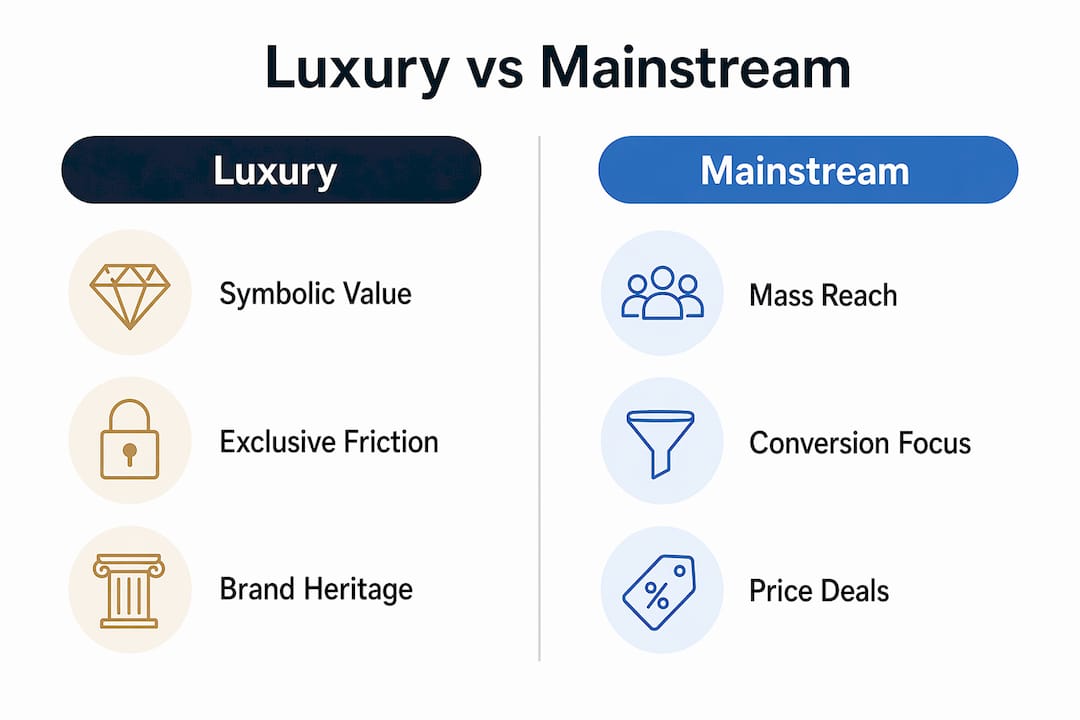
Luxury marketing and mainstream marketing share almost no strategic DNA. Mainstream brands optimize for reach, conversion rate, and frictionless checkout. Luxury brands do the opposite on purpose.
Luxury marketers deliberately introduce friction into the purchase process to reinforce privilege and exclusivity. A waitlist for a Hermès Birkin is not a supply chain failure. It is a marketing instrument. The wait signals that the product is worth waiting for, and that not everyone qualifies. Mass retailers remove every barrier between desire and purchase. Luxury brands build barriers and call them experiences.
The other major distinction is the role of brand heritage. Gucci’s 1921 founding story, Dior’s couture legacy, and Prada’s Milanese craft narrative are not nostalgia. They are active marketing assets that justify premium pricing and create emotional distance from competitors. You can read more about how brand heritage shapes positioning in luxury fashion today.
Here is how the two approaches compare across key dimensions:
| Dimension | Luxury Marketing | Mainstream Marketing |
|---|---|---|
| Core goal | Communicate symbolic value and rarity | Drive volume and conversion |
| Purchase friction | Deliberate, signals exclusivity | Minimized for speed |
| Pricing strategy | Aspirational, never discounted publicly | Competitive, promotional |
| Channel tone | Curated, editorial, restrained | Broad, high-frequency, promotional |
| Customer relationship | Long-term clienteling | Transactional |
| Content focus | Heritage, craft, cultural relevance | Features, benefits, price |
Pro Tip: Never run a luxury campaign with a countdown timer or a “limited time offer” banner. Scarcity in luxury is communicated through access and waitlists, not urgency clocks.
What digital and ai-driven practices are reshaping luxury marketing?
Digital transformation in luxury is not about selling more through more channels. It is about using precision tools to deepen relationships while protecting brand aura. The shift is from mass advertising to curated, multi-channel engagement.

AI enables hyper-personalized experiences in luxury retail by enhancing human-in-the-loop clienteling workflows. A brand advisor at Louis Vuitton or Valentino can now receive AI-generated purchase history summaries, style preference profiles, and event attendance records before a client appointment. The technology does not replace the advisor. It makes the advisor sharper and more attentive.
Social media plays a specific, bounded role in luxury marketing. Only one-third of luxury consumers are interested in completing purchases directly on social platforms. That number tells you exactly what social is for in luxury: education and aspiration, not checkout. Instagram and Pinterest function as curated galleries for Balenciaga and Saint Laurent, not storefronts.
Search visibility is also evolving fast. SEO in luxury retail now focuses on structured, factual content optimized for AI-driven search, a practice called Generative Engine Optimization (GEO). When a high-net-worth consumer asks an AI assistant for the best leather goods brands, you want your brand cited in that answer. Vague aspirational copy does not get cited. Structured, specific content does.
Key digital practices luxury marketers should prioritize in 2026:
- Precision multi-channel engagement: Map each channel to a specific role in the client journey rather than broadcasting the same message everywhere.
- AI-assisted clienteling: Use platforms that surface client insights for brand advisors without automating the relationship itself.
- GEO-optimized content: Publish structured, factual brand and product content that AI search engines can cite accurately.
- Social as editorial: Treat Instagram, Pinterest, and TikTok as brand magazines, not sales channels.
- Private communication channels: Shift high-value client conversations to WeChat mini-programs, WhatsApp, or dedicated CRM messaging tools.
Pro Tip: When briefing your content team, ask one question for every piece of digital content: “Would this appear in an AI-generated answer about our category?” If the answer is no, the content is probably too vague to serve your brand.
How does clienteling drive luxury sales and engagement?
Clienteling is the practice of building long-term, personalized relationships between brand advisors and individual clients, and it is the highest-leverage marketing activity in luxury retail. It is not a sales tactic. It is a relationship architecture.
80% of luxury consumers prioritize building direct relationships with in-store brand advisors to access exclusive events and previews. That figure reflects a fundamental truth about luxury buyers: they want to feel known, not targeted. A Chanel client who receives a personal invitation to a private runway preview is not being marketed to in any traditional sense. She is being recognized.
Effective clienteling in practice follows a clear sequence:
- Build the client profile. Capture purchase history, style preferences, life events, and communication preferences. Platforms like Salesforce Luxury Cloud or Tulip Retail help advisors manage this data without making the interaction feel transactional.
- Personalize every touchpoint. Send handwritten notes for significant purchases. Reference past conversations in follow-up calls. Acknowledge birthdays and anniversaries with exclusive access, not discount codes.
- Create privileged access moments. Invite top clients to product previews, private shopping hours, or brand events before the general public. Exclusive drops and waitlists reward engagement while preserving scarcity.
- Shift to private channels. Move high-value client communication away from mass email campaigns and toward direct messaging via WeChat, WhatsApp, or in-app CRM tools. This mirrors how luxury brands in China have built loyalty through WeChat mini-programs.
- Measure relationship depth, not just revenue. Track client tenure, event attendance, and referral behavior alongside purchase frequency. These metrics reveal loyalty that last-click attribution will never capture.
The shift from public ads to private messaging preserves luxury’s aura and deepens customer loyalty through exclusive benefits. For luxury watch collectors, personalized upselling through clienteling also creates natural opportunities to introduce complementary services. You can explore how personalized upselling works in the luxury watch category for a practical parallel.
How do you balance exclusivity with digital marketing reach?
The central tension in luxury digital marketing is this: broader reach risks diluting the brand, but invisible brands do not grow. The answer is channel governance, not channel avoidance.
Luxury brands prioritize channel governance with flagship sites as brand temples, social media as curated galleries, and CRM as private salons. Each channel has a distinct voice, a distinct audience segment, and a distinct purpose. The flagship website for Prada or Valentino is not an e-commerce site with a nice logo. It is the definitive brand statement, where every image, word, and interaction reflects the brand’s full creative vision.
The luxury market is moving from indulgence to discernment, requiring brands to stop relying on hype and focus on cultural relevance to create lasting brand mythology. This means sponsoring art exhibitions, partnering with architects, commissioning original music, and aligning with sports like Formula 1 or polo. These cultural connections build brand mythology that no paid media campaign can replicate.
Here is a practical channel governance model for luxury marketers:
| Channel | Primary Role | Tone | What to Avoid |
|---|---|---|---|
| Flagship website | Brand temple and conversion | Editorial, authoritative | Discount banners, pop-ups |
| Instagram/Pinterest | Curated gallery | Visual, restrained | High-frequency posting, memes |
| CRM and email | Private salon | Personal, exclusive | Mass promotional blasts |
| WeChat/WhatsApp | Client intimacy | Conversational, direct | Automated chatbot replies |
| Paid search | Precision acquisition | Factual, brand-safe | Broad match, generic keywords |
Over-targeting in paid digital is one of the most common mistakes luxury brands make. Running retargeting ads that follow a Gucci prospect across every website they visit signals desperation, not desirability. Frequency caps, premium publisher placements, and contextual targeting protect brand perception far better than performance-maximized campaigns. You can also explore how promotions affect luxury brand perception to understand where the line sits between smart incentives and brand erosion.
Pro Tip: Replace last-click attribution with a multi-touch model that credits brand-building touchpoints like editorial coverage, event attendance, and organic search. Last-click attribution systematically undervalues the channels that do the heaviest lifting in luxury.
Key takeaways
Luxury marketing succeeds when it communicates symbolic value through controlled exclusivity, precision clienteling, and cultural relevance rather than mass reach or promotional tactics.
| Point | Details |
|---|---|
| Friction is a feature | Deliberate purchase barriers like waitlists signal exclusivity and reinforce brand desirability. |
| Digital reach requires governance | Assign each channel a distinct role: flagship site as brand temple, social as gallery, CRM as private salon. |
| Clienteling outperforms advertising | 80% of luxury consumers prioritize direct advisor relationships over mass marketing touchpoints. |
| AI enhances, not replaces, human service | Use AI to sharpen advisor intelligence while keeping the client relationship personal and human. |
| Cultural relevance builds mythology | Partnerships with arts, sports, and local events create brand stories that paid media cannot manufacture. |
Why luxury marketers need to stop chasing digital metrics
I have watched luxury brands pour budget into performance marketing dashboards that look impressive and deliver almost nothing of lasting value. The click-through rate on a Bottega Veneta retargeting ad tells you almost nothing about whether that brand is building the kind of desire that drives a $4,000 purchase six months later.
The brands getting this right in 2026 are the ones treating AI as a tool for their advisors, not a replacement for them. When a brand advisor walks into a client appointment knowing that client’s last three purchases, their upcoming anniversary, and their preference for structured silhouettes over fluid ones, that is luxury service. AI made it possible. The human made it meaningful.
What I find most underrated in luxury marketing right now is the cultural investment angle. A Dior exhibition at a major museum or a Valentino partnership with a contemporary artist generates press, social content, and brand mythology simultaneously. It reaches the right audience without broadcasting to everyone. That is the art of desire in practice.
My caution to any luxury marketing team: do not let your digital agency convince you that more data means better decisions. The most important signals in luxury, such as client tenure, referral behavior, and event attendance, rarely show up in a standard analytics dashboard. Build measurement models that capture relationship depth, not just revenue events. The brands that figure this out will own the next decade of luxury growth.
— Camila
Discover luxury footwear that embodies marketing excellence
The principles behind great luxury marketing come to life in the products themselves. Naiseshopper curates authenticated pieces from the world’s most coveted houses, and each one tells a story of craft, exclusivity, and considered design.
The Dior Black Leather Oxfords and Derby are a masterclass in understated authority, exactly the kind of product that rewards a clienteling conversation rather than a flash sale. For those who favor bold silhouettes, the Alexander McQueen Chic Gray Leather Boots deliver the dramatic proportions and precision construction that define the house’s identity. Naiseshopper guarantees authenticity on every piece, with global shipping and personal shopper support for clients who want the full luxury experience at an accessible price point.
FAQ
What is the core role of marketing in luxury retail?
Marketing in luxury retail communicates symbolic value, rarity, and aspiration rather than product utility or price. Its primary function is to build and sustain desire through controlled exclusivity and high-touch client experiences.
How does digital marketing affect luxury sales?
Digital influence affects at least 45% of luxury sales, making precision multi-channel engagement a critical strategy. The impact is strongest when digital channels reinforce brand aura rather than drive direct transactional conversions.
Why is clienteling more effective than advertising for luxury brands?
Clienteling builds the direct, personalized relationships that 80% of luxury consumers actively seek with brand advisors. Advertising reaches audiences; clienteling retains and deepens loyalty with the clients who drive the most revenue.
Should luxury brands sell directly on social media?
Social commerce is not the primary role for luxury brands on social platforms. Only one-third of luxury consumers want to complete purchases on social, so the channel performs best as an editorial and aspirational space rather than a checkout funnel.
What is generative engine optimization in luxury marketing?
Generative Engine Optimization (GEO) is the practice of structuring brand content so AI-powered search engines cite it in purchasing recommendations. GEO is now critical for luxury brands that want visibility when affluent consumers use AI assistants to research high-end purchases.