TL;DR:
- Luxury demand cycles involve recurring expansion and contraction in high-end spending driven by economic shifts and changing consumer values. Understanding these cycles enables brand leaders to time production and inventory strategies effectively, especially given the faster recovery and amplified swings compared to the broader economy. Consumer preferences are shifting towards authentic connections and experiences, influencing demand patterns across different market segments and product categories.
Luxury demand cycles are defined as recurring patterns of expansion and contraction in high-end consumer spending, driven by income elasticity, macroeconomic shifts, and evolving consumer values. Understanding luxury demand cycles is the single most important analytical skill for brand executives and market analysts who need to time purchasing decisions and protect inventory margins. The global personal luxury goods market is stabilizing at 2%–5% growth in 2026, according to projections from Bain & Company and Morgan Stanley. That narrow range signals a market in transition, not collapse. The executives who read these cycles correctly will outperform those who rely on lagging financial reports alone.
What makes luxury demand cycles unique?
Luxury demand cycles behave differently from general consumer markets. The core reason is income elasticity greater than one, meaning luxury spending rises and falls faster than income itself. Luxury goods carry a beta of approximately 3.2 relative to overall consumption. That number means luxury demand amplifies economic swings in both directions.

The recovery speed is equally striking. During the 2008 financial crisis, the luxury equity index recovered in 14 months. The S&P 500 took 49 months. That gap reflects the concentrated wealth base that supports luxury spending. When high-net-worth consumers regain confidence, they return to luxury purchases faster than the broader population returns to discretionary spending.
| Metric | Luxury Market | General Economy |
|---|---|---|
| Income elasticity | Greater than 1.0 | Approximately 1.0 |
| Beta vs. consumption | ~3.2 | 1.0 |
| Post-2008 recovery time | 14 months | 49 months |
| Pricing strategy in downturns | Production cuts | Price discounts |
The cycle amplitude also differs by category. Hard luxury goods like Rolex watches and Cartier jewelry tend to hold value and recover faster than soft luxury apparel. Geography matters too. China, Japan, and the Middle East are driving sizable upside in 2026, while European and North American markets show more moderate momentum.
Pro Tip: Track the luxury equity index alongside your brand’s sell-through data. When the index diverges from your internal numbers, you are likely seeing a segment-specific signal that broad market data will miss.
How does consumer behavior shape luxury demand in 2026?
The behavioral drivers of luxury demand cycles have shifted decisively. Consumers are no longer buying Gucci or Prada primarily to signal status. Over 51% of affluent luxury consumers now prioritize genuine connection and friendship over status display. That shift changes when and why purchases happen, which directly affects demand timing.
This is what analysts at Prophet call the “reassurance era.” Consumers in this era value brands that solve real problems, offer wellness-oriented services, and prove relevance through convenience. Heritage alone no longer drives purchase decisions. Brands like Bottega Veneta and Saint Laurent that have built emotional resonance through craft and community are better positioned than those relying on logo visibility.
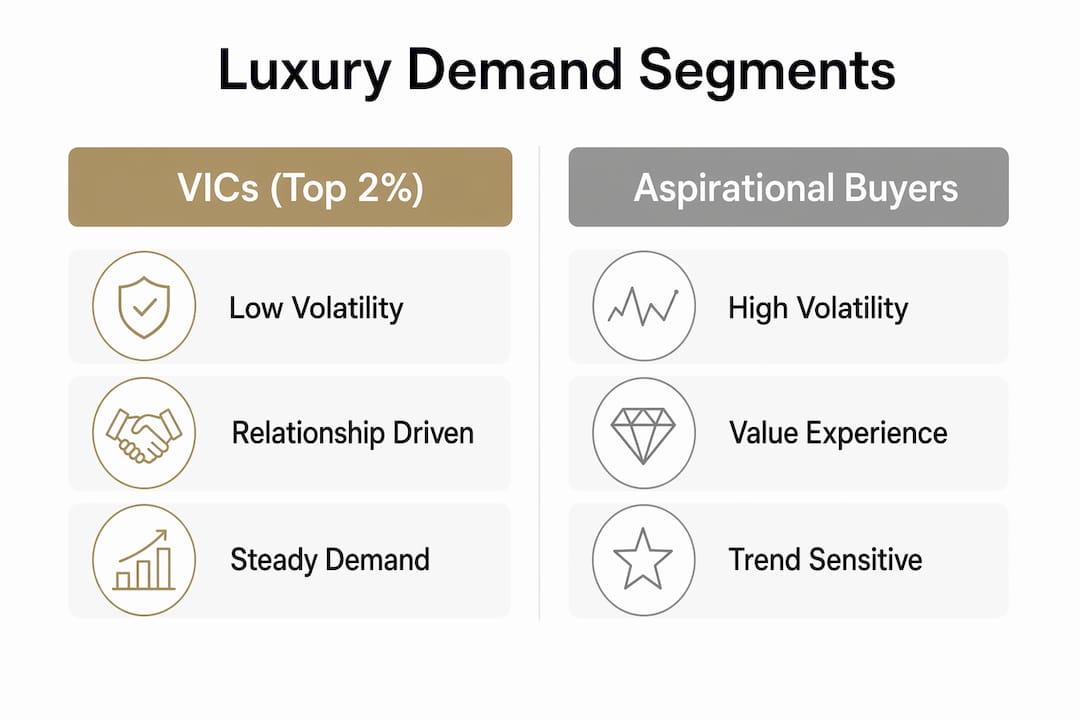
Segmentation is where the real analytical work happens. The luxury market is experiencing a K-shaped recovery. VIC clients and aspirational consumers are moving in opposite directions. Very Important Clients, the top 2% of spenders, remain resilient. Aspirational middle-market consumers face inflation pressure and are pulling back.
| Consumer Segment | Demand Volatility | Primary Spending Driver |
|---|---|---|
| VICs (top 2%) | Low | Relationship, exclusivity, craft |
| Aspirational buyers | High | Status, trend, perceived value |
| Younger HNW consumers | Medium | Experiences, wellness, self-expression |
| Entry-level luxury | Very high | Accessibility, brand recognition |
Younger high-net-worth consumers are also shifting toward transformational experiences like travel, wellness, and cultural events. HSBC analyst Erwan Rambourg has flagged this as a broken value proposition for goods-heavy luxury brands. Understanding these luxury shopper profiles is no longer optional for accurate demand forecasting.
Pro Tip: Build separate demand models for VICs and aspirational buyers. Blending them into a single forecast will consistently underestimate resilience at the top and underestimate volatility at the entry level.
How do luxury demand cycles affect inventory strategy?
Operational discipline is the direct application of cycle intelligence. Luxury brands that expanded production aggressively during 2021 and 2022 now carry excess inventory that erodes brand equity and pricing power. That overexpansion is a textbook cycle management failure. The lesson is clear: production decisions made at the peak of a cycle create the biggest problems at the trough.
The correct response to a downturn is not discounting. Luxury brands reduce production rather than cut prices during contractions. This protects scarcity, maintains perceived value, and preserves pricing power for the recovery phase. Mass-market retailers do the opposite. That strategic difference is what allows luxury brands to recover faster and at higher margins.
Here are the best practices for aligning inventory and purchasing with demand cycle intelligence:
- Set production ceilings before the cycle peaks. Use sell-through velocity and waiting-list data to identify when demand is outpacing sustainable supply.
- Protect hero SKUs. Iconic products like the Chanel Classic Flap or Balenciaga Triple S carry disproportionate brand equity. Never discount these, even under inventory pressure.
- Segment inventory by customer type. VIC-targeted products require different replenishment logic than aspirational entry-level items.
- Build in a contraction buffer. Maintain 15%–20% production flexibility to reduce output quickly when leading indicators turn negative.
- Avoid promotional pricing as a clearance tool. Use private client sales or exclusive access events instead. These protect public price integrity while moving inventory.
Understanding why luxury discounts matter requires nuance. Discounting at the wrong point in the cycle destroys the brand equity that drives recovery. Timing and channel selection are everything.
Pro Tip: Monitor your wholesale partners’ sell-through rates weekly, not monthly. A two-week lag in detecting a slowdown at wholesale can translate to six weeks of excess production you cannot unwind.
What are the best tools for forecasting luxury demand?
Demand forecasting in luxury requires leading indicators, not lagging ones. Financial reports confirm what already happened. Sophisticated analysts use real-time signals like sell-through rates at wholesale, waiting-list dynamics at flagship stores, and staff turnover at key retail locations. These metrics reveal revenue weakness before it shows up in earnings.
The most useful leading indicators for luxury demand forecasting include:
- Wholesale sell-through rates: Track weekly. A drop below 65% at key wholesale partners signals demand softening 6–8 weeks ahead of reported revenue.
- Flagship store waiting lists: Length and conversion rate on iconic SKUs. Shortening wait times at Chanel or Hermès boutiques signal demand normalization or contraction.
- Staff turnover at flagship locations: High churn at top-performing stores often precedes client experience degradation and reduced repeat purchase rates.
- Search volume trends: Google Trends data for brand and product names provides a real-time proxy for aspirational consumer interest.
- Resale market pricing: Secondary market prices for Rolex, Chanel, and Louis Vuitton reflect true demand sentiment faster than primary retail data.
AI and data analytics are changing how brands model these indicators. Platforms that integrate point-of-sale data, CRM signals, and social listening can now generate demand forecasts at the SKU level. The brands using these tools most effectively are those that have already segmented their client data by VIC status, purchase frequency, and category preference.
Experience-heavy luxury categories like wellness and travel are outperforming asset-heavy goods categories in 2026. Analysts tracking only hard goods data are missing a structural shift in where luxury spending is going. Incorporate hospitality and experiential spend data into your broader demand model for a complete picture.
Understanding fashion seasonality in luxury also sharpens forecast accuracy. Seasonal peaks in Q4 and pre-summer collections create predictable demand windows that smart buyers can plan around.
Key takeaways
Luxury demand cycles reward analysts and executives who act on leading indicators and protect brand equity through every phase of the cycle.
| Point | Details |
|---|---|
| Luxury cycles amplify economic swings | A beta of ~3.2 means luxury demand falls faster and recovers faster than broader markets. |
| VICs anchor revenue stability | The top 2% of clients drive nearly 50% of spend and remain resilient during downturns. |
| Production cuts beat price cuts | Reducing supply during contractions protects scarcity and preserves long-term pricing power. |
| Leading indicators beat earnings reports | Sell-through rates and waiting-list data reveal demand shifts weeks before financial reports confirm them. |
| Consumer values have shifted | Over 51% of affluent buyers now prioritize connection over status, changing purchase timing and motivation. |
The cycle intelligence most brands are still missing
By Camila
After years of watching luxury brands navigate boom and bust cycles, the pattern I see most often is this: executives trust their financial reports too much and their client data too little. The brands that consistently outperform across cycles are not the ones with the best products. They are the ones with the best relationships with their top 200 clients.
Top VIC clients contribute nearly 50% of luxury industry spend. That concentration means your demand forecast is really a relationship forecast. If your top clients are increasing purchase frequency, you are entering an expansion phase regardless of what the macro data says. If they are slowing down, no amount of aspirational marketing will compensate.
The other thing I would push back on is the obsession with AI forecasting tools as a silver bullet. The technology is genuinely useful, but only when the underlying client data is clean, segmented, and current. I have seen brands invest heavily in forecasting platforms while their CRM data was two years out of date. The output was sophisticated-looking noise.
The most underrated forecasting tool is still a well-trained sales associate at a flagship store. They know before anyone else when clients are browsing without buying, when waiting lists are shortening, and when the energy in the store has changed. Build systems that capture and escalate those signals. Pair them with your analytics platforms. That combination beats either approach alone.
— Camila
Shop luxury with confidence at Naiseshopper
Knowing where the luxury market stands in its cycle changes how you shop. Right now, the market is in a stabilization phase, which creates real opportunity for buyers who move with precision rather than impulse.
Naiseshopper curates authenticated pieces from Gucci, Chanel, Prada, Valentino, Bottega Veneta, Saint Laurent, and Balenciaga at prices that reflect genuine value. If you are looking for a polished, investment-worthy piece right now, the Emporio Armani With Heel Black is a strong example of the kind of refined, cycle-resilient style that holds its appeal across seasons. Naiseshopper offers secure international shipping, flexible payment options, and authenticity guarantees on every order.
FAQ
What are luxury demand cycles?
Luxury demand cycles are recurring patterns of growth and contraction in high-end consumer spending, driven by income elasticity, macroeconomic conditions, and shifts in consumer values. They move faster and with greater amplitude than general consumer market cycles.
Why do luxury brands cut production instead of prices?
Luxury brands reduce production during downturns to protect scarcity and brand equity, which preserves pricing power for the recovery phase. Discounting destroys the perceived exclusivity that justifies premium pricing long-term.
How do vics affect luxury demand forecasting?
The top 2% of VIC clients account for nearly 50% of luxury industry spend and show far lower demand volatility than aspirational buyers. Tracking VIC purchase frequency provides a more reliable leading indicator than broad market data.
What leading indicators should analysts monitor?
Wholesale sell-through rates, flagship store waiting-list dynamics, and staff turnover at key retail locations are the most reliable early signals of luxury demand shifts, often revealing trends weeks before earnings reports.
How is consumer behavior changing luxury demand in 2026?
Over 51% of affluent luxury consumers now prioritize genuine connection over status, shifting demand toward high-touch service and experiential categories like wellness and travel rather than traditional goods-based luxury.