TL;DR:
- Online personal shopping combines expert stylists and AI tools to provide tailored product recommendations. AI services excel at speed and deal hunting, while human stylists offer authenticity verification and personalized advice for luxury items. Combining both approaches maximizes shopping efficiency, confidence, and access to exclusive inventory.
Online personal shopping is a service where expert human stylists or AI-powered tools help you find, select, and purchase products tailored to your specific style, budget, and needs. Known in the industry as virtual personal shopping, this service has moved well beyond department store concierges. Platforms like Stitch Fix, Amazon Personal Shopper, and ChatGPT integrations now bring personalized style guidance directly to your screen. Whether you are refreshing your wardrobe or sourcing a rare Chanel bag, the right personal shopper online makes the process faster, smarter, and far more satisfying.
What is personal shopping online and how does it work?
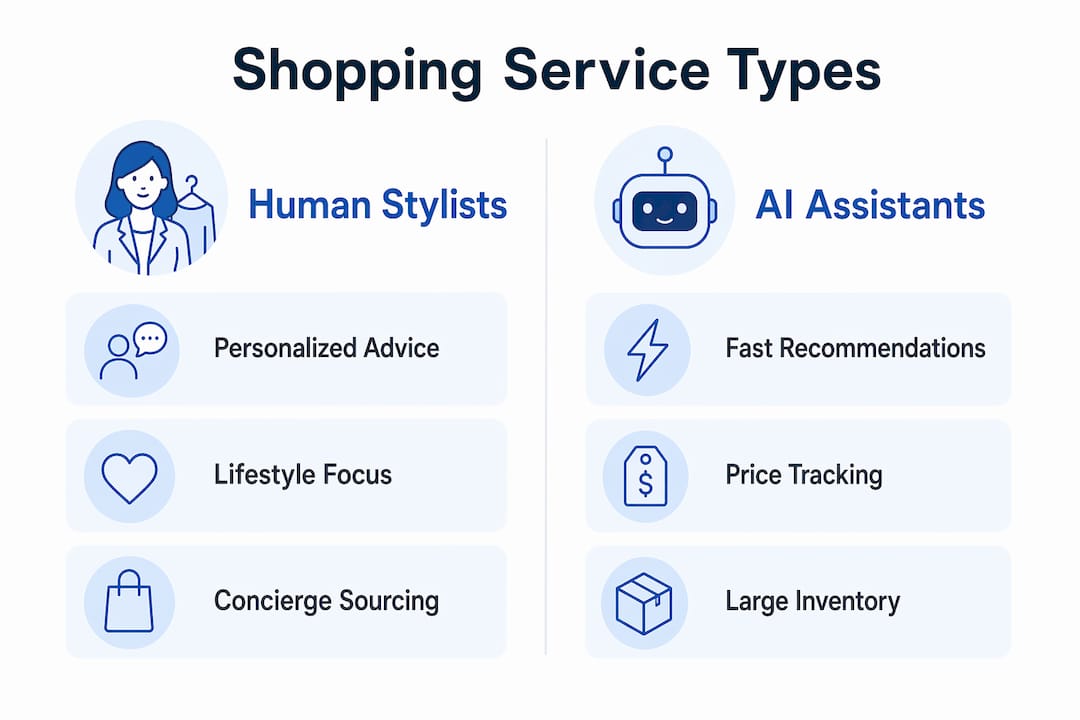
Personal shopping online is defined as a curated buying experience delivered remotely through either a live human stylist or an automated AI assistant. The two primary models are human-led video or chat consultations lasting 30–60 minutes and AI-driven services that scan thousands of products in seconds for personalized picks.
Human stylists bring taste, context, and conversation to the process. They ask about your lifestyle, your existing wardrobe, and the occasions you dress for before making a single recommendation. AI tools, by contrast, work at machine speed. They cross-reference your stated preferences with live inventory, price data, and trend signals to surface options you might never find on your own.

The industry term “virtual personal shopping” covers both models. You will see it used by retailers from Nordstrom to Net-a-Porter, and it applies equally to a Gucci concierge call and a ChatGPT prompt asking for outfit ideas under $200.
What are the main types of online personal shopping services?
The personal shopping services market splits cleanly into two categories, each with distinct strengths.
Human-led personal shopping services include:
- One-on-one video or chat consultations with a certified stylist
- Curated lookbooks or product edits sent after the session
- Wardrobe audits conducted via video walkthrough
- Luxury concierge sourcing for rare or unlisted inventory
AI-powered shopping assistants include:
- Instant product searches across thousands of SKUs
- Price alert features that notify you when an item hits a target discount, such as “buy when 30% off”
- Recurring purchase automation for everyday essentials
- Instant Checkout partnerships that reduce friction at the point of sale
The growth numbers favor AI. AI-powered assistants are expanding at a 32.9% compound annual growth rate. That pace reflects genuine consumer demand for faster, more personalized discovery. Still, speed is not everything. AI tools excel at rapid price comparisons and deal hunting but lack physical product verification, so consumers should stay cautious with high-value purchases.
Pro Tip: If you are buying everyday apparel or hunting deals, start with an AI assistant like ChatGPT or a platform like Amazon Personal Shopper. If you are investing in a designer piece from Prada, Bottega Veneta, or Saint Laurent, book a human stylist who can verify authenticity and fit context.
How does the online personal shopping process work?
The typical personal shopping experience follows four clear steps, whether you are using a human stylist or an AI tool.
- Style and needs questionnaire. You share your size, budget, preferred brands, lifestyle, and any specific occasions you are shopping for. Human services often follow up with a wardrobe review via video call.
- Curated selection or live appointment. A stylist builds a personalized edit, or an AI generates a shortlist. Services like Amazon Personal Shopper send up to 8 items for a one-week try-on period, charging you only for what you keep.
- Item approval. You review the selections, flag favorites, and request swaps. Human stylists adjust in real time. AI tools refine based on your feedback signals.
- Transaction and delivery. You confirm your choices, complete payment, and receive your items. Many services include return labels and virtual wardrobe management tools to track what you own.
The table below shows how the process differs between human-led and AI-driven services.
| Step | Human-Led Service | AI-Driven Service |
|---|---|---|
| Initial input | 30–60 min video or chat consultation | Style quiz or text prompt |
| Curation method | Stylist judgment and taste | Machine learning and inventory scan |
| Try-on policy | Varies by retailer, often 7–14 days | Amazon offers 7-day home try-on |
| Feedback loop | Real-time conversation | Preference data and ratings |
| Best for | Luxury, occasion dressing, wardrobe builds | Everyday items, deal hunting, speed |
For luxury shoppers, the luxury personal shopping workflow adds one more layer: concierge sourcing. A stylist contacts private channels and brand contacts to locate pieces that never appear on public e-commerce sites.
What are the benefits of online personal shopping?
The benefits of online personal shopping go well beyond convenience, especially for consumers investing in designer goods.
- Time savings. A skilled stylist or AI tool eliminates hours of scrolling. You receive a focused edit instead of a 500-item search results page.
- Intentional buying. Personal stylists prevent closet bloat by steering you toward pieces that integrate with what you already own, not just what looks good in isolation.
- Higher purchase confidence. Appointment-based virtual shopping drives average order values three times higher than casual browsing. That figure reflects focused, expert-guided decisions rather than impulse clicks.
- Access to exclusive inventory. Luxury personal shoppers source unlisted, rare items through private channels unavailable on any public site. This matters enormously when you are looking for a limited-edition Balenciaga piece or a vintage Chanel bag.
- Budget discipline. AI tools set price alerts and track deals across retailers, so you never overpay for a piece you could have bought at a better price last week.
The top benefits of luxury shopping online compound when you combine both service types. Use AI for research and price tracking, then bring a human stylist in to finalize a significant purchase.
Personal shopping is also no longer reserved for the ultra-wealthy. Everyday consumers now use these services for event preparation, seasonal wardrobe refreshes, and gift buying. The democratization is real and accelerating.
Pro Tip: Luxury shoppers should ask their personal shopper directly whether they have access to private or unlisted inventory. Many concierge services maintain relationships with brand boutiques and can source pieces months before they appear publicly, or locate sold-out styles entirely.
Personal shopping tips to get the most from every session
Getting strong results from any personal shopping service comes down to how well you communicate your needs upfront.
- Be specific about budget and non-negotiables. Tell your stylist or AI tool your exact price ceiling and any brands or styles you want to avoid. Vague inputs produce vague outputs.
- Role-play with AI for better results. Directing ChatGPT to act as a specific type of stylist, such as “a minimalist Parisian stylist” or “a streetwear buyer for a 30-year-old professional,” produces sharper, more relevant recommendations than a generic prompt.
- Verify AI suggestions independently. Always check AI-generated prices against the official retailer site before purchasing. AI tools occasionally surface outdated pricing or discontinued products.
- Use video consultations to build rapport. Human stylists perform better when they can see your existing wardrobe, your coloring, and how you carry yourself. A 10-minute video walkthrough at the start of a session saves multiple back-and-forth exchanges later.
- Ask about return policies before you commit. The best personal shopping services offer generous return windows. Knowing your options upfront removes the risk from trying something outside your comfort zone.
For a deeper look at buying designer brands safely online, the process of authentication and return protection matters as much as the style advice itself.
Key takeaways
Online personal shopping delivers the most value when you match the service type to your specific need: AI for speed and deals, human stylists for luxury and intentional wardrobe building.
| Point | Details |
|---|---|
| Two core service types | Human stylists offer nuanced guidance; AI tools deliver speed and price tracking. |
| Four-step process | Questionnaire, curated selection, item approval, and transaction with try-on options. |
| Luxury access advantage | Personal shoppers source unlisted inventory unavailable on any public e-commerce site. |
| AI requires verification | Always confirm AI-suggested prices and product details on the official retailer site. |
| Accessible to all budgets | Personal shopping services now serve everyday consumers, not just affluent clients. |
Why i think most people are using personal shopping wrong
I have watched the personal shopping category grow from a white-glove boutique service into a mainstream digital tool, and the biggest mistake I see is treating AI and human stylists as interchangeable. They are not.
AI tools like ChatGPT are extraordinary for research. They will find you the best price on a Gucci watch, alert you when a Valentino blazer drops to your target price, and generate 20 outfit ideas in 30 seconds. What they cannot do is look at your wardrobe and tell you that you already own three navy blazers and do not need a fourth, no matter how good the deal is. That judgment requires a human.
The future of this category is not AI replacing stylists. It is consumers learning to use both tools in sequence. Run your research and price tracking through AI. Then bring a human stylist in for the final decision on any purchase above a few hundred dollars. That combination produces the best outcomes I have seen, both in terms of style and financial discipline.
I also think the luxury sector is underusing personal shopping for what it does best: access. Most consumers do not realize that a good luxury personal shopper can locate pieces that are genuinely not available anywhere online. If you are serious about building a designer wardrobe, that private channel access is worth more than any discount code.
The role of personal shoppers in luxury fashion is shifting from optional perk to genuine competitive advantage for discerning buyers. The shoppers who figure that out early will build better wardrobes and spend less doing it.
— Camila
Discover luxury personal shopping at Naiseshopper
Naiseshopper brings the personal shopping experience directly to luxury consumers worldwide, with authenticated pieces from Gucci, Chanel, Prada, and more at prices that make designer fashion genuinely accessible.
One standout example of what a personal shopper can source for you: the Gucci G-Timeless Quartz Black Watch 38mm, a refined timepiece that pairs effortlessly with both tailored and casual looks. Naiseshopper guarantees authenticity on every piece, ships internationally with full insurance, and offers flexible payment options. If you are ready to shop with intention and confidence, Naiseshopper is where that experience starts.
FAQ
What does a personal shopper online actually do?
A personal shopper online curates product selections based on your style preferences, budget, and needs through either a live consultation or an AI-powered tool. Services range from wardrobe audits and styled lookbooks to sourcing rare luxury items through private channels.
Is online personal shopping worth it for luxury goods?
Personal shopping is especially valuable for luxury purchases because stylists access unlisted inventory unavailable on public sites and provide authentication guidance. The focused, expert-led process also drives significantly higher purchase confidence compared to solo browsing.
What are the best online personal shopping sites in 2026?
Stitch Fix and Amazon Personal Shopper are the leading mass-market options, while luxury-focused platforms like Naiseshopper offer curated designer inventory with personal shopper assistance for high-end purchases.
How much does an online personal shopping service cost?
Costs vary widely. AI tools like ChatGPT are free or low-cost, Amazon Personal Shopper charges a small monthly styling fee, and luxury concierge services may charge hourly rates or work on commission from the sale.
Can i use AI as my personal shopper for luxury fashion?
AI tools work well for research, price tracking, and initial discovery, but verifying AI-generated product details against official retailer sites is critical before any luxury purchase. For final decisions on high-value designer pieces, a human stylist adds judgment that AI cannot replicate.