Pack smarter and arrive looking polished with a single, portable styling system: a 7–9 piece capsule wardrobe, a short essentials checklist, and three non-negotiable packing rules. The system works because every item earns its place twice, once as a functional necessity and once as a style asset. Here is your starting checklist:
- Clothing: 2 bottoms, 5 tops, 1 dress or versatile layer, max 2–3 pairs of shoes
- Tech: phone charger, portable power bank, earbuds, laptop or tablet
- Toiletries: all liquids in containers of the legally allowed maximum size, packed in a single resealable bag per TSA rules
- Documents & valuables: passport, ID, boarding passes, travel insurance cards
- Medications: prescriptions in original packaging, kept in your carry-on, never checked
Three quick rules tie it together: wear your bulkiest items on travel day, choose fabrics that resist wrinkles and work across climates, and use compression packing cubes to reclaim space. Naiseshopper’s travel packing guide for designer fashion expands on each of these for luxury pieces specifically.
Key Takeaways
A carry-on styling system works when every item serves both a functional and a style purpose, and the 2–5–1 capsule wardrobe is the most reliable way to achieve that.
| Point | Details |
|---|---|
| Use the 2–5–1 capsule method | 2 bottoms and 5 tops produce multiple base outfits; accessories push the count higher. |
| Roll casual items, fold structured ones | Rolling reduces creasing for knits and tees; blazers and silk pieces fold inside-out along seams. |
| Follow TSA’s 3-1-1 liquids rule | All liquids must be in containers of 3.4 oz or less, packed in one 1-quart resealable bag. |
| Protect luxury pieces with tissue and dust bags | Wrap hardware in soft cloth and use acid-free tissue between silk or satin layers to prevent damage. |
| Naiseshopper for travel-ready designer pieces | Authenticated designer accessories with personal shopper support and shipping insurance for carry-on travelers. |
Table of Contents
- What should you pack in a carry-on? A prioritized checklist
- How do you build a capsule wardrobe for carry-on travel?
- What packing techniques actually save space in a carry-on?
- Which organizers keep your carry-on stylish and accessible?
- In-flight comfort items that help you arrive looking fresh
- What are the TSA rules you need to know before you pack?
- How do you pack and protect designer pieces in a carry-on?
- What is the right order to pack a carry-on?
- How do accessories multiply your outfit options?
- My honest take on carry-on-only travel
- Authenticated designer accessories for your next trip
- Sources
What should you pack in a carry-on? A prioritized checklist
Start with what you cannot replace or buy easily at your destination, then build outward.
Clothing
- 2 versatile bottoms (dark jeans or tailored trousers + one casual option)
- 5 tops that mix across both bottoms (3 casual, 1 polished, 1 layer)
- 1 dress or jumpsuit that covers both casual and evening occasions
- 1 lightweight jacket or blazer (doubles as a blanket on the plane)
- Underwear and socks for each day, plus one extra pair
- Sleepwear that doubles as loungewear
Tech
- Portable power bank (carry-on only; lithium batteries are not permitted in checked bags)
- Phone and laptop chargers, plus a universal adapter if traveling internationally
- Earbuds or noise-canceling headphones
- Laptop or tablet in an accessible sleeve for fast security screening
Toiletries Every liquid, gel, or cream must be in a container of 3.4 ounces (100 ml) or less, and all containers must fit inside one 1-quart transparent, resealable bag. Place that bag at the top of your carry-on or in an exterior pocket so you can pull it out at the security checkpoint without unpacking everything else. Travel-size fragrances count as liquids too; a travel-size perfume is the cleanest way to bring your signature scent without burning your liquid allowance.
Documents and valuables
- Passport and government-issued ID
- Printed or downloaded boarding passes
- Travel insurance and health insurance cards
- Credit cards and a small amount of local cash
- Keep these in a dedicated pouch at the top of your bag or in your personal item
Medications Keep all prescription medications in your carry-on, ideally in their original labeled packaging. The TSA does not require prescriptions to be in original bottles, but customs officers at international destinations sometimes do. Pack a small pill organizer for daily vitamins if space is tight, and bring more than you need for the trip length in case of delays.
Pro Tip: Pack for hypothetical scenarios and you will overpack every time. If you can buy it at a pharmacy or corner store at your destination, leave it at home.
How do you build a capsule wardrobe for carry-on travel?
A disciplined color palette is the single most powerful tool for carry-on-only travel. Choose two or three neutrals (black, navy, camel, or white) and one accent color, and every piece you pack will pair with every other. A capsule wardrobe built around this palette can generate a week’s worth of distinct outfits from far fewer pieces, according to packing research from Quartz.
The 2–5–1 method
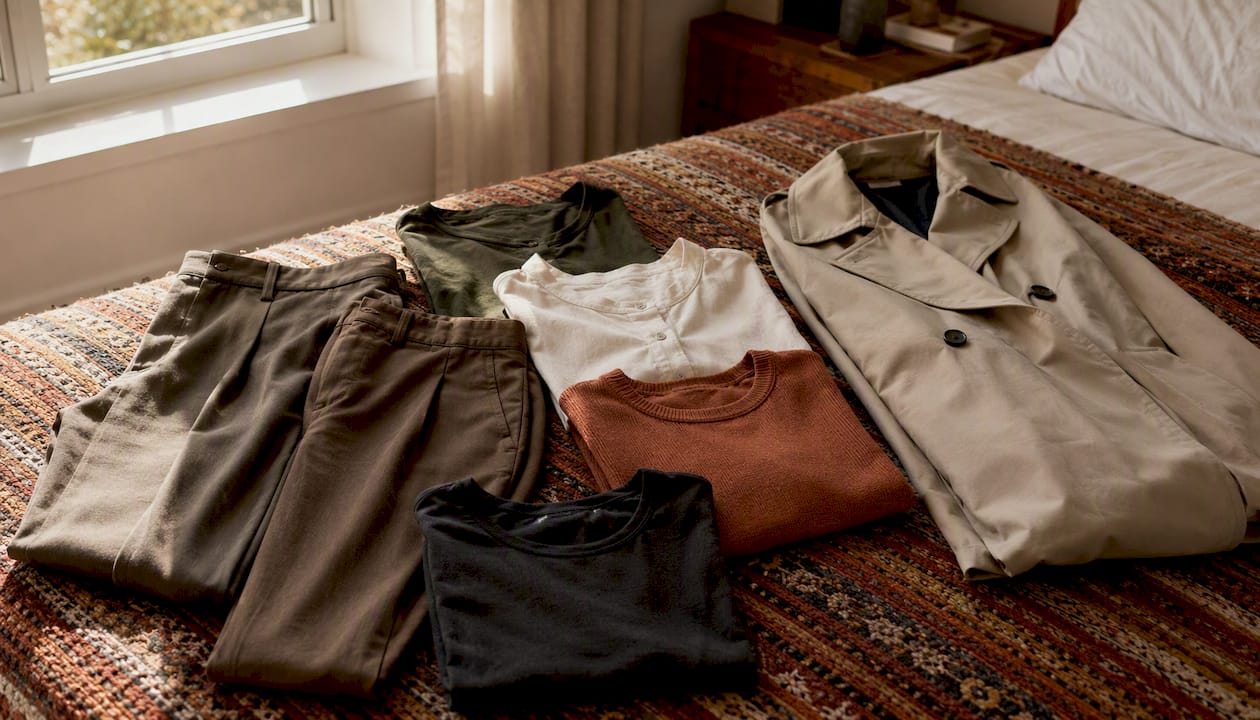
The 2–5–1 method is the most practical formula for carry-on-only travel: 2 bottoms, 5 tops, and 1 statement piece (a dress, a blazer, or a versatile layer). Two bottoms paired with five tops produce ten distinct combinations before you factor in layering or accessories.
| Bottom | Top options | Outfit count |
|---|---|---|
| Dark slim jeans | White tee, striped tee, silk blouse, knit, blazer | 5 |
| Tailored trousers | White tee, striped tee, silk blouse, knit, blazer | 5 |
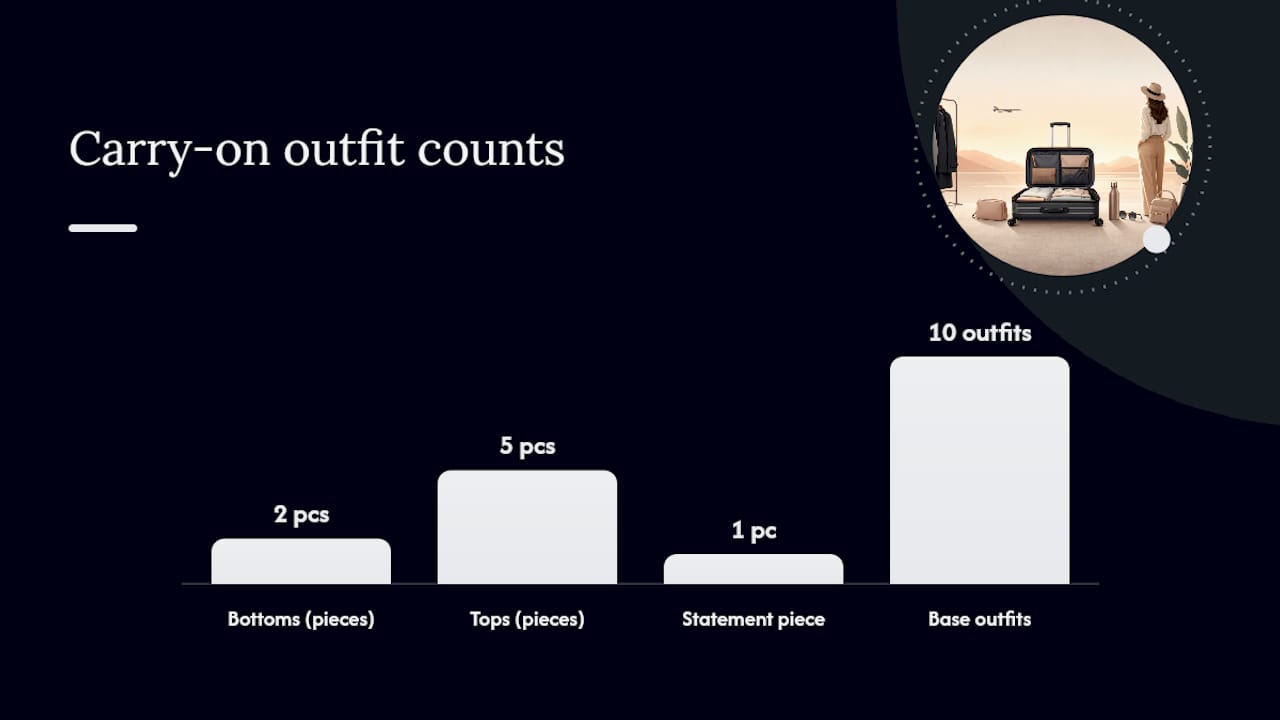
That is ten base outfits from seven pieces, and accessories push the number higher.
Fabric choices that travel well
- Merino wool: resists odor, regulates temperature, and barely wrinkles; one merino top can work for three or four days
- Ponte or scuba knit: holds its shape through a full travel day and looks polished enough for dinner
- Nylon and polyester blends: lightweight, quick-dry, and wrinkle-resistant; ideal for active days
- Avoid: 100% linen (wrinkles aggressively), heavy denim (takes up too much space), and dry-clean-only fabrics unless you are packing them with care
Outfit formulas to build from
- Travel day: wear your heaviest jeans, sneakers, and a blazer or oversized jacket on the plane; pack everything lighter
- Daytime exploring: slim trousers + knit top + white sneakers or loafers
- Evening: silk blouse or polished top + tailored trousers + a compact heel or dressy flat
- Active day: leggings or joggers + a performance tee + clean sneakers
- Layering: a lightweight scarf or wrap adds warmth and a fresh look without adding bulk
Shoe rule: limit yourself to 2–3 pairs maximum. Wear the bulkiest pair (chunky sneakers, boots) on travel day, as Real Simple recommends, and pack one versatile flat and one dressier option. Shoes take up more space than almost anything else in a carry-on.
What packing techniques actually save space in a carry-on?
Rolling plus selective folding plus compression cubes produces the best space-to-wrinkle tradeoff. The logic is straightforward: rolling distributes a garment’s bend across a continuous curve rather than a sharp crease, which compresses volume and reduces deep creasing for casual and knit fabrics. Structured pieces, blazers, dress shirts, and tailored trousers, are better folded flat to preserve their shape.
- Sort before you pack. Lay every item out on the bed. If two pieces serve the same function, leave one behind.
- Roll casual items. T-shirts, jeans, knitwear, underwear, and activewear all roll tightly. Start at the hem and roll toward the collar, keeping tension even.
- Fold structured pieces. Blazers fold inside-out (shoulders together) to protect the lining. Dress shirts fold along their natural seams.
- Load shoes first. Place shoes heel-to-toe along the bottom of the bag near the wheels, as Away’s packing guide recommends. Stuff the cavities with socks, a charger, or a small pouch to protect shoe shape and use dead space.
- Pack compression cubes by category. One cube for tops, one for bottoms, one for underthings. Zip each cube to its first closure, then use the compression zip to shrink it down. According to Condé Nast Traveler, compression cubes meaningfully reduce packed volume versus loose packing.
- Stack cubes like drawers. Lay them flat and stack them so you can pull one cube without disturbing the others.
- Toiletries and valuables go last. Place the quart bag and your document pouch at the very top or in an exterior pocket for fast access at security.
Pro Tip: For delicate designer knits or structured blazers, wrap them in a single sheet of acid-free tissue before folding. It reduces friction between layers and prevents surface snags.
Which organizers keep your carry-on stylish and accessible?
The right organizers do more than keep things tidy. They let you find what you need in seconds and double as styling tools when you arrive.
- Compression packing cubes: the backbone of any organized carry-on; use one per clothing category so you can pull a cube without unpacking the whole bag
- Tech pouch: keeps chargers, cables, earbuds, and adapters in one place; pull it out as a single unit at security instead of fishing through your bag
- TSA quart bag: place it in an exterior pocket or at the very top of your main compartment; it needs to come out at every checkpoint
- Jewelry roll: protects necklaces from tangling and rings from scratching; far more compact than a hard jewelry case and easier to slip into a personal item
- Shoe pouches: keep soles away from clothing; a simple drawstring bag works, but a structured pouch protects shoe shape better
- Leather valuables pouch: a slim leather travel valuables pouch holds your passport, cards, and a few bills in one flat piece that slides into any bag without bulk
Scarves and wraps deserve a special mention. A lightweight cashmere or silk-blend scarf takes up almost no space, but on the plane it works as a blanket or neck wrap, and on arrival it becomes a belt, a bag accent, or a shoulder layer over a simple outfit. It is one of the highest-return items you can pack.
Pro Tip: Use a modular personal-item insert that detaches from your main bag. When you switch from your carry-on to a day bag at your destination, you grab the insert and go without repacking a single item.
For a deeper look at organizing luxury accessories before and during travel, Naiseshopper’s luxury accessories organization guide covers jewelry, belts, and small pieces in detail.
In-flight comfort items that help you arrive looking fresh
The goal is not just to survive the flight. It is to step off the plane ready to go.
- Portable power bank: keeps your phone charged through long connections; lithium-ion power banks must travel in your carry-on, never in checked luggage
- Compression socks: reduce swelling on flights over two hours; wear them from the gate and swap to your regular shoes before landing
- Eye mask and neck pillow: a contoured sleep mask blocks cabin light completely; a compact inflatable lumbar pillow does more for posture than most neck pillows on long-haul flights
- Lip balm and a mini facial mist: cabin humidity drops significantly during flight, and both items take up almost no space; AARP’s carry-on essentials list flags lip balm as one of the most consistently overlooked comfort items
- A self-purifying water bottle or electrolyte packets: low cabin humidity accelerates dehydration; electrolyte packets weigh almost nothing and make a real difference on flights over four hours
- A spare layer: even if you wear your jacket on the plane, a lightweight merino cardigan in your personal item gives you a fresh layer to put on before landing
Pack a small refresh kit in a zip pouch inside your personal item: a travel-size deodorant, a mini cleanser or face wipe, a stain-removal stick, and a small fragrance. Two minutes in the airport bathroom before you exit arrivals makes a noticeable difference.
What are the TSA rules you need to know before you pack?
Security surprises slow everyone down. A few minutes of prep at home eliminates them entirely.
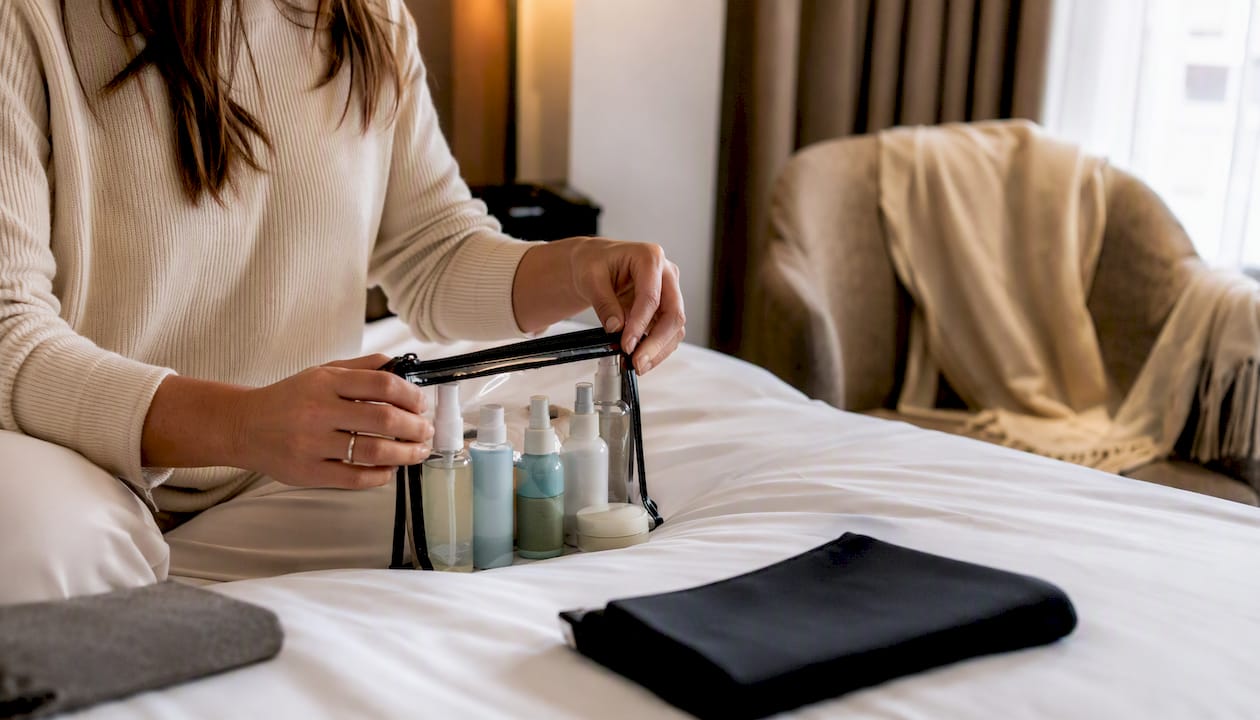
The 3-1-1 liquids rule: all liquids, gels, aerosols, creams, and pastes must be in containers of 3.4 ounces (100 ml) or less. All containers must fit inside a single 1-quart transparent, resealable bag, one bag per passenger. This applies to everything from shampoo to toothpaste to perfume. The TSA enforces this at every domestic checkpoint, and most international airports apply the same standard.
Electronics at security:
- Laptops and tablets must come out of your bag and go into a separate bin at standard TSA checkpoints (TSA PreCheck members are exempt)
- Power banks and lithium batteries stay in your carry-on; they cannot go in checked bags
- Keep cables and chargers in your tech pouch so they do not trigger a secondary bag check
Carry-on size:
- Most major US carriers allow a carry-on of approximately 22 × 14 × 9 inches, but limits vary by airline and aircraft type; check your specific carrier before you pack
- Personal items (a tote or backpack) typically must fit under the seat in front of you; dimensions vary, so confirm with your airline
Quick pre-departure screening checklist:
- Quart bag accessible and at the top of your bag
- Laptop and tablet in a sleeve you can pull out in one move
- Boarding pass and ID in your jacket pocket or the front of your personal item
- No prohibited items in your carry-on (check the TSA website for the current list)
- Wear slip-on shoes or shoes that come off quickly if you do not have PreCheck
How do you pack and protect designer pieces in a carry-on?
Designer and luxury items need a few extra steps, but none of them are complicated.
- Fold, do not roll, structured luxury pieces. A Prada blazer or a Saint Laurent silk blouse folds inside-out along its natural seams. Rolling structured garments stresses the fabric and distorts the silhouette.
- Use tissue paper between layers. A single sheet of acid-free tissue between a folded silk or satin piece prevents friction marks and color transfer from adjacent items.
- Keep dust bags on handbags. If you are carrying a Chanel or Bottega Veneta bag as your personal item, keep it in its dust bag inside a structured tote. The dust bag protects the leather from scratches and humidity fluctuations.
- Protect hardware. Wrap metal hardware (clasps, chains, buckles) in a soft cloth or a small piece of felt before packing. Metal-on-metal contact during transit causes scratches that are difficult to reverse.
- Consider shipping for high-value pieces. For a Birkin or a particularly fragile garment, insured shipping to your hotel may be safer than carry-on transport. Naiseshopper offers shipping insurance on purchases, which extends peace of mind from checkout to destination.
Packing a luxury piece well is not about being precious with it. It is about understanding the specific vulnerabilities of the material, leather versus silk versus structured wool, and addressing each one with a simple, targeted solution. A dust bag and two sheets of tissue cost nothing and prevent damage that costs hundreds to repair.
For a full breakdown of fabric-specific packing methods, Naiseshopper’s guide on packing luxury apparel without damage covers every major material category.
What is the right order to pack a carry-on?
A repeatable sequence eliminates the last-minute scramble and keeps the bag balanced.
- Plan your outfits first. Lay out every piece you intend to bring and build complete looks before anything goes in the bag. If a piece does not belong to at least two outfits, leave it behind.
- Pack shoes and heavy items at the bottom. Shoes go heel-to-toe near the wheels. Jeans and heavier bottoms go in next, flat against the back panel.
- Load compression cubes. Tops cube, bottoms cube, and underthings cube go in stacked like drawers. Compress each one before stacking.
- Add structured or delicate pieces. Blazers and silk items fold on top of the cubes, protected by tissue if needed.
- Toiletries and tech. The quart bag and tech pouch go in last, near the top or in exterior pockets.
- Valuables and documents. Passport pouch, cards, and boarding passes go into your personal item or a secure interior pocket, never at the bottom of a full bag.
- Final compress and weigh. Use the bag’s internal compression straps if it has them. Weigh the bag if you are close to the airline’s carry-on weight limit (many international carriers enforce one).
Last-minute checklist before you leave home:
- Passport and ID confirmed
- Medications in carry-on
- Quart bag packed and accessible
- Power bank charged and in carry-on
- Laptop and charger in bag
- Wearing your bulkiest shoes and jacket
How do accessories multiply your outfit options?
Accessories are the most space-efficient styling tool in a carry-on. A single scarf, a belt, and two jewelry pieces can make the same outfit look like four different ones.
The rule: choose accessories in your palette’s accent color and one neutral metal (gold or silver, not both). Every accessory should work with at least three of your packed outfits.
- Scarves and wraps: one silk or lightweight wool scarf works as a neck piece, a belt, a bag accent, a hair wrap, or a light layer; it is the single highest-return accessory per gram
- A belt: transforms a loose blouse into a structured look and gives trousers a polished finish; choose one that works with both your bottoms
- Two jewelry pieces: a pair of earrings and a simple necklace or bracelet cover most occasions; keep them in a jewelry roll to prevent tangling
- A compact crossbody or clutch: a small bag that fits inside your carry-on gives you a hands-free option for evenings without packing a second full-size bag; Naiseshopper’s guide to designer handbag styles covers which shapes travel best
Sunglasses count as an accessory too. One pair in a hard case protects them and takes up minimal space. They shift a casual daytime look toward something more intentional without any extra effort.
My honest take on carry-on-only travel
The hardest part of carry-on-only travel is not the packing. It is the mental shift from “what if I need this?” to “what will I actually wear?” Most overpacked bags contain three or four outfits that never get worn, packed as insurance against scenarios that never materialize.
The 2–5–1 system works because it forces that decision before you leave home. Once you commit to two bottoms and five tops, the outfit math is already done. You stop staring at your suitcase at 11 PM wondering if you need a fourth pair of shoes.
What changed my own packing was treating accessories as the variable, not the clothing. A silk scarf from a Chanel boutique or a compact Valentino crossbody does more for outfit variety than two extra tops ever could. The clothing is the canvas; the accessories are where the style actually lives. Working with Naiseshopper’s editorial team on luxury packing content reinforced that instinct: the travelers who pack the lightest tend to own the fewest pieces and the best ones.
Authenticated designer accessories for your next trip
Packing light does not mean packing without style. Naiseshopper carries authenticated designer accessories from Gucci, Chanel, Prada, Bottega Veneta, Saint Laurent, and Balenciaga at discounted prices, with every piece verified for authenticity before it ships.
For carry-on travel specifically, the right compact crossbody, a silk scarf, or a structured dust-bag-protected clutch can cover three different outfit moments without adding meaningful weight. Naiseshopper’s personal shopper service helps you find exactly the right travel-friendly piece for your wardrobe, and shipping insurance means your purchase arrives protected. Browse the full collection at Naiseshopper and let a personal shopper point you toward the pieces that travel best.
Sources
- TSA
- AARP: 8 Items Every Traveler Over 50 Needs in Their Carry-On
- 6 packing techniques that fit a week into a carry-on | Quartz
- Real Simple
- How to Pack a Carry-On | Blog | Away