The fastest way to curate travel-ready looks is a 10–15 piece capsule built around versatile bottoms, three to four tops, and one multipurpose layer. The exact 12-piece framework below, the outfit math behind it, and a step-by-step packing routine will get you to carry-on-only with looks that photograph beautifully every single day.
Start here — three actions before you pack:
- Pick your bottoms first. They anchor the palette and determine what tops actually work.
- Lock a tight color story: three neutrals plus one accent, nothing outside it.
- Pack one multipurpose layer (a trench, a cardigan, or a silk-blend blazer) that handles the plane, a cool evening, and a light drizzle.
A well-built 12-piece capsule using the 4-2-1 framework (4 tops, 2 bottoms, 1–2 layers, plus a dress or jumpsuit, 2 shoes, and accessories) can generate 20+ outfit combinations. That is more than enough for a week of carry-on travel, and it leaves room for the one spontaneous dinner that calls for something a little more polished.
Pro Tip: Before you zip the bag, photograph every planned outfit on a flat surface. Save them in a phone folder labeled by day. Morning decisions on the road drop from ten minutes to thirty seconds.
Key Takeaways
A 12-piece capsule using the 4-2-1 ratio (4 tops, 2 bottoms, 1–2 layers, plus a dress or jumpsuit, 2 shoes, and accessories) can yield up to 24 outfit combinations and covers most carry-on trips with room for one laundry cycle.
| Point | Details |
|---|---|
| Start with bottoms | Pick your two bottoms first; they anchor the palette and determine which tops actually work. |
| Lock a tight palette | Three neutrals plus one accent means every piece mixes without effort and every photo looks intentional. |
| Use the 4-2-1 ratio | Four tops, two bottoms, and one multipurpose layer generate 20+ outfit combinations from 12 pieces. |
| Pack strategically for carry-on | Wear bulky items on travel day, roll soft pieces, use packing cubes, and weigh the bag before you leave home. |
| Naiseshopper fills capsule gaps | Authenticated designer ready-to-wear and accessories at discounted prices, with personal shopper assistance across the US. |
Table of Contents
- What is a travel capsule wardrobe and why does it beat overpacking?
- How to build a 12-piece travel capsule using the 4-2-1 framework
- Five outfit formulas that make your capsule work harder
- Packing tactics that actually work for carry-on-only travel
- How to adapt the capsule for climate, activity, and destination
- A one-page pre-packing routine to plan outfits before you close the suitcase
- Common capsule and packing mistakes — and how to fix them fast
- Why 10–15 pieces work: the outfit math and the base-list system
- What the 4-2-1 math actually means in practice
- Why the capsule approach is worth trusting for stylish travelers
- Naiseshopper has the elevated pieces your capsule is missing
- Sources
What is a travel capsule wardrobe and why does it beat overpacking?
A travel capsule wardrobe is a small, cohesive set of pieces chosen specifically to mix and match with each other. Every item earns its place by working with at least three other pieces in the bag. Nothing is packed “just in case.”
The system works for three reasons. First, outfit math: a tight palette means every top pairs with every bottom, multiplying combinations without multiplying weight. Second, fabric discipline: quick-drying merino, linen blends, and technical weaves let you rewear pieces between washes without looking or feeling like you did. Third, palette discipline: when every piece shares the same color story, getting dressed in an unfamiliar hotel room takes no mental energy at all.
Common capsule sizes and when each fits:
- 10 items: Weekend trips and city breaks of two to four days; carry-on personal item only.
- 12–13 items: The sweet spot for 7–10 day trips with laundry access; fits a standard carry-on.
- 15 items: Longer trips, mixed climates, or itineraries that include both beach and business.
For style-conscious travelers, the capsule approach delivers something overpacking never can: every photo looks intentional. When your pieces share a palette and a silhouette language, the resulting travel photos have a visual coherence that random packing simply cannot produce. Stylists consistently advise building from pieces you already wear at home and sticking to that strict three-neutral-plus-one-accent palette so every item mixes without effort.
How to build a 12-piece travel capsule using the 4-2-1 framework
A tested 12-piece capsule covers most carry-on trips and adapts to different climates with one or two swaps. Here is the exact item list, followed by palette and fabric guidance.
The 12-piece item list
| Category | Pieces | Notes |
|---|---|---|
| Tops (4) | Silk-blend cami, fitted merino tee, relaxed linen shirt, lightweight knit | Three weight levels handle 10°C+ temperature swings in a single day |
| Bottoms (2) | Tailored trouser (linen or stretch blend), dark-wash slim jean | Both pair with all four tops |
| Layer (1–2) | Trench or longline cardigan; optional blazer for business | Trench doubles as plane blanket and dinner layer |
| Dress/Jumpsuit (1) | Wrap dress or sleek jumpsuit | Day-to-night with a shoe swap |
| Shoes (2) | White leather sneaker (Away or Nike Air Max), leather sandal (Birkenstock Arizona) | Wear sneakers on the plane |
| Accessories | Silk scarf, minimal gold jewelry, structured tote, belt | Scarf transforms five looks on its own |
Palette guidance: Choose camel, ivory, and black as your three neutrals, then pick one accent (terracotta, cobalt, or olive). Every piece you pack must sit within that palette. Brands like Everlane, J.Crew, Banana Republic, and Quince consistently offer capsule-friendly neutrals at accessible price points, while Tortuga’s packing cubes keep the whole system organized inside the bag.
Fabric picks that travel well: Merino wool, linen blends, and technical fabrics outperform cotton on long travel days. Merino regulates temperature, resists odor, and dries quickly. Linen breathes in heat, though a linen blend holds shape better than pure linen. Tencel and wrinkle-resistant stretch blends are strong choices for trousers and dresses. For layering pieces that serve multiple roles, a high-quality cardigan or trench outperforms a blazer on most trips because it folds flat, acts as a plane blanket, and reads as polished at dinner. For eco-conscious fabric choices and care tips on the road, sustainable travel-friendly clothing is worth exploring.
Climate and style variations
- Warm-weather swap: Replace the jean with a linen wide-leg pant; add a second cami in the accent color; swap the trench for a lightweight linen overshirt.
- Cold-weather swap: Add a merino base layer and a wool-blend coat; replace sandals with ankle boots; keep the blazer as an inner layer.
- Business-travel tweak: Swap the linen shirt for a silk blouse; add one structured blazer; keep the wrap dress for evening client dinners.
- Evening upgrade: The wrap dress, a silk scarf tied as a belt, and the leather sandal handle most dinner reservations without adding a separate “going out” outfit.
Outfit-count math
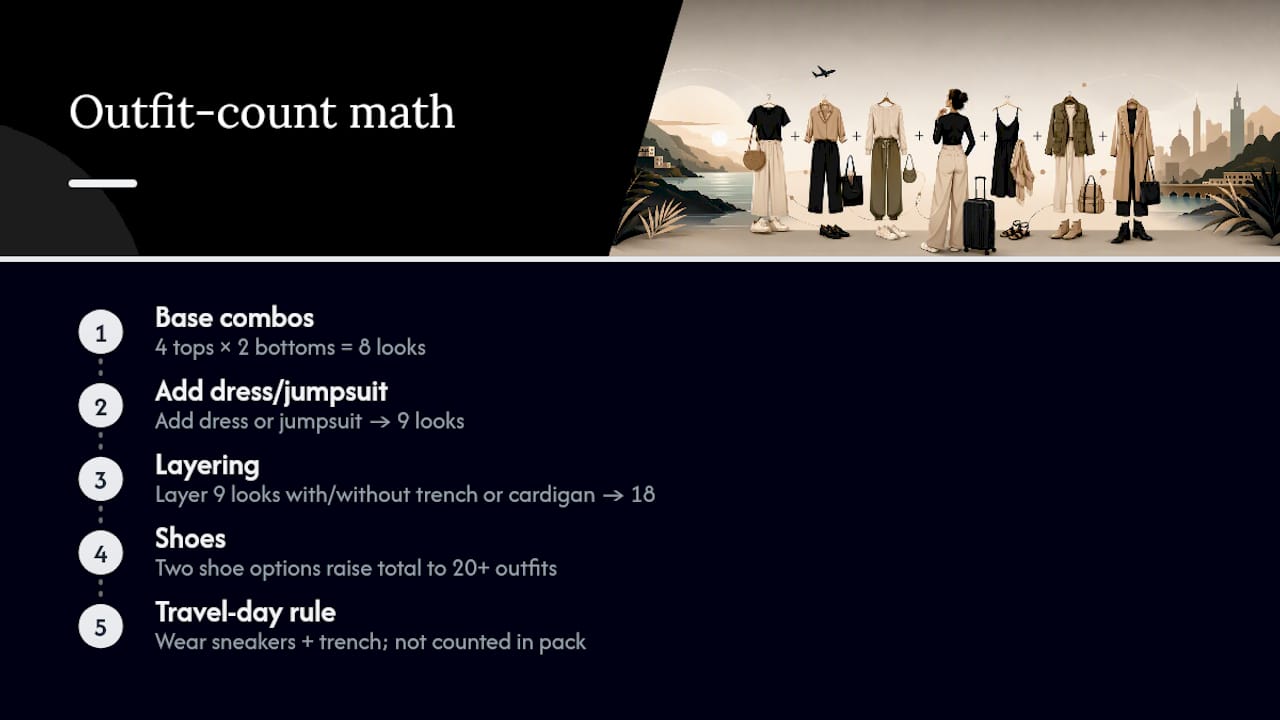
4 tops × 2 bottoms = 8 base combinations. Add the dress or jumpsuit for 9 distinct looks. Layer each of those 9 with or without the trench or cardigan for 18 variations. Swap between two shoe options on the key combinations and you reach 20+ outfits from 12 pieces. Wear the sneakers and the trench on travel day so neither counts against your packing weight.
Pro Tip: Apply the three-match test to every candidate piece before it goes in the bag. If a piece doesn’t pair with at least three other items already selected, leave it home.
Five outfit formulas that make your capsule work harder
Outfit formulas are repeatable combinations rather than day-by-day planning. They reduce decision fatigue and make a small capsule feel much larger. Here are five that work across the 12-piece framework above.
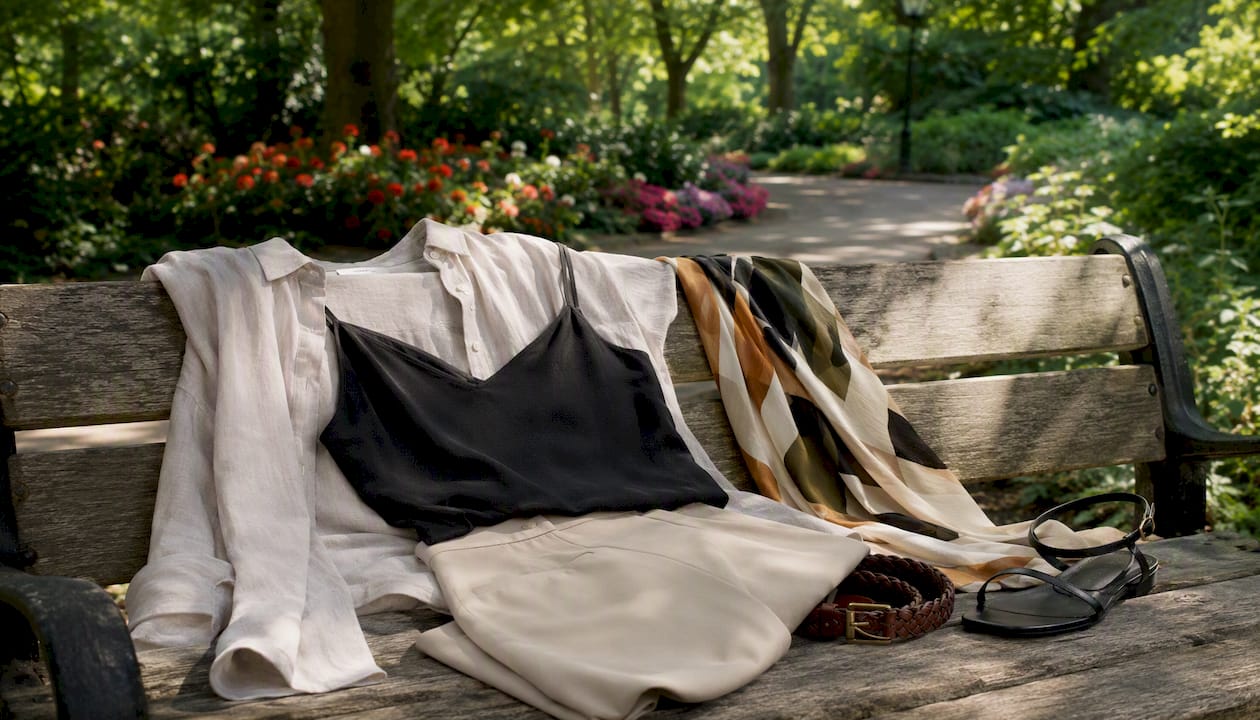
Formula 1: The polished day look Linen shirt (open, worn as a layer) + fitted merino tee underneath + tailored trouser + leather sandal. This reads as intentional and put-together for city sightseeing or a casual lunch. At night, close the shirt, add the silk scarf as a neck tie, and swap to the sandal’s dressier sibling.
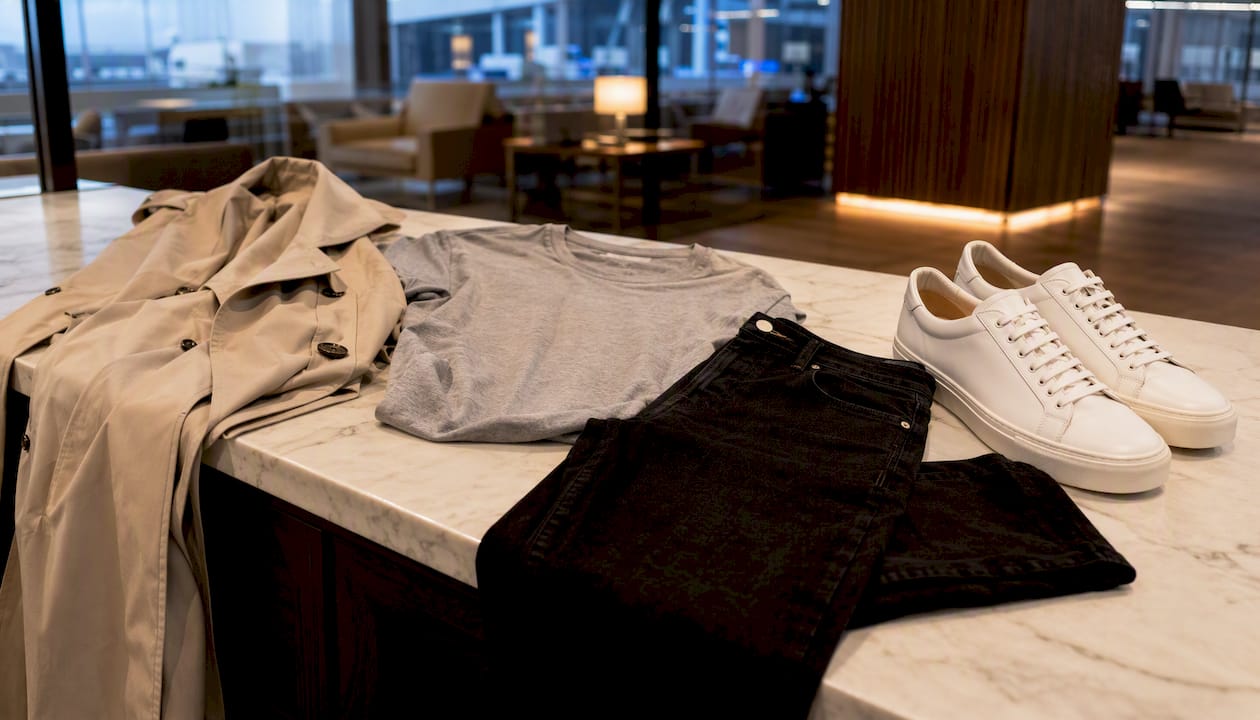
Formula 2: The easy travel day Merino tee + dark-wash slim jean + white sneaker + trench. Comfortable enough for a six-hour flight, sharp enough to walk straight into a hotel lobby or a museum. The trench does the heavy lifting here.
Formula 3: The slip-dress formula Wrap dress + white sneaker + denim jacket or linen overshirt layered on top. The sneaker keeps it casual for daytime; swap to the leather sandal and drop the overshirt for evening. This formula photographs especially well against textured walls and cobblestone streets.
Formula 4: The proportion play Silk-blend cami + wide-leg linen pant + blazer (if packed for business) + leather sandal. Bold proportion play between a fitted top and a relaxed bottom is one of the strongest styling moves in travel fashion right now. Add the belt to define the waist.
Formula 5: The knit-and-skirt formula Lightweight knit + wrap skirt or the dress worn as a skirt (tied at the waist) + sandal. Works for beach towns, warm-weather cities, and resort dinners. Layer the trench for a cooler evening.
How to shift each formula from day to night:
- Swap sneakers for the leather sandal.
- Add or remove the scarf as a belt, neck tie, or hair accessory.
- Add one piece of gold jewelry (a cuff or a layered necklace).
- Remove the outer layer to reveal the cami or knit underneath.
For layering strategies that keep looks polished rather than bulky, luxury layering techniques offer strong visual guidance.
Packing tactics that actually work for carry-on-only travel
Starting packing early, using travel pouches, and packing cubes are the practical habits that separate carry-on veterans from gate-check regulars. Here is the step-by-step sequence.
Step-by-step packing checklist:
- Wear your bulkiest items on travel day: sneakers, trench, and the heaviest layer.
- Roll soft pieces (tees, tanks, jeans, the cami) and fold structured items (blazers, linen dresses) flat to prevent deep creases.
- Place packing cubes (Tortuga’s compression cubes work well) in the main compartment, heaviest toward the back panel.
- Stash shoes in a shoe bag at the bottom of the suitcase or in the corners around the cubes.
- Keep the accessories block (scarf, jewelry roll, belt) in a flat pouch on top for easy access at security.
- Reserve your personal item (a structured tote) for the flight outfit layer, your laptop, and any liquids.
Laundry plan for a week-long trip: Pack enough outfits for several days when you have laundry access. A laundry bar (Fels-Naptha or a travel-size Soak) and a sink-wash routine every three to four days keeps the capsule fresh. Merino and technical fabrics dry overnight on a towel rack. Cotton takes 24+ hours, which is why it rarely earns a spot in a well-built capsule.
Weight and airline tips:
- Weigh your bag at home before you leave. Most US carriers allow 22 × 14 × 9 inches for overhead carry-on; Spirit and Frontier are stricter, so check the specific airline.
- Keep your personal item under 18 × 14 × 8 inches to clear most personal-item gauges.
- If you are close to the limit, move the heaviest shoe into the personal item tote.
Pro Tip: Separate dirty clothes in a lightweight mesh bag inside one packing cube. You will always know what is clean without unpacking everything.
For packing designer or delicate pieces without damage, packing luxury apparel for travel covers the specifics of protecting structured bags and silk pieces in transit.
How to adapt the capsule for climate, activity, and destination
The 12-piece base list stays constant. What changes is a short add-on block of one to three pieces specific to your trip’s conditions.
Climate swaps at a glance:
- Hot and humid (Miami, Southeast Asia, Caribbean): Swap the jean for linen wide-leg pants; replace the knit with a second cami; prioritize Birkenstock sandals and breathable sneakers like the Nike Air Max.
- Cool and temperate (London, San Francisco, Northern Europe): Keep the jean; add a merino base layer under the trench; swap the sandal for a low-heeled ankle boot.
- Cold (New York in January, mountain destinations): Add a packable wool-blend coat over the trench; add thermal base layers; replace sandals with leather ankle boots or low-heeled knee boots.
Activity add-ons (one or two pieces only):
- Beach: One swimsuit, one sarong (doubles as a scarf and a cover-up), one pair of flip-flops.
- Hiking: One pair of trail shoes, one moisture-wicking long-sleeve layer.
- Formal dinner or event: One elevated clutch, one pair of heeled sandals or mules.
- Business meetings: One structured blazer, one silk blouse.
Cultural and context notes: Beachwear does not translate to European city sightseeing. Tailored linen trousers and a silk-blend top carry you from the Uffizi to a Florentine dinner without a change. In conservative destinations, a lightweight linen overshirt worn open over a cami adds coverage without adding heat. Silhouette matters as much as coverage: a midi wrap dress reads as respectful and polished across most cultural contexts, making it one of the most versatile single pieces in any capsule. For guidance on eco-friendly fabric choices that hold up across climates, sustainable fashion resources offer practical care and wear guidance.
One-sentence climate rules:
- If temps will dip below 50°F, add merino base layers and swap the trench for a wool coat.
- If you are heading somewhere above 85°F, cut the knit entirely and add a second linen piece instead.
- If the itinerary mixes beach and city, the wrap dress and linen overshirt are your two hardest-working pieces.
A one-page pre-packing routine to plan outfits before you close the suitcase
Planning outfits before you pack is the single habit that separates a capsule that works from one that sits half-unused in the hotel closet. Travel writers and stylists recommend photographing full outfits before travel to avoid last-minute overpacking and to speed up morning decisions on the road.
Step-by-step pre-packing routine:
- Check the itinerary and forecast. List every activity: flights, sightseeing, dinners, meetings, beach days. Note the temperature range.
- Pick bottoms first. Lay out your two bottoms and the dress or jumpsuit. These anchor everything.
- Lock the palette. Confirm every top, layer, and accessory sits within your three neutrals plus one accent. Remove anything that breaks the palette.
- Assign outfits to activities. Match each formula to a day or event. You do not need a unique outfit for every day, only for every activity type.
- Photograph each complete outfit. Lay it flat, shoot it, save it in a phone folder. Label by activity (“Day 3 — museum + dinner”).
- Final edit. Count the outfits. If any piece appears in fewer than three looks, cut it.
The PACK method (Plan, Assign, Cut, Keep) maps directly onto this routine. The PACK method is effective because it forces a short, reusable list rather than an over-detailed one-off checklist. The Keep step is what refines your packing across multiple trips: save the final list and update it after each trip with what you actually wore.
Screenshot-ready mini-checklist:
- Bottoms locked and palette confirmed
- Every top pairs with both bottoms
- One multipurpose layer packed
- Outfits photographed and saved
- Bag weighed and within airline limits
- Laundry bar and mesh dirty-clothes bag packed
Pro Tip: Save your outfit photos in a dedicated phone album, not your camera roll. On a busy travel morning, you want to open one folder and see exactly what goes together, not scroll through 400 vacation photos.
Common capsule and packing mistakes — and how to fix them fast
Even experienced packers fall into the same traps. Here are the most frequent ones and the quick corrections.
- Packing “what if” items. A formal gown for a dinner that might happen, a heavy coat for weather that might turn cold. Plan for typical conditions, not worst-case scenarios — you can almost always buy or borrow an emergency item at your destination.
- A mismatched palette. One “fun” piece in a color that pairs with nothing else in the bag. It will sit unworn. Apply the three-match test before it goes in.
- Too many shoes. Three pairs of shoes for a seven-day trip is almost always one pair too many. Two shoes, worn strategically across the five outfit formulas, cover every scenario.
- Heavy cotton-only mix. Cotton tees and cotton jeans together create a bag that is heavy, slow to dry, and prone to wrinkles. Swap at least two pieces for merino or a technical blend.
- Forgetting the plane outfit. Packing your most comfortable pieces and then wearing something uncomfortable on a six-hour flight is a common mistake. The travel-day formula (merino tee + slim jean + sneaker + trench) should be planned as its own outfit, not an afterthought.
- Ignoring fit. A piece that fits perfectly at home but gaps, pulls, or rides up when you sit for hours is not a travel piece. Comfort and fit are non-negotiable for stylish travel clothing.
- Accessories as an afterthought. A silk scarf, one belt, and a minimal jewelry set weigh almost nothing and transform the same five pieces into fifteen distinct looks. Pack them deliberately, not as filler.
For protecting higher-value pieces in transit, the guidance on packing luxury apparel covers structured bags, silk pieces, and wrinkle prevention in detail.
Why 10–15 pieces work: the outfit math and the base-list system
The combinatorics are straightforward. Several tops paired with a couple of bottoms produce a base number of outfit combinations. Adding a dress or jumpsuit increases variety, which multiplies further with shoe options and layering pieces, resulting in numerous distinct outfit variations. A 12-piece capsule can yield up to 24 different outfits depending on weather and activity mix.
The base-list system makes this repeatable. Keep a permanent core checklist (the 12-piece framework above) and add only a short, climate-specific block for each trip. This approach is faster and more accurate than rebuilding a long checklist from scratch every time you travel. After three or four trips, the base list is refined to exactly what you actually wear, and the add-on block shrinks because you know your patterns.
Fabric choice is where the math gets its power. Merino wool, linen blends, and technical fabrics let you rewear pieces between washes without odor or visible wear. Merino in particular can be worn two to three days in a row in most climates before it needs a wash. That means a four-day outfit plan stretches to a seven-day trip with one sink wash, which is exactly the math that makes carry-on-only realistic.
Successful capsules also rely on three top weights: a light cami, a mid-weight knit, and a heavier layering shirt. That three-tier structure means one capsule handles significant temperature swings in a single day, which is common in coastal cities, mountain destinations, and shoulder-season travel.
Pro Tip: Choose merino or a technical blend for at least two of your four tops. Those two pieces will carry the most weight in your capsule, literally and figuratively, because they rewear cleanly and layer without bulk.
What the 4-2-1 math actually means in practice
The 4-2-1 label describes the core ratio: four tops, two bottoms, one layer (sometimes two). It is not a rigid formula but a ratio that keeps the capsule balanced. More tops than bottoms makes sense because tops are what people notice first and what get visibly worn fastest. Two bottoms is the minimum for variety; three is the maximum before the bag starts to feel heavy. One strong layer handles most weather and dress-code scenarios; a second layer (a blazer or a structured cardigan) is worth adding only for business travel or cold climates.
The accessories block is where the ratio gets multiplied. A silk scarf alone transforms five looks: worn at the neck, tied as a belt, wrapped as a headband, knotted on a bag handle, or draped as a lightweight layer over a cami. A single belt changes the silhouette of the wrap dress, the linen trouser, and the wide-leg pant. Minimal gold jewelry adds polish to every formula without adding weight. Building a luxury capsule wardrobe that lasts starts with understanding that accessories are not extras; they are multipliers.
The 4-2-1 ratio also keeps the bag honest. When you are tempted to add a fifth top “just in case,” the ratio reminds you that the math already covers 20+ looks. The fifth top is almost always a “what if” item in disguise.
Why the capsule approach is worth trusting for stylish travelers
The capsule method gets dismissed by some travelers as too restrictive, too minimal, or too much work upfront. That criticism misses the point. The work happens before the trip, not during it. Every morning on the road, you open a bag where everything works together, every outfit is already photographed, and the only decision is which formula fits the day’s activity.
Testing capsules across climates and carry-on constraints, from a long weekend in New York to a ten-day trip mixing beach and city, consistently confirms the same outcome: the capsule traveler arrives looking more put-together than the overpacker, not less. The overpacker has more options and fewer outfits. The capsule traveler has fewer pieces and more looks, because every piece was chosen to work with every other piece.
Naiseshopper’s curated inventory of authenticated designer ready-to-wear, from silk-blend pieces by Saint Laurent to tailored trousers from Prada and packable accessories from Bottega Veneta, offers exactly the kind of investment-quality pieces that anchor a travel capsule for years. A single well-chosen designer piece in a neutral colorway earns its place in the capsule on every trip, which makes the cost-per-wear calculation very different from fast fashion.
Naiseshopper has the elevated pieces your capsule is missing
Your capsule math works on paper. The gap is usually one or two investment pieces that tie the whole palette together: a silk-blend cami that reads as luxurious at dinner, a tailored trouser that transitions from sightseeing to a client meeting, or a structured tote that doubles as your personal item and your evening bag.
Naiseshopper carries authenticated designer ready-to-wear, shoes, and accessories from Gucci, Chanel, Prada, Valentino, Bottega Veneta, Saint Laurent, and Balenciaga, all at discounted prices with guaranteed authenticity. International secure shipping, localized pricing, and personal shopper assistance across the US mean you can fill your capsule gaps without the guesswork of sourcing designer pieces independently. For smart buying guidance before you shop, luxury fashion shopping tips covers what to prioritize when building an investment-quality travel wardrobe. Browse the full curated collection at Naiseshopper and let the personal shopper service help you find the exact pieces your capsule needs.
Sources
- The Golden Rules of Packing | Condé Nast Traveler
- Travel Capsule Wardrobe: Pack Light, Look Polished
- 21 Fool-Proof Outfit Ideas For Traveling + Styling Tips
- Travel Packing Guide: Pack Lightly
- Travel Outfits: What to Wear on Every Trip — TravelBuzzy