TL;DR:
- Organizing luxury accessories involves assigning each piece a protected storage space to maintain condition and ensure quick access. Proper storage methods for jewelry, handbags, and shoes protect delicate finishes, preserve shapes, and prevent damage. Consistent maintenance, thoughtful coordination, and optimal lighting enhance collection longevity and daily usability.
Organizing luxury accessories is defined as the practice of assigning each piece a dedicated, protected storage position that preserves condition, prevents damage, and allows retrieval in seconds. A well-organized luxury closet treats every handbag, fine jewelry piece, and designer shoe as an investment worth protecting. The gold standard for any collection is the “ready-to-wear” condition: the ability to find and select any piece in under 30 seconds without moving others or causing damage. That benchmark shapes every technique covered here, from the Upright-Only Rule for handbags to compartmentalized jewelry storage.
How to organize luxury jewelry for protection and accessibility
Fine jewelry must never be stored loose. Loose storage causes scratches on polished surfaces and tangles delicate chains beyond repair. Expert recommendations for 2025–2026 treat zero tolerance for loose storage as the baseline standard for any serious collection.
The right system gives every piece a designated, protected spot. Three formats work best:
- Velvet-lined drawer inserts: Individual compartments keep rings, earrings, and bracelets separated. The velvet surface prevents micro-scratches on gold and platinum finishes.
- Acrylic stackable organizers: Clear walls let you see every piece at a glance. Stackable acrylic organizers add a boutique feel while improving daily accessibility.
- Vertical hanging boards with hooks: Ideal for statement necklaces and pendants. Hanging prevents kinking and keeps chains display-ready.
Delicate chains need individual attention beyond a standard compartment. Store each chain in its own soft sleeve or small zip pouch before placing it in a drawer. This prevents the chain-on-chain friction that causes permanent kinks. For a Chanel pearl strand or a Bottega Veneta gold chain, that extra step protects a piece worth hundreds or thousands of dollars.
Pro Tip: Use a velvet roll with individual hooks for fine chains. Each chain hangs separately, stays tangle-free, and rolls up compactly for travel, making it the best solution for coordinating luxury travel essentials.
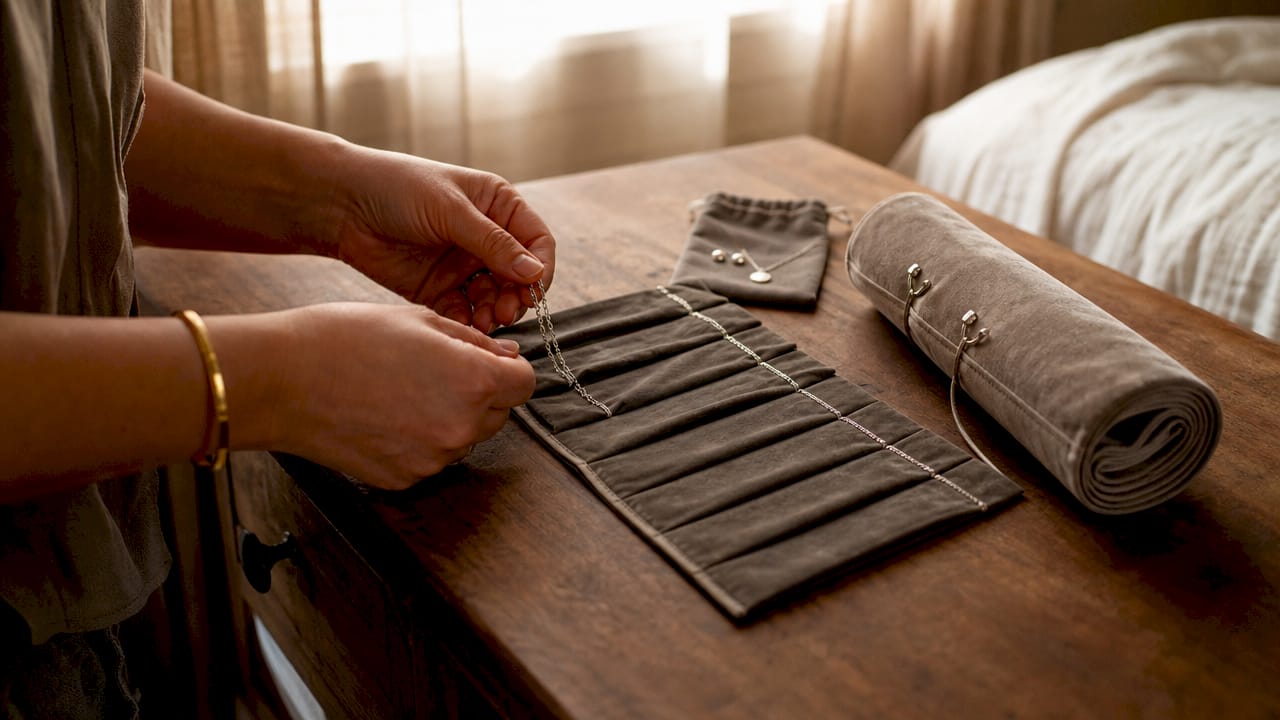
For rings and stud earrings, a tiered velvet tray inside a drawer keeps pairs together. Label each section with a small card if your collection is large. That one habit cuts morning selection time dramatically.
How should you store and display luxury handbags?
Luxury leather handbags stored incorrectly lose their shape permanently. The Upright-Only Rule is the single most important principle: every bag stands upright, stuffed with acid-free tissue paper, and never compressed or stacked against another bag. Stacking crushes structured silhouettes and creates permanent creases in soft leathers.
Open shelving at eye level is the display method of choice for serious collectors. Visible storage means you assess condition at a glance and select bags without disturbing others. Clear acrylic dividers keep bags upright and separated, preventing deformation while maintaining a clean, gallery-style aesthetic.
Hardware protection is a detail most collectors overlook. Metal clasps, chains, and buckles can permanently indent soft leather through a phenomenon called “hardware memory.” Wrapping metal parts in chamois cloth before storage prevents those impressions. Convertible straps should always be removed and stored separately for the same reason.
Key handbag storage habits at a glance:
- Store every bag upright with acid-free tissue stuffing inside
- Use breathable cotton dust bags or the original brand dust bag, never plastic
- Remove and store convertible straps separately to avoid surface impressions
- Wrap all metal hardware in soft chamois cloth before closing the dust bag
- Place bags on open shelves at eye level, never in stacked bins
Pro Tip: For handbag care between uses, insert a cedar block inside the dust bag. Cedar absorbs moisture and prevents the musty odor that develops in enclosed storage spaces.
Lighting matters more than most people realize. A simple LED strip along the shelf edge illuminates hardware and leather color accurately, so you coordinate designer accessories with confidence every morning.
Effective storage for luxury shoes and other accessories
Shoes, belts, scarves, and watches each need a different storage approach. Grouping them together without a system leads to creased silk, scratched buckles, and watches that need resetting every time you wear them.
-
Shoes: Adjustable shelves at eye level work best for heels and flats. Pull-out racks suit sneakers and loafers. Display stands are ideal for statement pairs like Saint Laurent heels or Gucci loafers that deserve visual prominence. Store shoes in their original boxes only if the boxes are labeled with a photo on the front. Unlabeled boxes hide shoes and guarantee you stop wearing them.
-
Scarves: Rolling silk scarves individually or folding them with acid-free tissue preserves color and prevents creasing. Store rolled scarves upright in a shallow drawer or bin so you see every pattern at once. Keep silk away from direct light to prevent fading.
-
Belts: Hang belts on individual hooks or a dedicated belt rack, coiled with the buckle facing outward. This prevents leather creasing at the fold point and keeps buckles scratch-free. Never fold a belt flat under other items.
-
Watches: Watch winders keep automatic luxury watches ready to wear without daily resetting. For collectors with multiple pieces, a winder cabinet with individual compartments is the practical choice. Dedicated leather watch rolls protect straps during travel and keep pieces separated at home.
-
Seasonal and lesser-used items: Use labeled bins or breathable fabric boxes for pieces you rotate out seasonally. Clear labels with contents and season prevent the “mystery box” problem that leads to forgotten accessories.
How do you coordinate luxury accessories cohesively?
Coordinating designer accessories in an organized space goes beyond storage. The goal is visual harmony that makes selecting and styling effortless. Material and hardware harmony is the professional stylist’s principle: match metal tones and leather finishes across your accessories to create a cohesive, understated look rather than a cluttered display.
Practical coordination habits that work:
- Group by metal tone: Keep gold-hardware pieces together and silver-hardware pieces together on your shelves. This makes it easy to coordinate high-end looks without second-guessing every morning.
- Organize by color family: Arrange bags and shoes in a color gradient from neutral to bold. This visual order prevents the “billboard” effect of mismatched colors competing for attention.
- Match leather finishes: Smooth leather, suede, and exotic skins each read differently. Grouping by finish helps you build outfits with intentional texture contrast rather than accidental clashing.
- Use consistent hardware finishes for closet fixtures: Brass hooks, chrome rods, and mixed metal fixtures undermine the visual calm of a well-organized space. Choose one metal finish for all storage hardware and commit to it.
For designer accessory styling, the rule is one focal piece per look. Your organized display should reflect that logic. Place statement pieces at the center of each shelf section and supporting accessories around them. That arrangement trains your eye to build outfits the same way a stylist would.
Essential maintenance habits for a pristine collection
A well-organized collection stays organized only with consistent upkeep. Frequent rotation, monthly tidying, and seasonal editing maintain organization and preserve accessory condition over time. Skipping these habits leads to clutter buildup and pieces that deteriorate unnoticed.
Pro Tip: Schedule a 15-minute monthly reset. Return every piece to its designated spot, check for dust, and note any items that need conditioning or repair. Consistency here protects thousands of dollars in accessories.
| Maintenance task | Frequency | Purpose |
|---|---|---|
| Return all pieces to designated spots | Weekly | Prevents clutter and misplacement |
| Wipe down shelves and organizers | Monthly | Removes dust that damages leather and metal |
| Condition leather bags and shoes | Every 2–3 months | Prevents cracking and dryness |
| Rotate seasonal pieces in and out | Twice yearly | Keeps active collection relevant and accessible |
| Inspect hardware and closures | Every 3 months | Catches wear before it becomes permanent damage |
Cleaning and conditioning are preventive care, not reactive fixes. A Prada Galleria bag conditioned regularly every few months holds its leather suppleness for decades. The same bag neglected for two years can crack at the fold lines, a repair that costs far more than the conditioner.
Key Takeaways
Organizing luxury accessories with dedicated storage methods, expert principles, and consistent maintenance is the most effective way to protect and enjoy a high-end collection.
| Point | Details |
|---|---|
| Zero loose jewelry storage | Every piece needs a compartment; loose storage causes scratches and tangles. |
| Upright-Only Rule for handbags | Store bags upright with acid-free stuffing and never stack them to prevent permanent creasing. |
| Hardware memory prevention | Wrap metal parts in chamois cloth and remove convertible straps before storage. |
| Material and hardware harmony | Match metal tones and leather finishes to coordinate designer accessories cohesively. |
| Monthly maintenance resets | Regular tidying, conditioning, and seasonal rotation keep the collection pristine and ready to wear. |
Why your storage setup is the real style decision
I’ve worked with luxury collections ranging from a single Chanel flap to 40-piece handbag walls, and the pattern is always the same. The collectors who wear their pieces most confidently are not the ones with the most items. They are the ones who can see every piece clearly and reach any item without disrupting the rest.
The Golden Zone principle changed how I think about display entirely. Placing your most-used accessories between eye level and waist height is not just a convenience tip. It is the difference between a collection you interact with daily and one you admire once a week. Pieces stored outside that zone get neglected. Neglected pieces deteriorate.
The other thing I tell everyone: lighting is not optional. A well-lit shelf turns your organized space into a display that inspires outfit choices. It also reveals condition issues, a scuff on a Valentino heel or a tarnished clasp on a Saint Laurent bag, before they become serious problems. Good lighting paired with a consistent care routine for designer accessories is the combination that keeps a collection genuinely wearable, not just beautiful to look at.
— Camila
Naiseshopper pieces worth adding to your organized collection
A well-organized wardrobe deserves pieces that hold their own on the shelf and in the outfit.
Naiseshopper carries authenticated designer pieces at accessible prices, including the Saint Laurent mid-top blue sneakers that make a bold statement on any display shelf, the Jimmy Choo pointed toe leather flats that anchor a neutral shoe collection with quiet elegance, and the Gucci G-Timeless watch for collectors building a serious timepiece rotation. Every piece ships with authenticity guaranteed and is priced to make building a curated collection genuinely possible. Browse the full selection at Naiseshopper and find the next piece your organized wardrobe is missing.
FAQ
How should fine jewelry be stored to prevent damage?
Fine jewelry must never be stored loose. Use velvet-lined compartments, acrylic organizers, or individual soft sleeves to keep each piece separated and scratch-free.
What is the Upright-Only Rule for handbags?
The Upright-Only Rule means every luxury handbag stands upright, stuffed with acid-free tissue, and is never stacked or compressed. Storing bags upright preserves shape and prevents permanent creasing in the leather.
How do you coordinate designer accessories without clashing?
Match metal tones and leather finishes across your pieces. Material and hardware harmony is the professional stylist’s method for mixing luxury and accessible accessories without creating a cluttered or mismatched look.
What is the Golden Zone in accessory organization?
The Golden Zone places your most-used accessories between eye level and waist height for easy reach and daily visibility. Items stored outside this zone tend to be neglected and are more likely to suffer damage from improper retrieval.
How often should you maintain a luxury accessory collection?
Return pieces to their designated spots weekly, wipe down storage surfaces monthly, and condition leather every 2–3 months. Seasonal editing twice a year keeps the active collection relevant and prevents clutter from building up.