The best luxury accessory storage tips come down to three non-negotiables: clean before you store, control your climate, and give every piece its own protected space. Your Chanel flap, your Hermès scarf, your fine jewelry — each one deteriorates faster from poor storage than from daily use. The good news? A few expert habits protect both the beauty and the resale value of your collection.
Here’s what every serious collector should do from day one:
- Store handbags upright on flat shelving, never stacked or leaned against a surface
- Stuff bags with acid-free tissue paper or purse pillows to hold their natural silhouette
- Keep accessories in breathable cotton dust bags, never plastic covers
- Wrap hardware, chains, and buckles in soft, lint-free cloth to prevent leather impressions
- Group accessories by category — bags together, jewelry separate, scarves rolled individually
- Maintain a climate-controlled environment with recommended relative humidity and temperature ranges to prevent leather damage.
- Keep everything away from heat sources, exterior walls, and direct sunlight
- Clean every piece thoroughly before putting it into storage
How to clean and prepare designer handbags before storage
Storing a dirty bag is one of the fastest ways to cause permanent damage. Oils, makeup residue, and surface grime embed deeper into leather during long storage periods, and what wipes off easily today becomes a stain in six months.
Start by emptying the bag completely, including the lining pockets. Shake out any debris, then wipe the exterior with a dry, lint-free microfiber cloth to remove dust. For finished leathers, unscented, residue-free baby wipes work well on surface dirt. Suede requires a dedicated suede brush to lift grime and restore the nap without flattening it.
Condition the leather before long-term storage. Leather behaves like skin: it dries out when neglected, and conditioning every 3–6 months keeps the fibers supple and crack-resistant. Avoid any product containing alcohol, oil, or perfume, as these degrade leather over time.
Pro Tip: Always spot-test any cleaning product on an inconspicuous interior seam before applying it to the exterior. Even products labeled “safe for leather” can react unpredictably with dyed or exotic skins.
Once cleaned, let the bag air dry completely in a well-ventilated space before placing it in storage. Sealing moisture inside a dust bag is a direct path to mold.
How to maintain handbag shape and use protective accessories
Shape loss is irreversible on most structured bags. A Bottega Veneta pouch that slumps in storage for a season will never fully recover its original silhouette without professional intervention.
Store bags upright, stuffed with acid-free tissue paper or a purse pillow sized to the bag’s interior. The goal is to replicate the bag’s natural at-rest silhouette, not to stretch it. Overstuffing bows side panels and stresses corner stitching, particularly on structured styles like the Hermès Sellier. Never use bubble wrap, newspaper, or plastic fillers — these trap moisture and off-gas compounds that damage leather and linings.
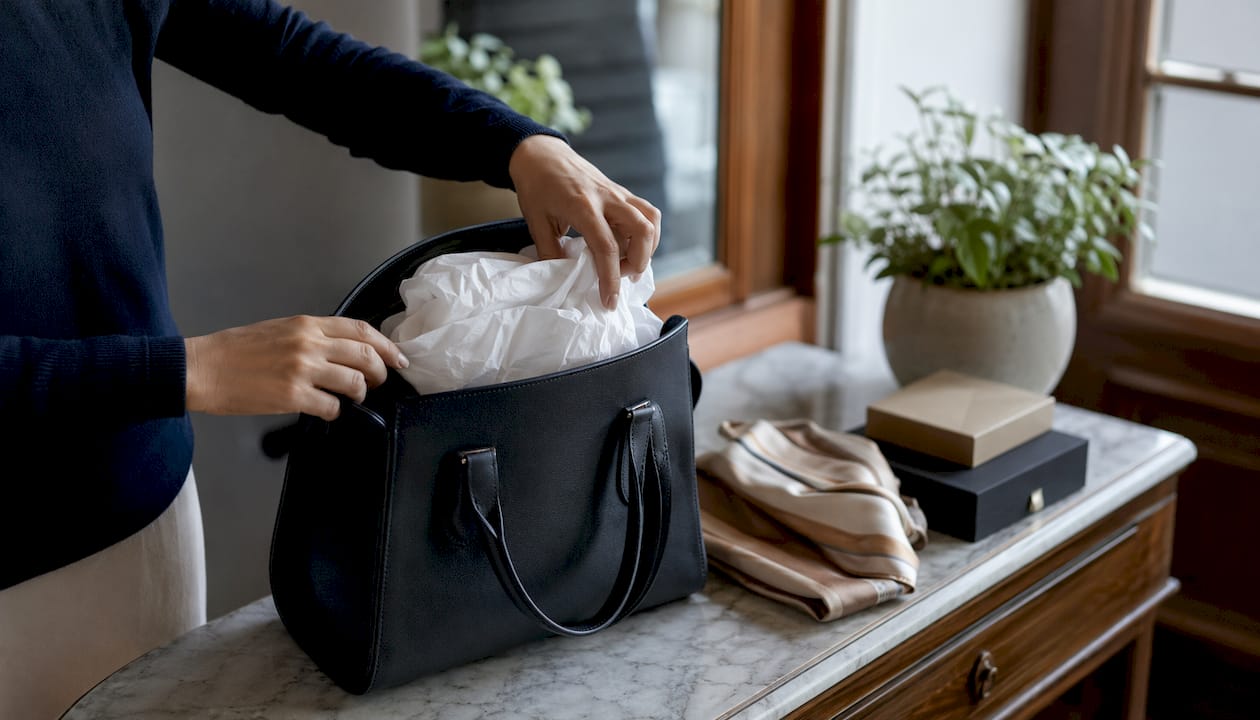
Wrap all metal hardware — chains, buckles, zipper pulls — in jeweler’s cloth or chamois before tucking them inside the bag. Loose chains left unprotected will indent satin, suede, and delicate evening leathers permanently. For bags with detachable shoulder straps, remove the strap and store it separately inside the dust bag.
Protective accessories every collector needs:
- Acid-free tissue paper (pH 7.0 or higher) for stuffing
- Breathable 100% cotton dust bags, one per handbag
- Jeweler’s cloth or chamois for wrapping hardware
- Purse pillows sized to specific bag styles
- Handbag liners or organizers to protect interior lining from spills and scratches
- Open shelving at eye level for visibility and air circulation
What climate conditions protect your luxury accessories best?
Temperature and humidity are the two variables that determine whether your leather ages gracefully or deteriorates. The Smithsonian Museum Conservation Institute recommends maintaining a relative humidity between 40–55% and a stable temperature of 60–75°F for textile and leather preservation.
| Condition | Ideal Range | Risk if Outside Range |
|---|---|---|
| Relative humidity | 40–55% RH | Below 40%: leather brittleness; above 60%: mold growth |
| Temperature | 60–75°F | Heat accelerates drying; cold causes stiffness |
| Light exposure | Zero direct light | UV fades color, degrades leather and fabric |
| Air circulation | Consistent airflow | Stagnant air promotes mold and odor |
Avoid placing storage near radiators, exterior walls, or any heat source. A small ultrasonic humidifier near your storage area addresses environments that run dry in winter. For humid climates, indicating silica gel packets — the kind that change color when saturated — help manage condensation spikes inside dust bags. Use one small packet per bag maximum, and replace it the moment it shifts color.
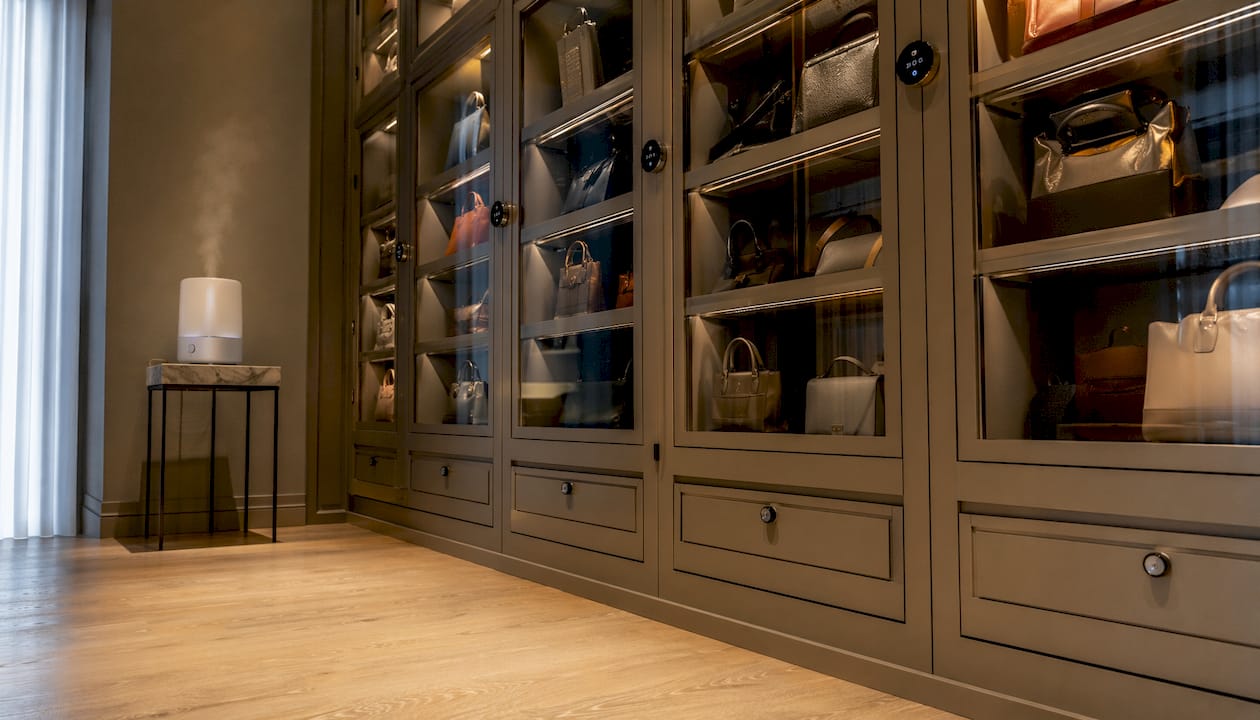
Plastic bins trap moisture, creating the stagnant microenvironment that accelerates mold and chemical damage to leather and linings. Open shelving or original boxes with lids left open are always the better choice.
Common storage mistakes that damage luxury accessories
Most collection damage happens not from use, but from storage errors that compound quietly over months.
- Hanging bags by their handles: This causes permanent stretching and silhouette distortion — one of the most common and most preventable mistakes
- Stacking or leaning bags: Creates creases and hardware impressions on adjacent pieces
- Using plastic covers or bubble wrap: Traps moisture and off-gases chemicals onto leather
- Storing near heat or sunlight: Fades color and dries leather faster than any amount of use
- Overstuffing: Stretches seams and warps the bag’s designed geometry
- Skipping climate control: Leads to brittleness in dry conditions or mold in humid ones
- Leaving hardware unwrapped: Metal buckles and chains indent leather permanently over time
How to protect your luxury collection from theft and loss
Physical preservation alone isn’t enough. A collection worth protecting from humidity deserves equal protection from theft.
Installing a motion-sensor monitored alarm system in the room where your accessories are stored is the baseline recommendation from Chubb, one of the leading insurers of high-value personal property. Arm every accessible door and window opening in that space, including those above ground level.
Pro Tip: Layer your protection: physical security (monitored alarm, locked cabinetry) combined with a Valuable Articles insurance policy gives you both deterrence and financial recovery if the worst happens. Talk to your broker about coverage that reflects current replacement values, not purchase prices.
Secure display options like locked glass-front cabinetry let you enjoy visibility without full exposure. Keep your collection out of sight from windows and avoid discussing specific pieces or storage locations publicly.
Custom storage solutions that combine style with protection
The right storage system does more than protect your pieces. It makes your collection genuinely usable, so a bag you own is a bag you actually wear.
Modular cabinetry with velvet-lined, soft-close pull-out trays minimizes friction and scratching for delicate items like watches and sunglasses. Dedicate separate compartments to each accessory category rather than mixing types in a single drawer. For high-end accessory organization, the standard is ready-to-wear access: every piece reachable within thirty seconds, without moving anything else.
Storage solutions by accessory type:
- Jewelry: Never store loose — use compartmentalized trays with individual positions; hang necklaces separately on velvet rolls to prevent tangling
- Sunglasses: Velvet-lined individual slots or pouches, never stacked
- Scarves: Folded in acid-free tissue or rolled in individual cotton sleeves; direct light fades Hermès prints over months
- Belts: Coiled with the buckle facing outward on a hook system inside a wardrobe door
- Watches: Individual cushions in a dedicated roll or case; automatic movements benefit from a watch winder. For proper care of metal bands, watch band storage guidance applies equally to luxury timepieces
- Handbags: Open shelving at eye level, one bag per slot, each in its own dust bag
How to prevent pests from damaging your luxury accessories
Pests are a real threat to leather, silk, and wool accessories, and most collectors never think about them until damage appears. Moths target natural fibers including cashmere scarves, wool-lined bags, and fabric accessories. Leather-boring beetles, though rarer, can damage untreated hides in dark, undisturbed storage.
Cedar blocks and sachets of dried lavender placed near storage areas repel moths without introducing chemicals that could damage delicate materials. Avoid mothballs entirely — the naphthalene they release discolors leather and leaves a persistent odor that is nearly impossible to remove from structured bags. Inspect your storage space seasonally, and check pieces you haven’t touched in several months for any signs of insect activity. Good air circulation, which also protects against mold, is equally effective against pest conditions.
Long-term storage for seasonal or rarely used pieces
Pieces you rotate out seasonally need a more deliberate approach than everyday bags. Before putting anything away for three months or longer, complete a full cleaning and conditioning cycle, then re-stuff and re-wrap every piece as described above.
Check on stored pieces every 4–6 weeks. Leather needs occasional air exposure, and a bag sealed in a dust bag for an entire season without any airflow can develop odors or surface changes even in a controlled environment. Open the dust bag briefly, let the piece breathe for an hour, then reseal. For long-term handbag preservation, storing inside original boxes with lids left open provides both structure and airflow. Never seal boxes shut.
Key Takeaways
Proper luxury accessory storage combines climate control, physical protection, and consistent maintenance to preserve both condition and resale value.
| Point | Details |
|---|---|
| Climate is non-negotiable | Maintain humidity and temperature within recommended safe ranges to prevent leather cracking and mold. |
| Shape protection starts with stuffing | Use acid-free tissue paper or purse pillows; never use plastic, bubble wrap, or newspaper. |
| Hardware causes hidden damage | Wrap all chains, buckles, and hardware in chamois or jeweler’s cloth before storage. |
| Security layers matter | Combine a monitored alarm system with a Valuable Articles insurance policy for full protection. |
| Organization enables use | Store every piece at eye level with individual space so your collection stays accessible, not archived. |
Ready to add pieces worth protecting? Naiseshopper carries authenticated designer accessories from Prada, Valentino, and Versace at prices that make building a serious collection genuinely possible. Shop the Prada leather stilettos or browse the full curated collection at Naiseshopper.