TL;DR:
- Professional authentication is essential due to the sophistication of modern counterfeits.
- Authenticity checks involve detailed analysis of components, documentation, and provenance.
- Independent verification protects buyers from financial loss, legal issues, and market devaluation.
One in three used Rolex watches on the secondary market fails professional authenticity checks. That number should stop any serious collector cold. The counterfeit watch trade is no longer limited to obvious fakes sold on street corners. Today’s sophisticated replicas can fool experienced buyers, trusted dealers, and even some basic verification tools. Whether you’re eyeing a vintage Patek Philippe or a pre-owned Audemars Piguet, understanding how authentication works is the single most important thing you can do before handing over five, six, or seven figures. This guide breaks down the entire process so you can buy with real confidence.
Table of Contents
- What is luxury watch authentication?
- Key steps and methods in authenticating luxury watches
- Understanding edge cases: Frankenwatches, superclones, and vintage challenges
- Economic impact and why expert authentication matters
- A collector’s lens: What most guides miss about luxury watch authentication
- Ready to buy with confidence?
- Frequently asked questions
Key Takeaways
| Point | Details |
|---|---|
| Professional authentication is critical | Even advanced counterfeits regularly fool collectors, making expert checks essential with high-value watches. |
| Edge cases are common | Frankenwatches and superclones make simple checks unreliable for luxury timepieces. |
| Market is growing fast | The global authentication market is expanding rapidly as collector demand for assurance rises. |
| Protect your investment | Effective authentication preserves both value and trust for buyers and sellers alike. |
What is luxury watch authentication?
Luxury watch authentication is the professional process of verifying that a timepiece is genuinely what the seller claims it to be. It goes far beyond a quick visual check or a glance at the serial number. True authentication confirms the watch’s origin, validates its components, and traces its provenance through documented history. Understanding luxury authentication basics helps you see why this process is non-negotiable for serious buyers.
Authentication differs significantly from casual verification. A casual check might involve comparing logos, checking the crown action, or listening to the movement. Professional authentication, by contrast, involves trained specialists using calibrated tools, brand-specific databases, and deep knowledge of production variations across model years. The difference matters enormously when you’re dealing with a watch worth $20,000 or more.
The goals of a proper authentication process include:
- Verify origin: Confirm the watch was manufactured by the stated brand
- Validate components: Ensure all parts are correct for the reference and production period
- Trace provenance: Review service records, box and papers, and ownership history
- Detect substitutions: Identify any replaced or non-original parts
- Confirm value: Establish a reliable basis for pricing and resale
The stakes are uniquely high in luxury watches because of the extraordinary complexity involved. Rolex alone produces hundreds of reference variations across its catalog, each with specific dial configurations, bezel types, and movement generations. A single wrong detail can indicate a counterfeit or a compromised piece. As authenticity explained in depth, the margin for error in this category is essentially zero.
“The luxury timepiece authentication market was valued at $1.3 billion in 2024, reflecting just how critical verified provenance has become for collectors and investors worldwide.”
That figure tells you everything about the direction this industry is heading. Buyers are no longer willing to take risks on unverified pieces, and the market has responded with a growing ecosystem of professional authenticators, certification services, and specialist platforms.
Key steps and methods in authenticating luxury watches
Knowing what authentication means is one thing. Understanding how it’s done in practice is the next essential step. Professional authentication follows a structured sequence that leaves very little to chance.
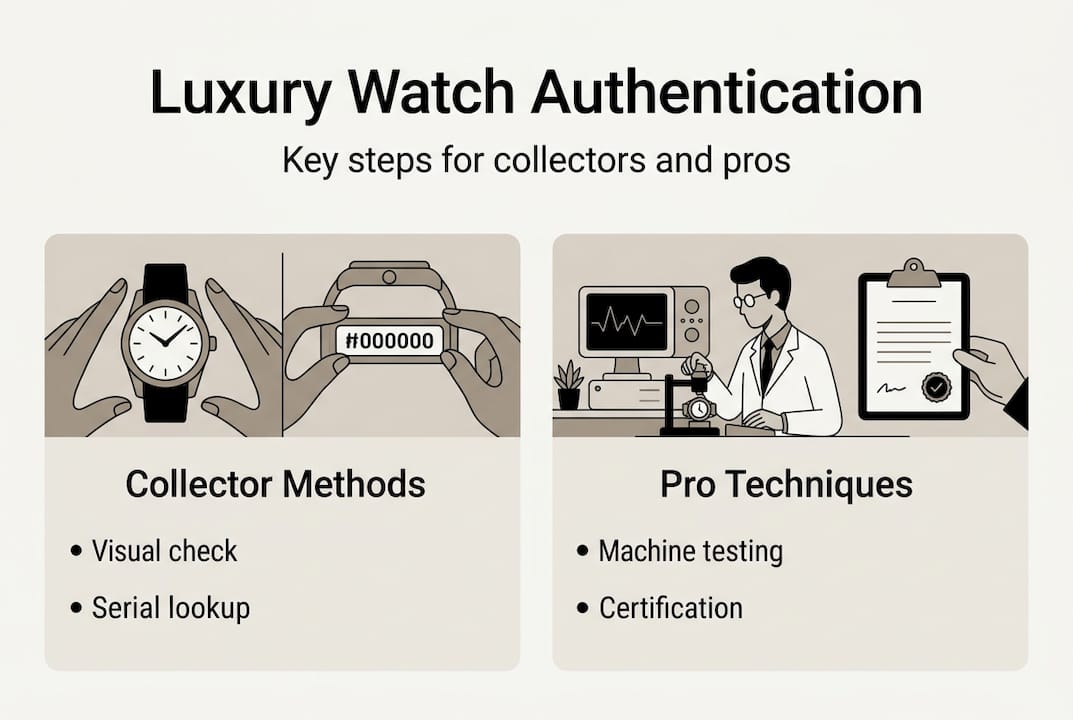
- Visual inspection: Examine the dial, hands, case, and crown under magnification for print quality, finishing consistency, and color accuracy
- Serial and reference verification: Cross-check engraved serials against brand databases to confirm production records
- Movement analysis: Open the caseback and inspect the caliber for correct finishing, engravings, and component layout
- Documentation review: Authenticate box, papers, service records, and any accompanying certificates
- Provenance check: Trace ownership history and confirm the watch has not been reported stolen or involved in disputes
- UV and tool-assisted checks: Use ultraviolet light to detect refinishing, replaced parts, or tampered engravings
| Method | DIY collector | Professional service |
|---|---|---|
| Visual inspection | Basic | Magnified, calibrated |
| Serial verification | Limited database access | Full brand database |
| Movement analysis | Rarely possible | Standard procedure |
| Documentation review | Self-assessed | Expert validated |
| UV and tool checks | Unlikely | Routine |
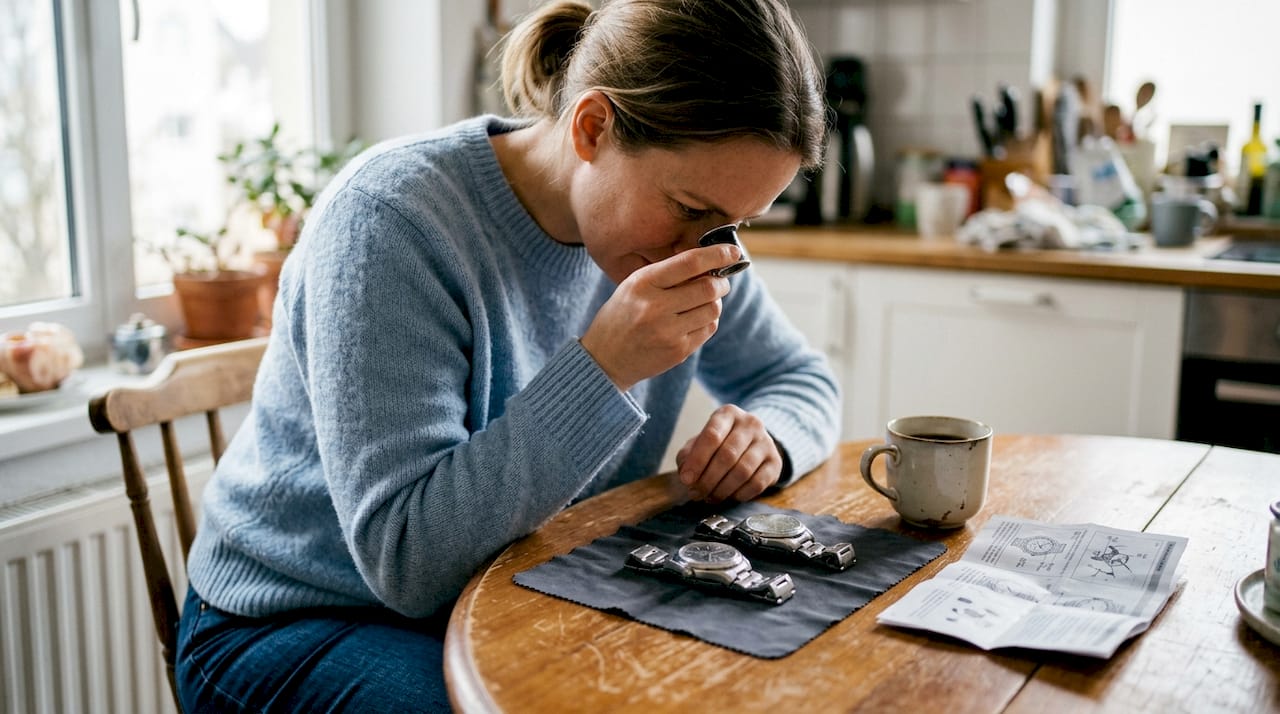
For professional authentication reasons, the gap between what a collector can do at home and what a certified specialist delivers is significant. DIY checks are useful for filtering obvious fakes, but they consistently miss the sophisticated threats.
Pro Tip: Always insist on third-party certification for any watch purchase above $5,000. Even if the seller provides documentation, an independent assessment protects you from Frankenwatches that pass casual checks but fail holistic authentication. Use these expert tips for buying to sharpen your pre-purchase checklist.
Superclones are the most alarming development in recent years. These are replicas engineered to match the weight, finishing, and even the movement sound of genuine pieces. They are not cheap products. Some superclones cost hundreds of dollars to produce and are deliberately designed to defeat casual and intermediate-level checks.
Understanding edge cases: Frankenwatches, superclones, and vintage challenges
Not all counterfeits are obvious. A closer look at specialty cases reveals how nuanced authentication truly is, and why even experienced collectors get caught off guard.
A Frankenwatch is a watch assembled from genuine brand components that do not belong together. For example, a Rolex Submariner might carry an authentic dial from one production year, a case from another, and a movement from a third. Every individual part is real. But the combination is wrong, making the watch inauthentic and significantly less valuable. These pieces are especially dangerous because they feel right in hand and pass surface-level scrutiny.
Edge cases include Frankenwatches and superclones that replicate weight and finishing to a degree that surprises even veteran buyers. Superclones go a step further by mimicking the internal movement, using cloned calibers that look correct under basic inspection.
| Edge case | Key challenge | Telltale sign |
|---|---|---|
| Frankenwatch | Genuine parts, wrong combination | Mismatched production dates |
| Superclone | Cloned movement and finishing | Inconsistent engravings under magnification |
| Vintage piece | Missing archival data | Period-incorrect parts or patina |
| Refinished watch | Altered surfaces | UV-revealed polishing marks |
Knowing what makes a watch luxury at a component level is your best defense against these traps. Authentic luxury watches maintain strict consistency across dials, hands, and movements for each specific reference and production period.
Vintage watches present a separate category of challenge. Older models may lack complete archival records, making it harder to confirm original specifications. Natural aging creates patina and wear that can either be authentic or artificially induced. Parts may have been legitimately replaced during historical servicing, which complicates the assessment. Specialists who focus on vintage pieces develop a calibrated eye for period-correct details that generalist authenticators sometimes miss.
Key warning signs across all edge cases:
- Date fonts that differ from brand standards for the production year
- Cyclops lens magnification that does not match the correct specification
- Caseback engravings that show inconsistent depth or spacing
- Crown action that feels loose or does not click with the correct resistance
- Lume plots that glow the wrong color or fade unevenly
Economic impact and why expert authentication matters
Beyond the expert challenges, the growing impact of inauthentic pieces and the market’s response underline why authentication can never be skipped.
The numbers are striking. Bezel rejected 34% of submitted watches in 2025, with 51% of those rejections involving Rolex. That means more than one in three watches submitted to a major authentication service failed to pass. The rejection rate has been climbing year over year, reflecting both the sophistication of counterfeits and the stricter standards being applied by professional services.
“Authentication is not a luxury add-on. It is the foundation of every sound purchasing decision in the secondary watch market.”
For buyers, the economic risks of skipping authentication are severe:
- Financial loss: Paying full price for a counterfeit or compromised piece
- Resale difficulty: Unverified watches are harder to sell and command lower prices
- Legal exposure: Knowingly reselling a counterfeit can carry legal consequences
- Insurance complications: Insurers may deny claims on watches without authentication records
- Emotional cost: The disappointment of discovering a prized piece is not genuine
For reasons to authenticate that go beyond personal protection, consider the broader market impact. Counterfeits erode trust across the entire secondary market, depressing values for legitimate pieces and creating friction for honest sellers. Every authenticated transaction strengthens the ecosystem that protects your collection’s long-term value.
Pro Tip: Treat authentication costs as part of your purchase budget, not an afterthought. A $200 to $500 authentication fee on a $15,000 watch is a small price for certainty. Check out the authenticated pre-loved guide for practical frameworks on buying verified pre-owned luxury.
A collector’s lens: What most guides miss about luxury watch authentication
Most authentication guides focus on procedure and tools. What they rarely address is the human element, and it’s the part that matters most.
Even experienced collectors get fooled. Emotional investment in a particular reference, excitement about a rare find, or simple fatigue during a long buying session can all compromise your judgment. The psychological pull of a great deal is powerful, and sophisticated sellers know how to use it. We’ve seen seasoned buyers skip steps they know they should follow because the watch “felt right.”
Technology helps, but it also creates false confidence. Database tools and AI-assisted verification are improving fast, but collector buying tips consistently point to the same lesson: no single tool is definitive. The most reliable authentication combines multiple methods, multiple perspectives, and a healthy dose of skepticism.
The most important habit you can build is this: always seek outside verification, regardless of your expertise level. Not because you lack knowledge, but because an independent eye removes bias from the equation. The collectors who never get burned are not necessarily the most knowledgeable. They are the most methodical.
Ready to buy with confidence?
Putting authentication knowledge into practice starts with choosing the right place to buy. At Naise Shopper, every luxury watch in our catalog goes through rigorous verification before it reaches you.
Whether you’re looking for a statement piece like the Gucci Dive Watch 40mm or exploring our full range of certified timepieces, you’re shopping on a trusted luxury watch marketplace built around one promise: authenticity you can count on. Our team handles the hard work so you can focus on the joy of the find. Explore our curated selection and buy with total peace of mind.
Frequently asked questions
What are the most common signs of a counterfeit luxury watch?
The most common signs include incorrect logo fonts, uneven printing, off-weight cases, non-matching serials, and movements that differ from brand standards. Superclones replicate weight but typically fail consistency checks across different production eras.
How reliable is self-authentication compared to professional services?
Self-authentication catches basic fakes, but even seasoned collectors miss advanced counterfeits, making professional assessment essential for high-value purchases. Professional verifiers rejected 34% of watches in 2025 submissions, a rate no casual check could replicate.
What is a ‘Frankenwatch’?
A Frankenwatch is a watch composed of genuine brand parts but not assembled to original specifications, making it inauthentic and far less valuable. Frankenwatches pass casual checks but fail holistic inspection by trained specialists.
Why are vintage watches harder to authenticate?
Vintage watches may lack archival data, have period-inconsistent parts, or show natural age-related variation that requires deep expertise to verify. Edge cases include vintage versus modern historical variations that only specialists can reliably distinguish.