Measure your foot length in centimeters, then check the specific brand’s official size chart before you trust any generic EU-to-US table. EU sizing moves in Paris points (6.67mm increments) while US sizing moves in roughly 8.47mm jumps, so the two systems drift apart as sizes get bigger. Anchoring to your cm measurement first is what actually cuts down on returns.
TL;DR:
- Rely on foot length in centimeters and brand-specific size charts rather than generic EU-to-US tables to reduce sizing errors and returns.
- Measure your foot at the end of the day while wearing the expected socks or insoles, using the larger foot’s measurement to ensure accuracy.
- Designer shoes tend to run small and narrow, especially in pointed-toe or structured styles, making sizing up advisable when between sizes.
- Brands like Chanel and Louboutin often fit tighter or smaller, requiring you to order a half size larger than the standard conversion suggests.
- Always verify sizing details with the brand’s specific chart and customer feedback for that style before purchasing, especially for fit-sensitive shoes.
Table of Contents
- Designer Shoe Size Conversion Charts You Can Actually Use
- How Do You Measure Your Foot for Shoe Shopping?
- Do Chanel, Gucci, and Louboutin Run True to Size?
- What Mistakes Lead to the Most Shoe Returns?
- Why Trust This Designer Shoe Sizing Guide?
- Fit Beats the Number on the Box
- Shop Designer Shoes With Confidence
- Where to Verify Shoe Sizing Details
- Sources
- FAQ
Designer Shoe Size Conversion Charts You Can Actually Use
Generic conversion charts get you in the neighborhood, not the exact address. The math explains why: a Paris point equals 6.67mm, while a full US size jumps by about 8.47mm. Those two systems don’t scale at the same rate, so a conversion that lines up perfectly at a size 37 can be off by half a size by the time you reach a 42. That’s not sloppy sizing. It’s basic geometry between two measurement systems that were never designed to match each other.
Here’s a reference table using foot length in centimeters as the anchor, which is the one number that stays consistent no matter which brand’s chart you’re reading:
| EU Size | US Women’s | US Men’s | Foot Length (cm) |
|---|---|---|---|
| 38 | 7.5 | ~6 | ~24.1 |
| 38.5 | ~8 | 6.5 | ~24.4 |
| 39 | ~8.5 | 7 | 24.8 |
| 40 | ~9 | 7.5 | ~25.4 |
| — | 9.5 | ~8.5 | ~26 |
| 42 | ~10 | ~9 | ~26.7 |
| — | ~10.5 | ~10 | 27.3 |
| 44 | ~11 | ~10.5 | ~27.9 |
Treat this as a starting point, not gospel. A US women’s size 8 generally maps to a EU 38 or 38.5, but “generally” is the operative word. This is exactly why tools built around foot length in centimeters, also known as Mondopoint sizing, give more reliable results than a straight EU-to-US formula. Once you know your cm measurement, you can cross-reference it against a specific brand’s chart instead of guessing your way through a universal table that was never built with that brand’s lasts in mind. Our own designer size conversion guide walks through this same logic across shoes and ready-to-wear.
How Do You Measure Your Foot for Shoe Shopping?
Getting an accurate cm measurement takes five minutes and solves most sizing headaches before they start.
- Stand on a piece of paper with your heel against a wall.
- Mark the point where your longest toe ends.
- Measure the distance from the wall to that mark in centimeters.
- Repeat for both feet, since most people have one foot slightly longer.
- Use the larger measurement as your true foot length.
Measure at the end of the day, when feet are at their largest after hours of standing and walking. If you typically wear the shoe with a thin sock or an insole, measure with that in place, and add a few extra millimeters of allowance for toe room, especially with stiffer leathers that won’t stretch much over time.
Width matters just as much as length, and this is where a lot of shoppers get tripped up. US sizing uses letters like B for a standard women’s width and D for a standard men’s width, while EU sizing rarely labels width at all. If your foot is wider than average, a perfect length match in EU sizing can still feel tight across the ball of the foot.
Pro Tip: If you fall between two sizes on the cm chart, size up rather than down, especially for structured leather or pointed-toe styles that won’t give much with wear.
Do Chanel, Gucci, and Louboutin Run True to Size?
Not consistently, and that’s the real lesson behind every designer size conversion. Luxury labels use their own lasts, and those lasts vary not just by brand but by shoe style within the same brand.
- Chanel tends to run smaller than standard sizes, particularly in ballet flats and structured pumps.
- Christian Louboutin often fits tighter, partly due to the pointed toe box.
- Gucci varies widely by style. Sneakers like the Ace are often close to standard sizing, while dressier loafers can fit narrower.
- Prada usually fits close to standard sizes, but rigid materials like patent leather offer less break-in room.
- Manolo Blahnik often fits smaller in the toe box, a common trait among pointed-toe designer pumps.
Designer shoes commonly run slightly small and narrow, and pointed-toe styles amplify that effect regardless of brand. Loafers and sneakers tend to sit closer to a brand’s stated size than pumps or mules do. Here’s how to put it together: if your foot measures 25.5cm and you’re eyeing a Chanel flat that runs half a size small, order the EU 39.5 or US 8.5 instead of the EU 39 the standard chart suggests. Our Gucci sneaker sizing breakdown covers this exact style-by-style variation in more depth.
What Mistakes Lead to the Most Shoe Returns?
Most sizing mistakes come down to trusting one source when you needed three.
- Relying only on a generic EU-to-US chart instead of the brand’s own sizing page.
- Ignoring width entirely and focusing on length alone.
- Skipping style-specific notes, so a pointed pump gets ordered the same size as a sneaker from the same brand.
- Buying without checking the return policy first, especially on final-sale luxury items.
Before you check out, run through this: measure your foot in cm, pull up the brand’s official chart, skim customer fit notes for that specific style, confirm the return window, and if you’re still unsure, order two adjacent sizes and send one back. Size up when the style has a pointed toe, rigid material, or a brand reputation for running small. Size true to chart, or even down slightly, for stretchy materials or styles noted as roomy.
Why Trust This Designer Shoe Sizing Guide?
This guide combines published brand size charts, established measurement standards like the Paris point and Mondopoint systems, and fit notes gathered from real designer shoe buyers, curated by Camila for Naiseshopper.
Designer shoe fit notes and customer reviews matter enormously for luxury purchases because handcrafted styles can vary from batch to batch, even within the same brand and size.
Naiseshopper curates authenticated designer listings alongside brand sizing information, and our designer shoe fitting guide expands on measurement and brand-chart use in more detail.
Fit Beats the Number on the Box
Chase comfort, not a perfect number match. If a size 39 Chanel flat and a size 39.5 fit your foot equally well in the store, the one that doesn’t pinch after twenty minutes of walking wins every time. For pointed-toe pumps or anything structural, try before you buy when you can, or order from a retailer with a genuinely flexible return policy so uncertainty doesn’t turn into a costly mistake.
— Camila
Shop Designer Shoes With Confidence
You get more than a static size chart: authenticated designer shoes with sizing details pulled straight from the brand, plus access to assistance when a style’s fit history raises questions.
Every listing points you back to the specific brand’s sizing guidance rather than a one-size-fits-all conversion table, so you’re comparing your cm measurement against the right reference before you commit. For fit-sensitive styles, such as pointed pumps or flats with limited stretch, personal shopper assistance can help address sizing questions before checkout rather than after a return request. Localized pricing and secure international shipping are offered to complete the purchasing process. Check the size chart on the product page for your next pair and review the return and insurance options before you place your order.
Where to Verify Shoe Sizing Details
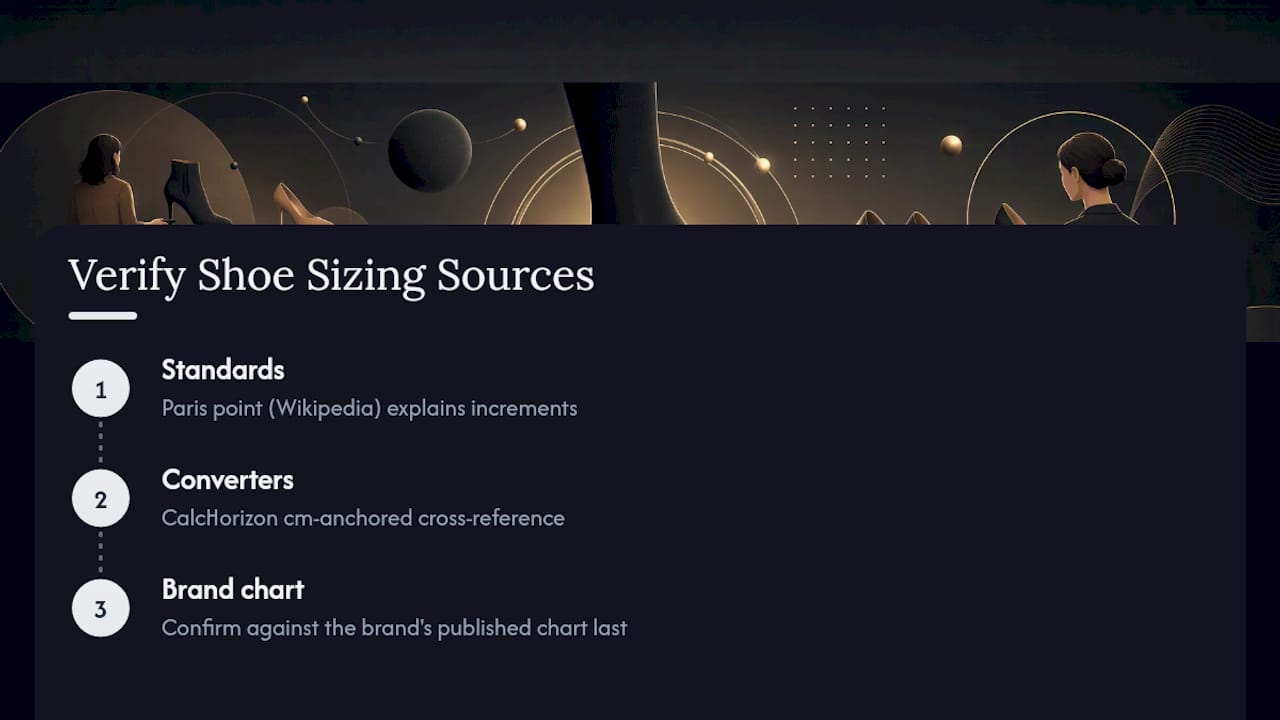
For the measurement science behind conversions, the Paris point standard on Wikipedia explains the increment differences driving EU-to-US drift. For cm-anchored conversions across multiple systems, CalcHorizon’s shoe size converter is a solid cross-reference. Always confirm against the specific brand’s own published chart last.
Sources
- Paris point — Wikipedia
- Shoe Size Converter | US, EU, UK, JP/KR, MX & More | CalcHorizon
- Designer Shoe Sizing Guide: How to Find the Perfect Fit for Luxury Bra – Sole Guard
FAQ
What Is a Size 42 in Designer Shoes?
A EU 42 typically converts to a US women’s size 10.5 to 11 or a US men’s size 9, corresponding to a foot length of about 26.7cm. Confirm against the specific brand’s chart, since pointed-toe or narrow-cut styles can run tighter at this size.
What US Size Is a Designer Size 8?
A US size 8 usually corresponds to a EU 38 or 38.5, though this isn’t universal since brands apply their own lasts. Measure your foot at roughly 24.1 to 24.4cm and check the brand’s specific chart to confirm.
Is a Size 9 a EU 39 or 40?
A US women’s size 9 most commonly converts to a EU 39 to 40, with a foot length near 25.4cm. Brands running small, like Chanel or Louboutin, may put you closer to the EU 40 for a comfortable fit in that size.
What Is a EU 44 in US Sizing?
A EU 44 generally converts to a US men’s size 10.5, matching a foot length around 27.9cm. Check width as well, since EU sizing rarely specifies it and a true length match can still feel narrow.