Get the right fit by measuring in centimeters, fitting the larger foot, and using each brand’s official size chart — then adjust by the brand and style rules below. This designer shoe fitting guide pairs podiatrist-backed measurement protocol with brand-specific tendencies for Gucci, Christian Louboutin, Balenciaga, Prada, Chanel, Saint Laurent, Bottega Veneta, and Valentino, so you can order online with real confidence.
Fast rules to apply right now:
- Measure heel-to-longest-toe length in centimeters at the end of the day, standing with full weight
- Fit to the larger foot; use a removable insole to compensate on the smaller side
- Leave 1–1.5 cm (roughly one thumb-width) between your longest toe and the shoe’s end
- Heel slip up to a few millimeters on new stiff leather is normal; more than that signals a poor fit
- Size up 0.5 for pointed-toe heels and French-heritage narrow lasts; stay true to size for most sneakers
- Patent leather and satin have almost no give — size up if the fit feels snug at the toe box
Key Takeaways
Measure in centimeters, fit the larger foot, and apply brand-specific size rules — those three steps resolve the majority of designer shoe fit problems before a purchase is made.
| Point | Details |
|---|---|
| Measure in CM at end of day | Stand with full weight; record the larger foot; feet expand 5–8% from morning to evening. |
| Leave 1–1.5 cm toe space | One thumb-width gap between the longest toe and shoe end is the podiatrist standard. |
| Apply brand size rules | Louboutin and Chanel typically need +0.5 to +1.0 US; Balenciaga sneakers often need –0.5 US. |
| Material determines stretch | Nappa leather molds with wear; patent and satin have almost no give — size up if snug. |
| Naiseshopper personal shopper | Share your CM measurement and style name for last-specific fit guidance before you buy. |
Table of Contents
- How do you measure your feet correctly for designer shoes?
- How do you convert your CM measurement to US, EU, UK, and Italian sizes?
- What are the fit tendencies for major designer brands?
- How do foot shape and width affect which designer size you should choose?
- How does heel height change the way a shoe fits?
- When should you size up in designer shoes?
- How do you buy designer shoes online and minimize returns?
- What can you do if a designer shoe fits slightly off?
- What do podiatrists and personal shoppers recommend for getting the fit right?
- What most buyers get wrong about designer shoe sizing
- Naiseshopper makes sizing less stressful for luxury shoe buyers
- Sources
How do you measure your feet correctly for designer shoes?
The measurement that matters is your heel-to-longest-toe length in centimeters, taken while you are standing with your full body weight on the foot. That single number is what designer brand size charts actually use — it is the Mondopoint principle, and it removes the guesswork from international conversions.
Step-by-step measurement method:
- Time it right. Measure at the end of the day. Feet can expand significantly from morning to evening, so an afternoon or evening measurement captures your foot at its largest and prevents a shoe that fits at 9 AM from pinching by 3 PM.
- Gather your tools. You need a sheet of blank paper (larger than your foot), a pencil or pen, and a ruler or measuring tape in centimeters.
- Set up the wall method. Place the paper flat against a wall on a hard floor. Stand on the paper with your heel touching the wall and your full weight on the foot.
- Trace the outline. Have someone trace around your foot, or hold the pencil vertically and trace yourself. Keep the pencil perpendicular to the paper — angling it inward shortens the measurement.
- Mark and measure. Draw a straight line from the back of the heel mark to the tip of the longest toe. Measure that line in centimeters to one decimal place (e.g., 24.5 cm).
- Measure both feet. Foot asymmetry is common. Record both measurements and use the larger number when consulting any size chart.
- Note your width. Measure the widest part of your foot across the ball. This number matters for last selection, especially in narrow-lasted designer styles.
A Brannock device captures length, arch length, and width simultaneously and is the most precise in-store tool available. If you have high arches or a notably long arch relative to your heel-to-toe length, ask a sales associate to take a Brannock reading — arch length can push you into a different size than heel-to-toe alone suggests.
Pro Tip: Wear the socks or hosiery you plan to use with the shoes when you measure. A sheer stocking versus a padded sock changes the effective fit by up to 2–3 mm — enough to matter in a narrow-lasted pump.
Pre-purchase checklist:
- Measurement taken at end of day, standing, full weight
- Both feet measured; larger foot recorded
- Width (ball measurement) noted
- Socks or hosiery worn during measurement
- Measurement repeated if you traced without a helper (single-person tracing tends to run short)
How do you convert your CM measurement to US, EU, UK, and Italian sizes?
Convert by matching your measured centimeters to the brand chart’s CM column — that is the most reliable method, and it sidesteps the inconsistency between US, EU, UK, and Italian numbering systems. Designer houses use Italian, French, or brand-specific sizing that does not map 1:1 to US sizes, so always go CM-first rather than converting label-to-label.
CM-based size conversion reference (women’s)
Worked example — 24.5 cm foot:
Your measured length is 24.5 cm. The table maps that to US 7.5 / EU 37.5 / UK 5 / IT 37.5. Now apply the brand and style adjustments:
- Ordering a Louboutin pointed-toe pump? Size up to US 8 (EU 38) — the narrow last compresses the toe box.
- Ordering Balenciaga Track sneakers? Stay at US 7.5 — the sneaker last is generous.
- Ordering a Chanel ballet flat? Size up 0.5 to US 8 — Chanel flats run narrow and short.
Half-size rounding rules:
- If your CM measurement falls between two rows, choose the larger size for closed-toe styles and the smaller for open-toe sandals.
- For pointed-toe heels or patent leather, always round up — the toe box narrows and the material won’t give.
- Italian sizing at luxury houses tends to be truer to foot length; French-heritage lasts often run smaller and may need a half-size up.
What are the fit tendencies for major designer brands?
Brands differ — use the brand rule first, then your measured CM second. Italian sizing is typically truer to foot length while French-style or house-specific lasts can run smaller, but even within a single house, a sneaker and a pointed-toe heel can behave like two entirely different sizing systems.
-
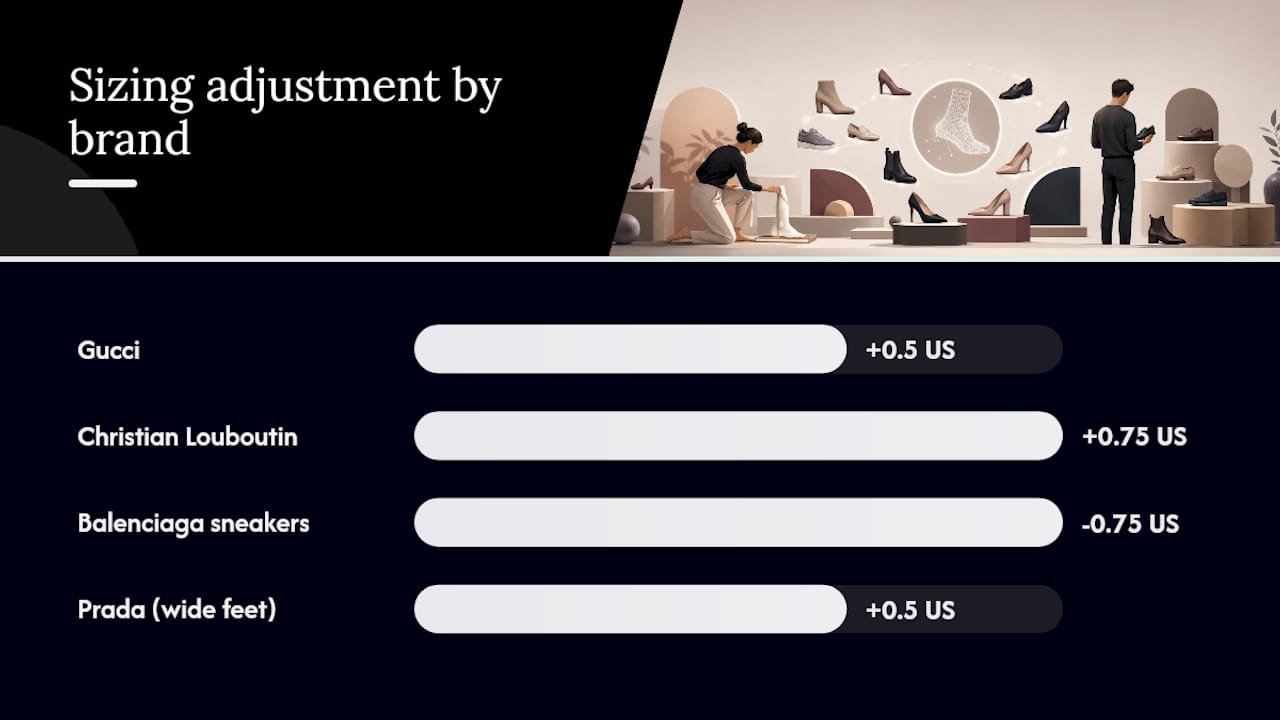
Gucci: Runs about half a size small across most styles. Size up 0.5 US. The Horsebit loafer and Princetown mule are particularly snug at the toe box. Sneakers like the Ace tend to fit more generously — some buyers stay true to size there. Soft leather uppers will mold over time, so a snug-but-not-painful initial fit is acceptable in loafers.
-
Christian Louboutin: The most consistent advice from buyers and stylists: size up 0.5 to 1.0 US, especially in pointed-toe pumps and stilettos. The narrow last is a deliberate design choice, not a manufacturing variation. Wide-footed shoppers often need a full size up. Louboutin sneakers (Rantulow, Louis Junior) fit closer to true size.
-
Balenciaga: Sneaker silhouettes (Triple S, Track, Speed) run large — size down 0.5 to 1.0 US. Structured heels and boots tend to fit true to size or slightly small. The chunky platform sole on many sneakers does not affect length sizing, only the visual proportion.
-
Prada: Generally true to size in classic pumps and loafers, but the Monolith lug-sole boot and some structured styles run slightly narrow. Wide-footed shoppers should size up 0.5. Nappa leather styles will soften with wear; saffiano leather has less give and warrants a more precise fit from the start.
-
Chanel: Ballet flats run small and narrow — size up 0.5 to 1.0. The cap-toe slingback tends to run true to size in length but narrow in width. Chanel’s two-tone flats are a classic fit challenge: the leather is stiff initially and the toe box is short. Allow for break-in time or size up if your foot is wide.
-
Saint Laurent: Pumps and heeled sandals run true to size in length but narrow. Wide feet should size up 0.5. The Tribute sandal and Opyum pump have a steep pitch that pushes the foot forward — check toe room carefully. Saint Laurent sneakers fit true to size or slightly large; some buyers size down 0.5 in low-top styles.
-
Bottega Veneta: Runs true to size in most styles. The BV Lido sandal and Stretch mule are generous. Intrecciato leather styles soften quickly and conform well to the foot — a snug initial fit usually resolves within a few wears. Wide feet tend to do well here compared to other luxury houses.
-
Valentino: The Rockstud pump runs slightly small and narrow — size up 0.5. The Tan-Go platform pump fits more generously due to the platform construction. Garavani sneakers (Open for a Change, Freedots) tend to run true to size. Satin evening styles have no stretch; size precisely or go up 0.5.
Pro Tip: Fit tendencies shift by season when a house introduces a new last. Check the product-specific reviews for the exact style and season you are buying — a Gucci loafer from one collection can fit differently from the same model released two seasons later.
Relying on “true to size” language in product descriptions is risky. That label reflects the brand’s own last, not a universal standard. When you are uncertain, contact customer service or a personal shopper with your CM measurement and the specific style name — that combination gives them enough to give you a real answer.
How do foot shape and width affect which designer size you should choose?
Width and foot shape often matter more than length alone. The right choice is the combination of length, width, and last that matches your foot anatomy — not just the number on the size chart.
-
Wide feet: Many designer lasts are cut narrow by design. Sizing up 0.5 in length can open the toe box slightly, but it also lengthens the shoe, which creates heel slip. A better first move is to look for styles with a rounder or more square toe box (Bottega Veneta, some Prada loafers) rather than defaulting to a larger size.
-
Narrow feet: Pointed-toe styles and slim lasts (Louboutin, Saint Laurent pumps) can actually suit narrow feet well at true size. The risk is heel slip — use a gel heel grip to secure the counter rather than sizing down, which compresses the toe.
-
High arches: The instep sits higher, which can cause pressure across the vamp (the front upper). Look for styles with adjustable straps or a higher-cut vamp. Sizing up rarely fixes arch pressure — last shape is the variable that matters.
-
Flat feet: Flat-footed shoppers often find structured insoles improve comfort dramatically in heeled styles. The shoe’s arch support rarely matches a flat foot’s needs, so a thin orthotic insert is worth carrying.
-
Bunions: Avoid pointed-toe lasts entirely. Round or almond-toe silhouettes with soft leather (nappa, suede) are the most forgiving. Sizing up 0.5 can relieve pressure on the bunion joint, but a cobbler stretch at the ball is often a more targeted fix.
Pro Tip: Never size up a full size to solve a width problem. A shoe that is too long shifts your foot’s bend point away from the shoe’s flex point, which causes blisters at the ball and an unstable stride. Address width with last selection or a cobbler stretch, not a larger size.
How does heel height change the way a shoe fits?
Higher pitch pushes the foot forward, compressing the toes into the front of the shoe — so the fit you need at the toe box changes with every centimeter of heel height. This is why a shoe that fits perfectly as a flat can feel tight in the same size as a 90 mm pump.
- Flats and low heels (under 40 mm): Fit true to your CM measurement. The foot sits level and the toe box pressure is minimal.
- Mid heels (40–70 mm): A slight forward shift occurs. If the toe box is pointed or narrow, consider sizing up 0.5. Check that the heel cup holds firmly — a loose heel at mid height causes blisters faster than at flat.
- High heels (85–100 mm and above): The forward pitch is significant. Size up 0.5 in most closed-toe styles. Add a metatarsal pad or ball cushion to redistribute pressure off the forefoot. Walk several steps during try-on and check that your toes are not curling or gripping the insole.
- Platform heels: The platform offsets some of the pitch, reducing the effective incline. Platforms often fit closer to true size than a stiletto of the same stated height. The Valentino Tan-Go and Balenciaga platform styles are good examples — buyers frequently report no need to size up despite the height.
High-heeled shoes can feel tight due to pitch rather than actual length. Before sizing up, check whether the heel cup is secure and whether the arch aligns with the shoe’s arch point. If the arch does not align, changing size rarely fixes the discomfort — last shape is the issue.
When should you size up in designer shoes?
Size up when the shoe is uncomfortably narrow in the toe box, when the style has a narrow pointed last, or when the material has no stretch. Those three conditions cover the majority of sizing-up decisions in luxury footwear.
Checklist for sizing up 0.5:
- The toe box compresses your toes when standing (not just when sitting)
- The style is a pointed-toe pump, stiletto, or narrow-lasted loafer
- The material is patent leather, satin, or structured fabric — materials with almost no give
- The brand tends to run small (Louboutin, Chanel, Gucci in most styles)
- Your foot width is medium-to-wide and the last is narrow
Checklist for sizing up 1.0:
- Wide foot in a narrow-lasted pointed-toe style (Louboutin pumps, Saint Laurent Tribute)
- Bunion or toe condition that requires extra toe box volume
- The half-size up still feels tight after 10 minutes of standing
When ordering online, consider ordering two sizes — your CM-matched size and the next half-size up — when the return policy is free. Try both while standing and walking on a hard floor (not carpet, which masks fit problems). Return the pair that fits worse.
Warning on over-sizing: Heel slip beyond 3 mm means the shoe is too large. A shoe that slips at the heel causes blisters and an unstable stride, and no insole fully compensates for excess length. If both sizes feel off — one tight, one slipping — the issue is likely width or last shape, not length.
How do you buy designer shoes online and minimize returns?
Prioritize a CM match, order sizes that bracket your measured CM when returns are free, and read fit-specific reviews for the exact style and colorway. Generic “true to size” ratings are less useful than a review that says “I’m a 24.5 cm foot and sized up to EU 38 — perfect in the toe box.”
Online buying checklist:
- Pull the brand’s official CM size chart (not a third-party conversion tool)
- Note the material and last type listed in the product description
- Read verified fit reviews filtered to your approximate size
- Confirm the return and exchange policy before adding to cart
- Order two sizes when returns are free and the brand is known to run small
- Check whether the style is a new last or a carry-over — new lasts have fewer reviews to rely on
How to phrase a fit question to customer service or a personal shopper:
- State your heel-to-toe length in centimeters for both feet
- Name the exact style, colorway, and season if known
- Describe your foot width (narrow, medium, wide) and any relevant conditions (bunion, high arch)
- Ask specifically: “Does this style run true to the brand’s standard last, or is it a new last?”
Pro Tip: When you receive the shoes, try them on a hard floor in the afternoon — not first thing in the morning and not on carpet. Walk for at least five minutes before deciding. Feet swell during the day, and carpet hides heel slip that would be obvious on tile or hardwood.
Naiseshopper’s safe designer buying guide covers return policy considerations and authenticity checks — worth reading before your first purchase. For fit-specific questions on a particular style, the personal shopper service can provide last-specific notes and photos on request.
What can you do if a designer shoe fits slightly off?
Small fit issues are often fixable with low-impact adjustments, but length problems are the hardest to correct without altering the shoe’s structure. Width, heel slip, and forefoot pressure are all more manageable than a shoe that is simply too short or too long.
- Removable insoles: Thin full-length insoles reduce interior volume slightly, which helps a shoe that is marginally too large. They also add cushioning for heeled styles.
- Gel heel grips: Stick to the interior heel counter to reduce slip by 2–4 mm. Ideal for narrow-heeled feet in a standard-width shoe.
- Metatarsal pads: Placed just behind the ball of the foot, these redistribute forefoot pressure in high heels and reduce the sensation of sliding forward.
- Cobbler stretching for width: A professional cobbler can stretch the ball of a leather shoe by 3–5 mm using a stretching machine and a leather conditioner. This is the right fix for bunion pressure or a slightly narrow toe box — not sizing up.
- Leather conditioner for gentle molding: Applying a quality leather conditioner to the interior of nappa or calf leather styles softens the material and speeds up the break-in process. Do not use conditioner on patent leather or satin.
- When to consult a cobbler: Any structural alteration — adding a heel lift, resoling, or stretching suede — should go to a cobbler who specializes in luxury footwear. A general repair shop risks damaging the finish or the last.
Pro Tip: When using insoles in a designer shoe, choose the thinnest option that solves the problem. Overstuffing the toe box with thick inserts changes the shoe’s flex point and can crack the insole lining of structured styles. For luxury footwear, preserving the original construction is worth the extra care.
Break-in timeline by material:
- Nappa leather: Softens noticeably within 3–5 wears; molds to the foot shape
- Patent leather: Minimal softening; what you feel on day one is close to what you get long-term
- Satin and fabric: No stretch; size precisely from the start
- Suede: Softens moderately and stretches slightly at the ball with wear
What do podiatrists and personal shoppers recommend for getting the fit right?
Follow podiatrist basics first — measure at the end of the day, fit the larger foot, leave a thumb-width of toe space — then layer in personal-shopper tactics for brand-specific nuance. The combination covers both the anatomical and the stylistic variables.
The podiatrist 7-point fit checklist covers: a thumb-width (1–1.5 cm) gap at the toe, correct width at the ball with no pinching, a firm heel counter that does not collapse, arch alignment with the shoe’s support point, no pressure points after walking, the shoe’s flex point matching the foot’s natural bend, and the fit tested with the sock or hosiery you plan to wear. Every point on this list should be confirmed before committing to a pair — in-store or online.
Podiatrists recommend checking all seven points as a unit, not just toe room. A shoe that passes on toe length but fails on heel counter firmness will cause problems within a few hours of wear.
For online purchases, the personal-shopper equivalent of this checklist is: confirm the CM measurement matches the brand chart, request last-specific notes for the exact style, ask for photos of the interior toe box and heel counter if the style is new, and verify the return window before ordering.
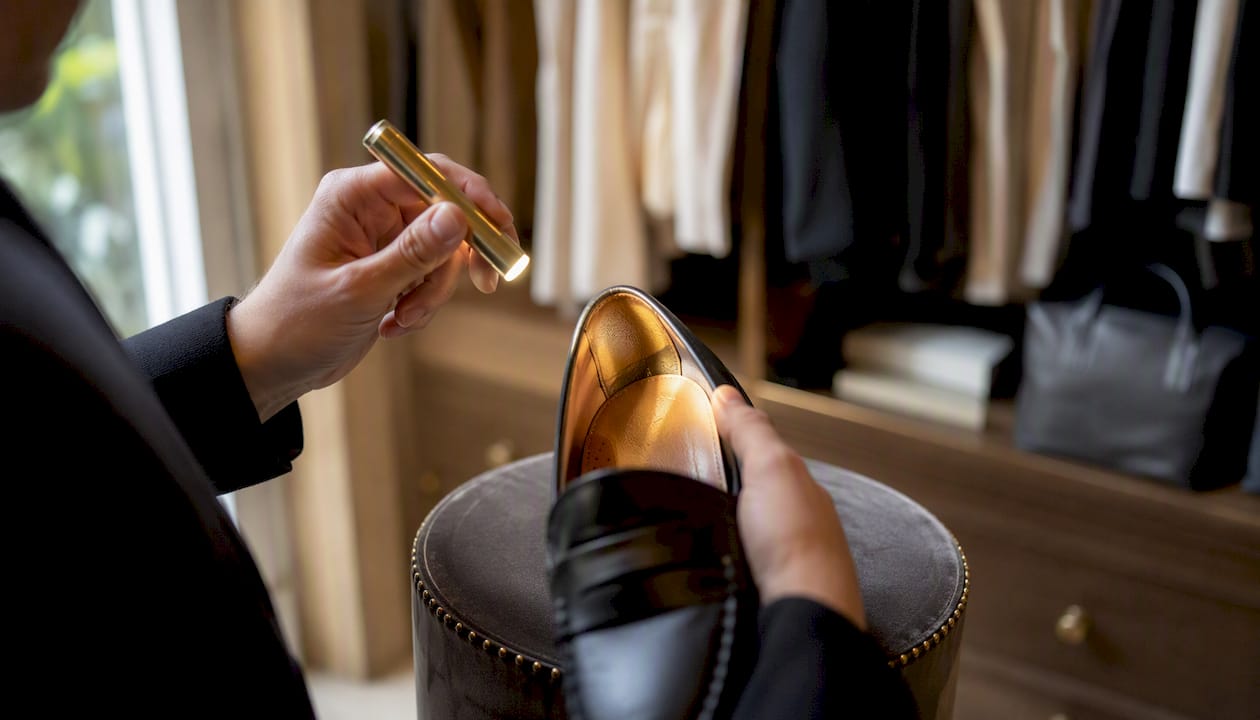
Pro Tip (podiatrist): The arch alignment check is the one most buyers skip. If the shoe’s arch point sits behind your natural arch, no amount of insole adjustment fully compensates — the shoe is the wrong last for your foot, regardless of size.
Pro Tip (personal shopper): When contacting a personal shopper or customer service, send your CM measurement and a photo of your foot outline on paper next to a ruler. That single image answers most fit questions faster than a paragraph of description.
What most buyers get wrong about designer shoe sizing
The conventional wisdom says: find your size in one brand, and you know your size everywhere. That logic works for fast fashion. It falls apart completely in luxury footwear, where a house’s last is as much a design signature as the hardware or the logo.
What experienced buyers learn quickly is that the CM number is the only portable fact. Your US size is a label that changes by brand, by style, and sometimes by season. The CM measurement does not change. Shoppers who anchor to their CM and treat every brand’s chart as a fresh translation are the ones who return shoes least often.
There is also a tendency to treat “runs small” as a simple instruction to size up. But sizing up in length to solve a width problem is one of the most common fit mistakes in luxury buying. It shifts the shoe’s flex point, creates heel slip, and often makes the fit worse in two ways instead of one. Width is a last problem, not a size problem — and the fix is last selection or a cobbler, not a larger number.
For anyone buying designer footwear for the first time, the personal shopper route is genuinely worth it. Not because the process is complicated, but because a single conversation with someone who knows the specific last can save a return, a reorder, and three weeks of waiting.
Naiseshopper makes sizing less stressful for luxury shoe buyers
Sizing uncertainty is the biggest reason luxury shoe purchases get delayed or returned. Naiseshopper’s personal shopper service cuts through that directly — you share your CM measurement, the style you want, and your foot-width notes, and the team provides last-specific fit guidance before you commit to a purchase.
Every pair on the platform is authenticated and ships internationally with flexible payment options and shipping insurance. The designer deals guide explains how discounts and return policies work across brands. For a specific starting point, the Saint Laurent mid-top sneakers page shows how product listings include brand and style details that support sizing decisions. Browse the full collection at Naiseshopper and use the personal shopper service for any style where the fit notes leave you uncertain.
Sources
These are the primary references used throughout this guide, each contributing a specific type of fit authority:
- How to Help: 10 points of proper shoe fit
- Podiatrist Shoe Fitting Guide » Balance Foot & Ankle
- Designer Shoe Sizing Guide: How to Find the Perfect Fit for Luxury Bra – Sole Guard
- Designer Shoe Sizes: The Definitive Guide to Luxury Fitment