A compact capsule of 20–25 carefully chosen pieces, built on the right fabrics and a simple three-layer system, is all you need to dress well across every season without starting over each time the temperature shifts.
Start here — your 8-step checklist:
- Core pieces: Own tops, mid-layers, bottoms, outerwear, and two to three shoe styles that cross seasons
- Fabric rule: Prioritize merino wool, cotton blends, and lightweight wool; avoid heavy synthetics
- Fit rule: Every piece must fit well enough to wear alone and slim enough to layer under something else
- Color strategy: Choose 2–3 neutrals plus one accent color; every piece must work with at least three others
- Layering formula: Base layer + thin mid-layer + removable outer + one accessory
- Quick audit: Spend 60–90 minutes this weekend trying on everything and pulling out what you haven’t worn in a year
- Buying rule: Splurge on outerwear, leather shoes, and tailored pieces; save on basics and trend items
- Maintenance note: Wash merino and cashmere by hand or on a delicate cycle; store off-season pieces in breathable cotton bags
Key Takeaways
A 20–25 piece capsule built on merino, cotton blends, and lightweight wool, anchored by a trench coat and a simple three-layer system, gives you a fully functional trans-seasonal wardrobe with minimal effort.
| Point | Details |
|---|---|
| Start with an audit | Spend 60–90 minutes trying on everything; keep only what you’ve worn six or more times in the past year. |
| Fabric drives versatility | Merino, cotton blends, and lightweight wool regulate temperature and layer cleanly across seasons. |
| Trench is the anchor piece | A lightweight trench coat covers more weather scenarios than any other single outer piece. |
| Color column multiplies outfits | Two to three neutrals plus one accent color lets every piece work with every other piece. |
| Naiseshopper for splurge pieces | Authenticated designer outerwear, shoes, and accessories at discounted prices support the cost-per-wear case. |
Table of Contents
- Why a trans-seasonal wardrobe saves you money and time
- How to audit your closet in 60 minutes
- What core pieces should your capsule actually contain?
- Layering techniques and outfit formulas that actually work
- How to build a color strategy that maximizes outfit combinations
- Why fit is the most underrated part of a versatile wardrobe
- What to splurge on and what to buy affordably
- Your 20–25 piece capsule: the complete checklist
- How to care for and rotate your capsule pieces
- A stylist note on fabric-first dressing
- My approach to building a trans-seasonal wardrobe
- Naiseshopper makes the splurge decisions easier
- Sources
Why a trans-seasonal wardrobe saves you money and time
The math is straightforward. Fewer, better pieces worn more often means a lower cost-per-wear on every item you own. A trench coat worn frequently costs a fraction per wear compared to a seasonal puffer worn only occasionally before it goes into storage. According to a versatility-scoring framework, 12 core pieces can generate 120 outfit permutations when chosen with mix-and-match in mind.
Beyond the numbers, the daily benefit is speed. When every piece in your closet works with at least three others, getting dressed stops being a decision problem.
How fabric and fit do the heavy lifting:
- Merino wool regulates body temperature across a 30-degree range, making it genuinely useful from September through April
- Cotton blends breathe in warm weather and layer cleanly under mid-layers when it cools
- Lightweight wool and ponte hold structure without adding bulk, so a blazer or straight-leg trouser reads polished in any season
- A well-fitted trench or lightweight leather jacket handles the widest temperature range of any single outer piece
Pro Tip: The most common trans-seasonal mistake is over-layering. Stylist Marina Ingvarsson recommends prioritizing fit and fabric over adding more pieces — a well-cut merino turtleneck under a trench is more polished than three thin layers fighting for space.
How to audit your closet in 60 minutes
A wardrobe audit produces two things: a clear list of what to keep and a short shopping list of genuine gaps. Block 60–90 minutes, pull everything out, and work through these steps.
- Try on every piece. Not just hold it up — actually put it on. You’ll immediately know what fits, what doesn’t, and what you’ve been avoiding.
- Record wear frequency. Keep a piece if you wore it six or more times in the past year. If you can’t remember wearing it, that’s your answer.
- Photograph your best outfits. Snap a photo of every combination that works. This becomes your personal lookbook and reveals which pieces are doing the most work.
- Sort into three piles: Keep, Tailor/Repair, and Donate/Sell.
- Map your gaps. Hold your keep pile against the 8-item checklist above. Missing a lightweight mid-layer? No versatile ankle boot? Write it down.
Decision rules that cut the gray area:
- Keep any piece that fits well and is tailorable to fit better
- Keep anything you’ve worn six or more times in the last 12 months, even if it feels boring
- Donate anything that fits only one season, one occasion, or one specific outfit
- Set aside sentimental pieces separately — they don’t belong in your working capsule
Pro Tip: After your audit, photograph the gaps list on your phone. Next time you’re tempted by an impulse buy, check the photo first. If the item doesn’t fill a gap, it doesn’t come home.
What core pieces should your capsule actually contain?
The goal is category coverage, not quantity. Each piece below earns its place by working across at least three seasons and pairing with at least three other items in the capsule. For a deeper look at building this kind of closet, the luxury capsule wardrobe guide from Naiseshopper is worth bookmarking.
Tops and base layers:
- 2–3 fitted crew-neck or V-neck tees in white, black, and a neutral (cotton or cotton-modal blend)
- 2 crisp button-down shirts — one white, one chambray or light blue
- 1–2 merino or lightweight cashmere turtlenecks or crewnecks
Mid-layers:
- 1 merino or cashmere cardigan in a neutral tone
- 1 tailored blazer in navy, camel, or charcoal (wool or ponte blend)
- 1 lightweight zip or half-zip pullover for casual layering
Bottoms:
- 2 pairs of straight-leg or slim-straight denim in dark wash and mid-wash
- 1 pair of tailored chinos or trousers in a neutral
- 1 midi skirt or versatile dress (ponte or crepe fabric holds shape across temperatures)
Outerwear:
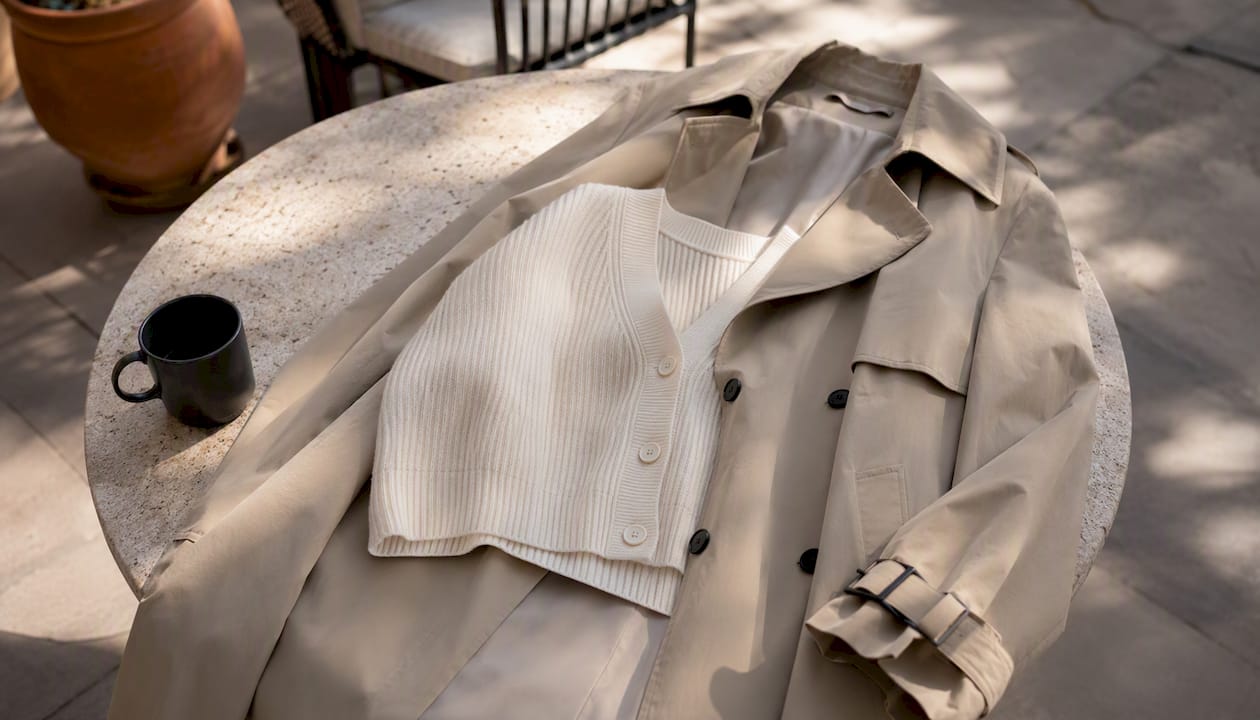
- 1 lightweight trench coat — the single most versatile outer piece for in-between seasons
- 1 leather or suede jacket for casual layering and texture contrast
Shoes:
- 1 pair of white or neutral leather sneakers
- 1 pair of ankle boots (leather, low heel or flat)
- 1 pair of loafers or leather flats
Transitional dressing works precisely because investment-grade anchors like the trench, merino layers, and tailored trousers handle variable weather without requiring a full wardrobe swap.
Fabric weight matters for layering without bulk. A merino turtleneck at 150–180 gsm sits cleanly under a blazer. A chunky-knit sweater at 400+ gsm does not. When buying mid-layers, check the fabric weight if it’s listed, or simply try layering it under a jacket in the fitting room before you buy.

Pro Tip: Choose bottoms with a slightly relaxed seat and thigh — not baggy, but with enough room that tucking in a thin base layer doesn’t pull. That one fit detail makes the difference between a bottom that layers and one that doesn’t.
Layering techniques and outfit formulas that actually work
The core system has four parts: a breathable base layer, a thin insulating mid-layer, a removable outer, and one quick-change accessory. Cotton blends, merino, and lightweight wool handle temperature swings best; heavy synthetics trap heat unevenly and look stiff when layered.
Eight outfit formulas for variable weather:
- Cool morning, warm afternoon (women’s): Merino turtleneck + straight-leg denim + trench + ankle boots + structured tote
- Cool morning, warm afternoon (men’s): White tee + merino crewneck + chinos + leather sneakers + lightweight trench over the arm
- Mild all-day (women’s): Chambray shirt (open, over a fitted tee) + midi skirt + loafers + minimal gold jewelry
- Mild all-day (men’s): Button-down shirt + tailored chinos + suede loafers + watch
- Cold day, indoor warmth (women’s): Cashmere turtleneck + blazer + straight-leg trousers + ankle boots + silk scarf
- Cold day, indoor warmth (men’s): Merino zip pullover + tailored blazer + dark denim + leather boots
- Casual weekend (women’s): White tee + leather jacket + mid-wash denim + white sneakers + crossbody bag
- Casual weekend (men’s): Chambray shirt + chinos + leather sneakers + lightweight cardigan tied at the waist or carried
Each formula follows the same logic: the base layer handles comfort, the mid-layer handles warmth, and the outer is the first thing you remove when the temperature climbs. Accessories shift the register from casual to polished without adding bulk.
Pro Tip: Proportion is everything when layering. A longer mid-layer under a shorter outer creates visual weight at the hip. Reverse it — a cropped cardigan under a longer trench — and the silhouette reads cleaner. Match the length logic to your body and the look you want.
How to build a color strategy that maximizes outfit combinations
A restrained palette is the single biggest multiplier in a trans-seasonal capsule. The column-of-color approach works like this: pick 2–3 neutrals that sit in the same tonal family (warm or cool), then add one accent color that works with all of them.
A warm-toned example column:
- Neutrals: camel, ivory, warm brown
- Accent: rust or deep olive
A cool-toned example column:
- Neutrals: navy, white, charcoal
- Accent: burgundy or forest green
Every piece you buy should fit somewhere in that column. If it doesn’t, it reduces your outfit permutations rather than adding to them.
How to add visual interest without reducing versatility:
- Use texture contrast instead of color contrast: a cream ribbed knit next to a smooth camel trench reads rich without clashing
- Small patterns (fine stripes, subtle houndstooth, tonal plaid) add depth while staying within the color column
- One statement piece per outfit is enough — a suede loafer or a textured bag does the work without competing with the rest
Mini exercise — four outfits from one color column (warm tones):
- Ivory tee + camel trousers + warm brown loafers
- Camel turtleneck + ivory midi skirt + rust scarf + ankle boots
- Warm brown blazer + ivory tee + straight-leg denim + camel sneakers
- Rust merino crewneck + camel chinos + brown leather boots
Pro Tip: Before buying any new piece, hold it against three items already in your closet. If it doesn’t work with all three, it’s narrowing your wardrobe, not expanding it.
Why fit is the most underrated part of a versatile wardrobe
A piece that fits perfectly on its own but pulls across the shoulders when layered is a single-season item. Fit for a trans-seasonal wardrobe means fit for layering, not just fit for wearing alone.
Three fit details that matter most:
- Shoulder seams should sit exactly at the shoulder point — if they drop, nothing layers cleanly over or under
- Sleeve length on shirts and base layers should end at the wrist bone so they don’t bunch under a jacket
- Silhouette room in the body of mid-layers should allow a thin base layer underneath without pulling
Three tailoring adjustments worth the cost:
- Hem shortening on trousers and skirts — the single most impactful alteration for a polished look
- Waist nip on a blazer or structured jacket — transforms a boxy piece into something that reads intentional
- Sleeve taper on shirts and jackets — reduces bulk at the wrist and makes layering cleaner
One caveat: don’t tailor pieces you plan to layer under. A blazer you’ve had taken in at the waist may not fit over a thick mid-layer. Tailor your outers for a clean silhouette; leave your mid-layers with a little room.
Pro Tip: Find one local tailor and bring in one piece immediately after your next purchase — a hem or a sleeve taper. Once you see the difference, you’ll never skip it again.
What to splurge on and what to buy affordably
The cost-per-wear principle is simple: divide the price of a piece by the number of times you’ll wear it. A $600 trench worn 100 times costs $6 per wear. A $60 fast-fashion jacket worn 10 times costs the same, and it won’t look as good by wear five.
Splurge on these categories:
- Outerwear (trench, leather jacket) — worn constantly, visible in every outfit, and structurally demanding
- Leather shoes (ankle boots, loafers) — quality leather ages well; cheap leather doesn’t
- A tailored blazer — the piece that elevates everything it touches
- One or two classic accessories (a watch, a structured bag) that work across every outfit
Save on these:
- Basic tees and cotton shirts — they wear out and should be replaced regularly
- Trend-driven pieces you’ll wear for one or two seasons
- Casual sneakers in non-leather materials
For the splurge categories, authenticated luxury pieces from classic heritage brands consistently outperform fast-fashion alternatives on longevity and cost-per-wear. The wardrobe basics checklist from Real Simple reinforces this: start with a small set of staples, add items only after wearing them, and reserve real spending for the pieces that anchor the whole system.
Smart shopping habits:
- Buy for fit first, always — no amount of quality compensates for a poor fit
- Wait 30 days before buying any trend piece; if you still want it after a month, it’s worth considering
- Track cost-per-wear for 12 months on every splurge purchase to validate your decisions
Pro Tip: Understanding how retail seasonality works can help you time splurge purchases for end-of-season sales, when authenticated luxury pieces are available at significantly better prices.
Your 20–25 piece capsule: the complete checklist
This capsule is designed for year-round versatility. Adapt the count up or down based on your lifestyle, but keep the category balance intact.
14 outfit examples from this capsule:
- White tee + dark denim + trench + ankle boots + structured bag
- Merino turtleneck + chinos + loafers + watch
- Chambray shirt (open) + white tee + mid-wash denim + white sneakers
- Blazer + merino cardigan + tailored trousers + ankle boots
- Cashmere turtleneck + midi skirt + ankle boots + silk scarf
- White tee + leather jacket + dark denim + white sneakers + crossbody bag
- Button-down shirt + chinos + loafers + zip pullover (tied at waist)
- Blazer + crisp white shirt + straight-leg denim + ankle boots
- Merino crewneck + midi skirt + loafers + belt
- Chambray shirt + tailored trousers + leather jacket + ankle boots
- Cashmere cardigan + white tee + dark denim + suede loafers + scarf
- Turtleneck + blazer + chinos + leather sneakers + watch
- White shirt + midi skirt + trench + ankle boots + structured tote
- Zip pullover + dark denim + leather jacket + white sneakers + sunglasses
For event-specific capsule building, the same mix-and-match logic applies — a blazer and tailored trousers from this capsule cover most formal occasions without adding dedicated event pieces.
How to care for and rotate your capsule pieces
Good care extends garment life dramatically. A merino sweater washed correctly lasts years; one thrown in a hot machine wash is done after a season.
Fabric care rules:
- Merino and cashmere: Hand wash or delicate cycle in cold water, lay flat to dry — never hang wet knits
- Leather and suede: Wipe clean with a damp cloth, condition leather twice a year, use a suede brush after each wear
- Denim: Wash inside-out in cold water, air dry to preserve shape and color
- Cotton shirts: Machine wash cold, remove promptly, hang or fold immediately to avoid creasing
30-minute seasonal rotation method:
- Pull out the pieces you won’t reach for in the next three months
- Clean everything before storage — never store dirty garments
- Fold knits and store flat in breathable cotton bags or boxes; never hang them
- Hang structured pieces (blazers, trench) on shaped wooden hangers in a breathable garment bag
- Rotate shoes into a cool, dry spot; stuff leather boots with cedar shoe trees to hold their shape
- Photograph your current active capsule so you know exactly what’s available
Shoe maintenance basics:
- Cedar shoe trees in leather shoes after every wear absorb moisture and hold shape
- Polish leather shoes every 4–6 wears; condition suede with a protective spray at the start of each season
- Resoling leather-soled shoes at the first sign of wear extends their life by years
Pro Tip: The travel packing guide from Naiseshopper applies the same capsule logic to packing — if your capsule is already edited, packing for a week takes under 20 minutes.
A stylist note on fabric-first dressing
Three stylist-tested rules that hold up across every season:
- Fit first, always. A $50 cotton shirt that fits perfectly reads more polished than a $300 shirt that doesn’t. Fit is the foundation; everything else is detail.
- One texture per outfit. Pair a smooth fabric with a textured one — a ribbed knit with a smooth trouser, a suede loafer with a crisp cotton shirt. Two competing textures fight; one contrast elevates.
- Accessory restraint. Choose one statement accessory per outfit. A great watch, a structured bag, or a silk scarf — pick one and let it work. Stacking accessories reduces the impact of each.
These rules align directly with what stylist Marina Ingvarsson cautions against: over-accessorizing and over-layering are the two fastest ways to undercut an otherwise strong outfit. For practical guidance on accessory selection, the luxury accessories styling guide from Naiseshopper is a useful reference.
Pro Tip: When you’re unsure whether an outfit is finished, remove one thing. Nine times out of ten, the edit improves it.
My approach to building a trans-seasonal wardrobe
Every wardrobe I build starts with the same three moves: a thorough audit, a strict palette limit, and a real investment in outerwear. The audit reveals what you actually wear versus what you think you wear — those two lists are almost never the same. The palette limit forces every new purchase to earn its place. And outerwear is where I spend real money, every time, because it’s the piece that frames every outfit from October through April.
For travel, the capsule approach is non-negotiable. Twelve pieces that all work together means a week-long trip fits in a carry-on, and nothing sits unworn at the bottom of the bag.
Three actions I take with every wardrobe build:
- Audit first, shop second. Never buy before you know exactly what’s missing.
- Limit the palette to five colors maximum. Anything outside the column gets left on the rack.
- Invest in the outer layer. It’s the first thing people see and the last thing you take off.
Naiseshopper makes the splurge decisions easier
Building a trans-seasonal wardrobe means making a handful of real investment decisions — the trench, the leather shoes, the watch that works with everything. Those are the pieces where quality and authenticity matter most, and where a wrong buy is an expensive mistake.
Naiseshopper carries authenticated designer pieces from Gucci, Saint Laurent, Prada, Bottega Veneta, and more, all at discounted prices with a full authenticity guarantee. For the splurge categories this guide recommends, that combination of verified quality and accessible pricing is exactly what cost-per-wear thinking calls for. The Saint Laurent mid-top sneakers are a strong example of a leather shoe built to last seasons, and the Gucci G-Timeless watch covers the one-statement-accessory rule for years. If you’d rather have a personal shopper handle the selection, that service is available directly through Naiseshopper for US purchases.
Sources
The following sources informed the fabric guidance, layering system, stylist note, and capsule recommendations throughout this article:
- Stylist-Approved Capsule Wardrobe Quince Clothing Picks
- Wardrobe basics checklist
- Transitional Dressing: Building a Wardrobe That Works Year-Round
- How to Dress for Transitional Months
- A Capsule Wardrobe For Winter-to-Spring Transitional Weather | Who What Wear