TL;DR:
- Properly reading and respecting luxury bag care tags is essential for maintaining the appearance and value of designer handbags.
- Understanding symbols and authenticity markers ensures delicate materials like leather and exotic skins are preserved without irreversible damage.
You spent serious money on that Gucci shoulder bag or Prada tote. Then one wrong cleaning decision later, the leather cracks, the color fades, or the hardware dulls. Learning how to read luxury bag care tags is the single most important skill you can develop as a designer bag owner. These small tags carry precise instructions from the brand itself, telling you exactly what your bag needs to stay pristine. Ignore them, and the damage is often irreversible. Follow them, and your investment holds its beauty and value for years.
Table of Contents
- Understanding the symbols on luxury bag care tags
- Decoding product identifiers and authenticity markers on care tags
- Step-by-step approach to safely cleaning your luxury handbag using care tags
- Common mistakes and troubleshooting when interpreting care tags
- Expected results and how to verify successful luxury bag care
- The silent language of luxury bag care tags and authenticity markers
- Explore premium luxury accessories to complement your care knowledge
- Frequently asked questions
Key Takeaways
| Point | Details |
|---|---|
| Care symbols importance | Pay close attention to care tag symbols to protect your luxury bag from damage. |
| Crossed-out methods | Avoid any cleaning techniques indicated by crossed-out icons on your care tag. |
| Authentication shifts | Luxury brands are adopting microchips over visible codes, changing how authenticity is verified. |
| Professional cleaning | Delicate materials often require professional care to prevent irreversible harm. |
| Verification matters | Know how to verify care results to maintain your bag’s value and beauty over time. |
Understanding the symbols on luxury bag care tags
Now that you know the importance of care tags, let’s learn to interpret the symbols you will encounter on luxury handbag labels. These care label symbols follow internationally recognized standards, and once you know the visual language, reading them becomes second nature.
The most common icons you will find on luxury handbag labels fall into five categories:
- Washing (water tub icon): A tub with water indicates hand or machine washing is permitted. Numbers inside the tub show the maximum water temperature in Celsius. A hand dipping into the tub means hand wash only.
- Bleaching (triangle icon): A plain triangle means bleach is allowed. A triangle with an X through it means never use bleach. Most luxury bags will show the crossed version.
- Drying (square icon): A square with a circle inside indicates tumble drying. Lines inside the square show flat or hang drying. Again, an X means avoid that method entirely.
- Ironing (iron icon): Dots inside the iron show temperature levels. One dot is low heat, three dots are high. An X means do not iron at all.
- Professional cleaning (circle icon): Letters inside the circle specify solvent types. A plain circle with an X means no dry cleaning permitted.
Crossed-out cleaning icons indicate prohibited cleaning methods to prevent irreversible damage. This is the most critical rule in the entire luxury bag care instructions system. When you see an X over any symbol, treat it as an absolute no.
| Symbol | Icon description | What it means |
|---|---|---|
| Water tub | Open tub | Hand or machine wash permitted |
| Water tub with X | Crossed tub | Do not wash in water |
| Circle with letter | Plain circle | Dry clean using specified solvent |
| Circle with X | Crossed circle | No dry cleaning |
| Triangle | Open triangle | Bleaching allowed |
| Triangle with X | Crossed triangle | No bleach |
| Iron with dots | Iron outline | Iron at the temperature indicated |
| Iron with X | Crossed iron | Do not iron |
Understanding these bag care tag meanings protects delicate materials like calfskin leather, suede, and embroidered canvas that can be destroyed by a single incorrect cleaning method.
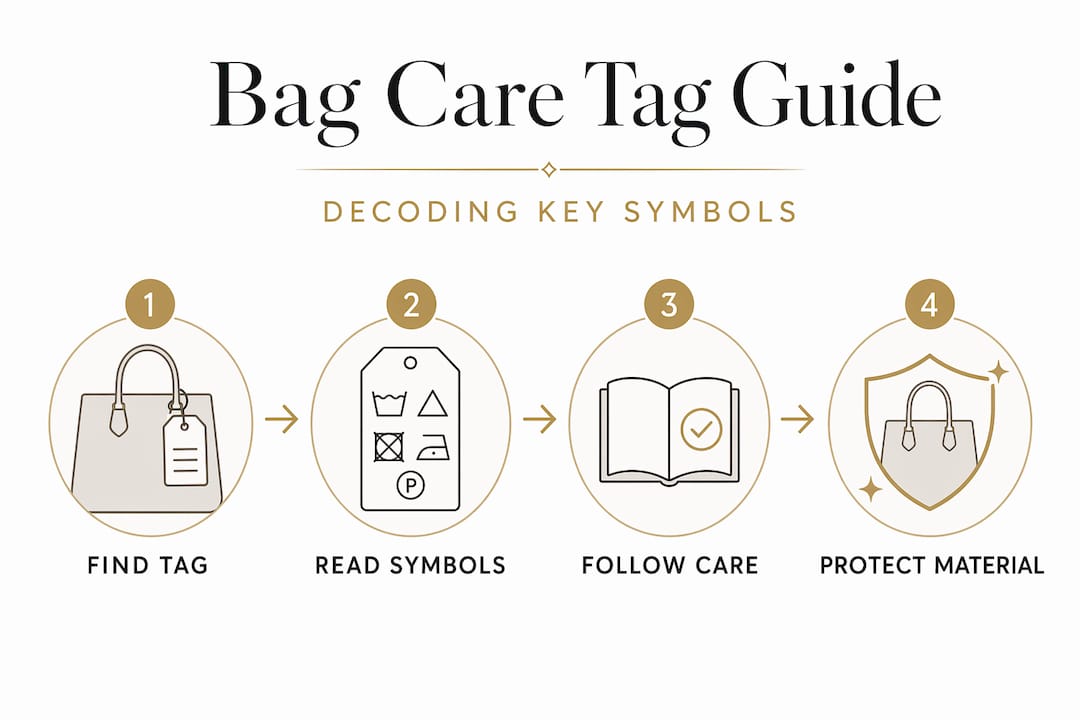
Pro Tip: If your bag’s care tag uses symbols you cannot identify, photograph it and cross-reference it against the ASTM standard chart before touching the bag with any cleaning product.
Decoding product identifiers and authenticity markers on care tags
Beyond care symbols, your bag’s label may also contain important authenticity and provenance markers to understand. These are not just reference numbers. They are a brand’s way of communicating where and when your bag was made.
Here is what you will typically find:
- Date codes: Combinations of letters and numbers that indicate production location and date. Louis Vuitton’s classic date codes, for example, used two letters for the factory and four numbers for the week and year of production.
- Serial numbers: Found in brands like Chanel and Bottega Veneta, sewn into interior labels or stamped into leather tabs. These numbers tie to production records.
- Country of origin tags: Required by most countries for import purposes. Authentic luxury bags always name a specific country, not a vague region.
- RFID microchips: A newer form of embedded authentication, invisible to the eye.
The evolution here is worth knowing. Louis Vuitton phased out visible date codes around March 2021 in favor of embedded RFID microchips. This shift fundamentally changed how authentication works for newer pieces.
How to identify and verify authenticity markers:
- Locate the interior label or leather tab in your bag’s lining.
- Note any alphanumeric codes and research the brand-specific format (LV, Chanel, Celine each use different systems).
- Check for a small RFID chip by running your finger along seams near the label. You may feel a slight raised bump.
- For microchipped bags, visit an authorized brand boutique with the bag to have a trained associate scan it.
- Cross-reference any serial number against the brand’s purchase receipt or authenticity card when applicable.
Consumers cannot access microchip data directly with standard phones. Generic NFC apps only confirm a chip exists, not that the bag is genuine. True luxury handbag authentication requires brand-authorized equipment. Understanding designer bag provenance gives you a much clearer picture of what each code means and why it matters.
Step-by-step approach to safely cleaning your luxury handbag using care tags
Knowing your bag’s specific cleaning rules, let’s walk through the exact steps to safely maintain your luxury handbag. This process works for everything from a structured Prada nylon tote to a buttery Bottega Veneta leather clutch.
- Read the care label first. Before touching the bag with any product, locate the tag and confirm every symbol present. This is non-negotiable.
- Identify prohibited methods. Note every crossed-out icon and keep those methods off the table entirely.
- Choose your cleaning product carefully. Use a mild, pH-neutral cleaner appropriate for the specific material. For leather, a dedicated leather cleaner is correct. For nylon, a gentle fabric cleaner works.
- Test on a hidden area. Apply a tiny amount to an inconspicuous spot like an interior corner and wait 10 minutes before proceeding.
- Clean gently and in small sections. Use a soft, lint-free cloth in circular motions. Never scrub.
- Follow recommended water temperatures. If the tag permits water cleaning, use water at or below the temperature shown. Warm water (around 30°C / 86°F) is the maximum for most luxury textiles.
- Air dry naturally. Never use a hairdryer or direct sunlight. Both cause color fading and material warping.
- Condition leather post-cleaning. After cleaning leather bags, apply a dedicated leather conditioner to restore moisture.
Common mistakes to avoid during the cleaning process:
- Never use fabric softener on leather. It causes cracking and surface discoloration over time.
- Avoid dishwashers entirely. They are far too harsh for any luxury bag material.
- Do not use alcohol-based wipes on painted or finished leather surfaces.
- Skip generic household cleaners. Products like dish soap contain surfactants that strip leather’s natural oils.
“Professional cleaning is often required for delicate luxury textiles and leathers to avoid irreversible damage from wrong solvents or processes.”
For exotic skins like crocodile, python, or ostrich, professional cleaning is not optional. It is required. These materials are chemically treated during production and respond unpredictably to consumer cleaning products. Explore luxury handbag care tips and best practices for handbag care to build a full maintenance routine around your collection.
| Material | Safe cleaning method | Avoid |
|---|---|---|
| Smooth leather | Leather cleaner + conditioner | Water immersion, alcohol |
| Suede | Dry suede brush, specialist spray | Water, liquid cleaners |
| Canvas (treated) | Damp cloth, mild soap | Bleach, abrasives |
| Nylon | Gentle fabric cleaner, cold water | Heat drying, fabric softener |
| Exotic skins | Professional cleaning only | Any home method |
Pro Tip: Store a small card with your bag noting its material and key care tag rules. It saves you from needing to re-read the tag every time and is especially useful when traveling.

Common mistakes and troubleshooting when interpreting care tags
Even with knowledge, mistakes happen. Here is how to avoid common errors and troubleshoot care tag confusion.
The single most costly mistake owners make is ignoring crossed-out cleaning symbols. It is the fastest path to irreversible damage on delicate materials like leather and suede. Seeing an X over a washing tub and thinking “it will probably be fine” is not a calculated risk. It is a guaranteed gamble with an expensive bag.
Common pitfalls to watch for:
- Assuming no date code means fake: Newer bags from brands like Louis Vuitton no longer carry visible codes. The absence of a code on a post-2021 piece is expected, not suspicious.
- Trusting smartphone NFC apps: These apps detect chip presence only. They cannot decrypt the brand’s proprietary authentication data.
- Ignoring fabric softener warnings: Many owners apply fabric softener thinking it will keep leather soft. It does the opposite. The chemicals alter leather’s pH and accelerate cracking.
- Misreading temperature numbers: A tub symbol with “30” means 30°C maximum, not 30°F or “approximately warm.” Precision matters here.
- Over-cleaning: Cleaning leather too frequently removes natural oils even with the correct products. Less is more.
“Understanding the full care tag system, including what symbols are absent, tells you just as much as what is present.”
If you encounter a tag where symbols are faded or illegible, do not guess. Contact the brand’s customer service with the bag’s serial number. They can provide care guidance specific to that product. Revisit your luxury bag care tutorial reference and brush up on luxury handbag terminology if any label language is unclear.
Pro Tip: Take a clear photo of your care tag the day you receive a new bag. Store it in your phone’s photos labeled with the bag name. You will always have a legible reference even if the physical tag fades.
Expected results and how to verify successful luxury bag care
After proper care, knowing how to recognize the signs of successful maintenance ensures your bag stays in top condition. The results of correct care are visible, tactile, and long-lasting.
Signs your bag has been properly maintained:
- Color vibrancy holds. Well-cared-for leather and canvas retain their original color depth. Fading, patchy tones, or surface grayness indicate past exposure to incorrect cleaning or UV damage.
- Materials stay supple. Leather should feel soft and flexible, not stiff or brittle. Regular conditioning after cleaning is what keeps this quality intact.
- Hardware stays bright and secure. Gold-tone and silver hardware on bags like a Saint Laurent Lou or Chanel Classic Flap should remain untarnished. Hardware that tarnishes quickly often indicates moisture exposure or abrasive cleaning products.
- Labels remain legible. Interior tags that are still crisp and readable signal careful handling. Worn or peeling labels result from rough cleaning or improper storage.
- Shape retention. Structured bags like the Balenciaga City or Gucci Horsebit maintain their silhouette when stored and cleaned correctly.
Long-term preservation also pays off financially. Properly maintained luxury bags command significantly higher resale prices. A Chanel Classic Flap in excellent condition, with legible interior tags and original hardware, sells for multiples more than the same bag in worn condition.
Pro Tip: Learn how to store luxury handbags properly alongside your care routine. Storage errors like stacking, overfilling, or leaving bags in plastic covers undo even the most careful cleaning work.
The silent language of luxury bag care tags and authenticity markers
Here is something most owners overlook: care tags and authenticity codes are not administrative formalities. They are the brand speaking directly to you about how to honor the craftsmanship inside that bag.
When Prada sews a care label into a Saffiano leather tote, they are encoding the specific needs of that particular hide, the dye process, and the finishing treatment used in their Arezzo factory. It is not a generic instruction sheet. It is precise guidance tied to that specific product. The same goes for Chanel’s serial stickers, Bottega Veneta’s weave codes, and Louis Vuitton’s shift from visible date codes to RFID technology.
That evolution from codes to microchips is genuinely fascinating. It reflects how luxury brands are layering digital authentication onto physical craftsmanship. The microchip is silent, but the quality speaks volumes, emphasizing craftsmanship beyond digital tags. The chip does not make the bag authentic. The stitching, the leather quality, and the hardware finish do. The chip simply allows brands to protect that craftsmanship in an age of sophisticated counterfeiting.
What this means for you as an owner is a shift in mindset. Reading care tags is not a chore before cleaning. It is learning to understand your bag’s specific identity. Every symbol, code, and embedded marker is the brand’s shorthand for “this is who we are, and this is how you protect it.” Owners who decode this language correctly spend less on repairs, maintain higher resale values, and carry their bags with the confidence of someone who actually knows what they own. Understanding designer bag provenance deepens that relationship with your collection in ways that go well beyond cleaning.
Explore premium luxury accessories to complement your care knowledge
Now that you are equipped to care for your bags expertly, explore luxury accessories that elevate your style alongside your pristine collection.
At Naise Shopper, we carry authenticated pieces that pair beautifully with the designer bags you are working so hard to maintain. Step into the Prada slip-on sneakers in black and blue for a sleek, directional look that complements structured leather totes perfectly. Add the timeless Gucci G-Timeless watch for an effortlessly polished finishing touch. Or make a bold statement with the Alexander McQueen neoprene boots, a sophisticated pairing for an oversized shoulder bag. Every piece is authenticated, discounted, and ready to ship worldwide.
Frequently asked questions
What do crossed-out symbols on luxury bag care tags mean?
Crossed-out cleaning symbols indicate methods you must avoid entirely, as they can cause irreversible damage to delicate materials like leather and suede.
How can I verify authenticity if my Louis Vuitton bag has no visible date code?
Louis Vuitton began phasing out visible date codes around March 2021, replacing them with embedded RFID microchips that only authorized brand scanners can read for verification.
Is it safe to wash my luxury bag in a washing machine or dishwasher?
No. Both are far too aggressive for luxury bag materials. Spot cleaning with the correct products or professional cleaning is always the safer choice for leather, suede, and delicate fabrics.
Can I trust a smartphone NFC app to authenticate my microchipped luxury bag?
No. Generic NFC apps cannot decrypt the proprietary data on luxury brand microchips. They only confirm a chip is present, which tells you nothing about whether the bag is genuine.