TL;DR:
- Luxury brand segmentation divides the high-end market into specific consumer groups and product categories. Precise segmentation enhances targeting and brand relevance in a slow-growing market by focusing on distinct personas like UHNWIs and emerging generations.
Luxury brand segmentation is the practice of dividing the luxury market into distinct consumer groups and product categories to sharpen targeting and positioning. Understanding luxury brand segmentation is no longer optional for marketers in high-end fashion. The global luxury market faces annual growth of only 1–3% through 2027, which means broad-stroke campaigns no longer move the needle. Brands that win in this environment speak precisely to defined segments, whether that means an Ultra-High-Net-Worth collector buying a Bottega Veneta piece or an aspirational shopper hunting authenticated Gucci at a discount. Precision is the new competitive advantage.
What is luxury brand segmentation and why does it matter?
Luxury brand segmentation, known in academic marketing as luxury market segmentation, divides the high-end market along two main axes: product categories and consumer personas. Luxury goods categories include fashion and accessories, watches and jewelry, beauty products, and art. Lifestyle purchases form a second axis, covering automotive, travel, home design, and premium alcoholic beverages.

These two axes matter because consumer behavior differs sharply across them. A buyer of a Chanel ready-to-wear jacket and a buyer of a Patek Philippe watch share a high income but carry completely different motivations, purchase frequencies, and brand loyalty patterns. Treating them as one audience wastes budget and dilutes brand positioning.
The practical payoff is significant. When you map your audience against specific segments, you can align product assortment, pricing architecture, and communication channels with real consumer expectations. That alignment is what separates brands that grow in a slow market from those that stagnate.
Core luxury goods and lifestyle segments at a glance
| Segment category | Examples | Key brand strategy implication |
|---|---|---|
| Fashion and accessories | Ready-to-wear, handbags, shoes | Trend cycles drive repeat purchase; heritage narrative builds loyalty |
| Watches and jewelry | Mechanical watches, fine jewelry | Investment framing and craftsmanship storytelling dominate |
| Beauty and fragrance | Prestige skincare, niche perfume | Ritual and sensory experience are the primary purchase drivers |
| Art and collectibles | Limited editions, designer objects | Scarcity and cultural cachet are the core value proposition |
| Luxury lifestyle | Automotive, travel, home design | Experiential value outweighs product ownership |
Who are the distinct luxury consumer segments?
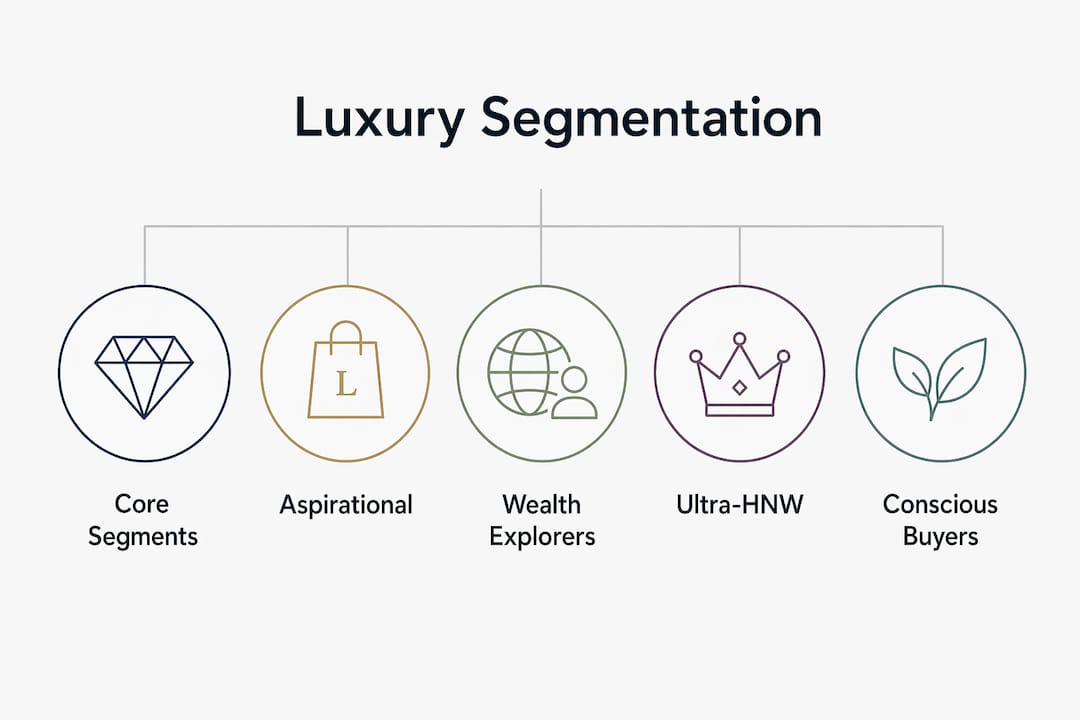
No single average luxury consumer exists. Four core personas define the modern luxury buyer, and each requires a different brand approach.
- Aspirational Curators are middle-to-upper-income consumers who buy selectively. They research extensively, prioritize authenticity, and treat each purchase as a curated statement. Platforms offering authenticated designer goods at accessible prices speak directly to this group.
- Wealth Explorers are affluent consumers who use luxury purchases to signal personal evolution. They gravitate toward emerging designers, limited drops, and cultural credibility over legacy brand names alone.
- Ultra-High-Net-Worth Individuals (UHNWIs) are the market’s anchor. UHNWIs are becoming the primary growth engine in luxury, shifting brand focus toward bespoke services, private access, and relationship-driven selling.
- Emerging Generations include Gen Z and younger Millennials entering luxury for the first time. They prioritize values alignment, digital fluency, and brand transparency over traditional status signals.
Each persona carries distinct psychographic triggers. Aspirational Curators respond to trust signals like authentication guarantees. UHNWIs respond to exclusivity and personal service. Emerging Generations respond to cultural relevance and sustainability credentials. You can explore a deeper breakdown of these profiles in Naiseshopper’s luxury shopper profiles guide.
Pro Tip: Map every brand touchpoint, from email subject lines to packaging, against the specific persona you are targeting. A message that resonates with a Wealth Explorer will often alienate a UHNWI, and vice versa.
How do sustainability and slower growth reshape segmentation?
The luxury market is not in crisis, but it is in recalibration. Growth of 1–3% annually through 2027 signals that brands can no longer rely on a rising tide to lift all boats. Precise segmentation becomes the primary tool for protecting margin and share.
Sustainability is now a purchase driver, not a PR footnote. 71% of global consumers consider sustainability important when buying, and 64% rank it among their top three decision factors. That number carries real weight in luxury, where a single purchase can represent thousands of dollars and months of consideration.
This shift creates new sub-segments worth tracking:
- Conscious luxury buyers who prioritize product longevity, ethical sourcing, and sustainability-driven desirability over seasonal novelty
- Heritage loyalists who value traditional craftsmanship and see longevity as inherently sustainable
- Value-aligned aspirationals who will pay a premium for brands with credible environmental and social commitments
Brands that treat sustainability as a checkbox will lose these sub-segments fast. Credibility requires specificity: named materials, verified supply chains, and transparent production stories. You can see how leading brands are adapting in Naiseshopper’s 2026 luxury trends report.
Pro Tip: Integrate sustainability messaging at the product level, not just the brand level. Telling a conscious luxury buyer that a specific Valentino bag uses vegetable-tanned leather is more persuasive than a general brand sustainability page.
How do you apply segmentation insights to luxury marketing strategy?
Segmentation data is only useful when it drives decisions. Here is a practical sequence for turning segment knowledge into campaign execution.
- Define your primary segment clearly. Choose one persona as your campaign anchor. A campaign built for Aspirational Curators and UHNWIs simultaneously will satisfy neither.
- Align your product selection with segment expectations. Aspirational Curators want authenticated classics. Wealth Explorers want limited or culturally charged pieces. Match your catalog to the segment’s desire profile.
- Build a narrative ecosystem, not just ads. Next-gen luxury marketing focuses on owned cultural assets: editorial content, events, and community. These create brand associations that paid media alone cannot build.
- Apply evidence-based marketing principles. Luxury buyers’ brand associations follow predictable patterns similar to other categories. Mental availability, the ease with which a brand comes to mind in a buying moment, matters as much in luxury as anywhere else.
- Use tiered offerings to serve multiple segments without diluting exclusivity. A brand can offer an entry-level accessory for Aspirational Curators and a made-to-order service for UHNWIs without contradicting itself, provided the communication stays segment-specific.
- Prioritize the privilege-based purchase experience. Luxury marketing logic centers on controlled scarcity and a slower, exclusive buying journey. Speed and mass reach are the wrong goals. Depth of desire is the right one.
For a broader view of how these principles apply in retail, Naiseshopper’s luxury retail marketing guide covers the full channel mix. You can also find parallel segmentation frameworks applied in adjacent luxury categories, such as this breakdown of yacht market segments, which illustrates how exclusivity and persona targeting translate across high-ticket verticals.
Pro Tip: Avoid building a single luxury campaign around conversion efficiency metrics. A Chanel campaign that generates 10,000 clicks from the wrong audience is less valuable than one that generates 200 from verified high-intent buyers in your target segment.
What metrics actually measure luxury segment performance?
Standard performance metrics fail luxury brands. Cost per acquisition and click-through rates measure volume and speed. Luxury marketing is built on depth and desire, not volume. Brand tracking, share of search, and net promoter scores are the metrics that reflect what actually matters: long-term brand health within each segment.
The right measurement framework for luxury segmentation includes:
- Brand tracking studies that monitor awareness, consideration, and desirability within each defined segment over time
- Share of search as a proxy for organic brand interest and cultural relevance
- Net Promoter Score by segment to identify which personas are most loyal and most likely to advocate
- Aspiration pool tracking to measure how many non-buyers in a segment actively desire the brand, since aspiration is a leading indicator of future revenue
- Qualitative research through interviews and ethnographic studies to understand the emotional and social drivers behind segment-specific purchase decisions
The key shift is from short-term conversion thinking to long-term segment health thinking. A brand that grows its aspiration pool among Emerging Generations today is building revenue for the next five years. That does not show up in a monthly CPA report.
Key Takeaways
Luxury brand segmentation is the single most important tool for protecting margin and relevance in a market growing at only 1–3% annually through 2027.
| Point | Details |
|---|---|
| Two-axis segmentation | Divide the market by both product category and consumer persona for precise targeting. |
| Four core personas | Aspirational Curators, Wealth Explorers, UHNWIs, and Emerging Generations each require distinct messaging and touchpoints. |
| Sustainability is a segment driver | 64% of luxury consumers rank sustainability in their top three purchase factors, creating distinct sub-segments. |
| Narrative over conversion | Build cultural assets and owned media rather than optimizing for clicks and cost per acquisition. |
| Measure brand health, not just sales | Track share of search, NPS by segment, and aspiration pools to gauge long-term segment performance. |
Precision segmentation is the only luxury strategy that holds in 2026
I have watched luxury brands spend enormous budgets on campaigns that looked beautiful and moved nothing. The common thread is always the same: they targeted “luxury consumers” as a monolith. That category does not exist in any meaningful way.
What I find most underestimated is the gap between aspiration and ownership within each segment. A brand can have enormous aspiration among Emerging Generations and zero conversion, not because the product is wrong, but because the purchase experience, the price architecture, or the channel mix does not match where that segment actually shops. Fixing that gap requires segment-specific data, not more creative spend.
The sustainability shift is also more structural than most brands admit. Conscious luxury buyers are not a niche. They are becoming the majority within Aspirational Curator and Emerging Generation segments. Brands that integrate sustainability at the product story level, not just the corporate responsibility page, will hold these segments. Brands that treat it as a marketing layer will lose them to those that do not.
The most exciting opportunity right now is dynamic segmentation. Consumer values and channels shift faster than annual planning cycles allow. Brands that build real-time feedback loops, through qualitative research, social listening, and segment-specific NPS, will adapt faster than those relying on static personas built in a strategy deck from two years ago.
Luxury brand differentiation in 2026 is not about being the most exclusive. It is about being the most precisely understood by the right people.
— Camila
Naiseshopper’s curated selection meets every luxury segment
Naiseshopper applies the principles of luxury market segmentation directly to its curated product catalog, offering authenticated pieces from Gucci, Chanel, Prada, Valentino, Bottega Veneta, Saint Laurent, and Balenciaga at accessible prices. Whether you are an Aspirational Curator seeking a verified classic or a Wealth Explorer drawn to bold, culturally charged design, the platform matches product to persona with precision.
The Gucci Dive Watch 40mm Stainless Steel is a strong example of a segment-targeted luxury product: a collectible timepiece that speaks to watch-segment buyers who value brand heritage and design credibility at a price point that opens the category to Aspirational Curators. Naiseshopper ships internationally with authentication guarantees and flexible payment options, making it the right destination for discerning shoppers across every luxury consumer segment.
FAQ
What is luxury brand segmentation?
Luxury brand segmentation is the process of dividing the luxury market into distinct groups based on product categories and consumer personas. It allows brands to tailor positioning, messaging, and product offerings to specific buyer motivations rather than treating all luxury consumers as one audience.
What are the main luxury consumer segments?
The four core luxury consumer personas are Aspirational Curators, Wealth Explorers, Ultra-High-Net-Worth Individuals, and Emerging Generations. Each group has distinct spending behaviors, value perceptions, and channel preferences that require separate targeting strategies.
How does sustainability affect luxury segmentation?
Sustainability has become a top-three purchase factor for 64% of luxury consumers, creating new sub-segments including conscious luxury buyers and value-aligned aspirationals. Brands that communicate sustainability at the product level, not just the brand level, retain these segments most effectively.
What metrics should luxury marketers track by segment?
Brand tracking studies, share of search, net promoter scores by segment, and aspiration pool size are the most relevant metrics for luxury. Short-term conversion metrics like cost per acquisition do not reflect the long-term brand health that drives luxury revenue.
Why does luxury marketing require a different segmentation approach?
Luxury marketing centers on controlled scarcity, exclusivity, and a privilege-based purchase experience rather than mass reach. Standard segmentation models built for volume-driven categories miss the emotional and social drivers that define luxury purchase decisions across all consumer personas.