TL;DR:
- Designer brand provenance is the verified record of a product’s origin, materials, craftspeople, and transfer of ownership. It establishes authenticity, builds trust, and enables premium resale prices by reducing perceived risks. Verifying provenance involves examining documents, using NFC chips, and tracking the item’s complete ownership history.
Designer brand provenance is defined as the documented origin, chain of custody, and craftsmanship trail that authenticates a designer item and establishes its measurable value. This is the standard industry concept behind what collectors and fashion enthusiasts often call “designer brand provenance explained” in their searches. Provenance is not a marketing story. It is a verifiable record, and understanding it changes how you buy, collect, and invest in luxury fashion. Knowing why provenance matters separates confident collectors from buyers who rely on guesswork.
What is designer brand provenance, and why does it matter?
Provenance, in the luxury fashion context, is the complete documented record of where a product came from, who made it, what materials were used, and how ownership transferred over time. The Association of Intelligent Diamond International (AIDI) defines full provenance credit as requiring both specific origin and an independently verified chain of custody. Incomplete claims reduce provenance value. That standard applies directly to fashion: a Gucci bag with a receipt, original box, and traceable factory record carries stronger provenance than one with only a brand label.
The critical distinction is between heritage and provenance. Heritage is a marketing signal; provenance is the actual documented, immutable chain of decisions, materials, and makers. Chanel’s history of Coco Chanel founding the house in Paris is heritage. The specific atelier, artisan, and material batch used to produce a particular jacket is provenance. One tells a story. The other proves it.
Collectors who understand this distinction make smarter purchases. They know which documents to request, which red flags to spot, and which pieces hold long-term investment value. Provenance is the foundation of luxury authentication and the single most reliable indicator of a designer item’s authenticity.
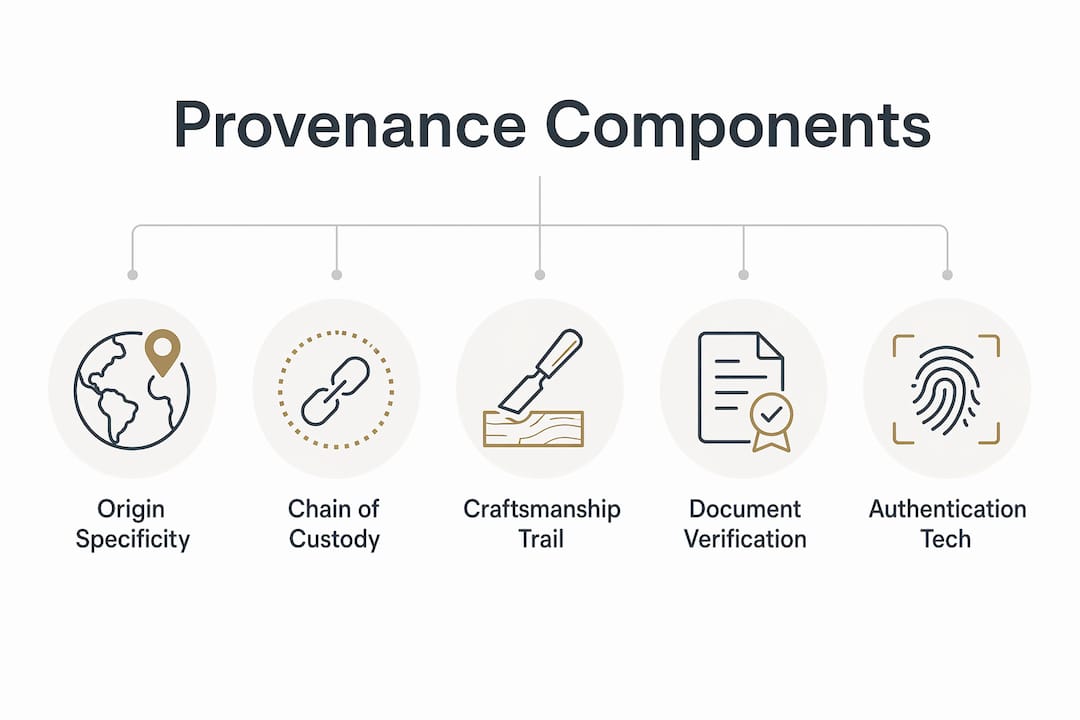
What are the core components of designer brand provenance?
Three elements form the backbone of any strong provenance record.
- Origin specificity: The geographic source of materials and production, ideally traceable to the factory, workshop, or even raw material supplier. A Bottega Veneta bag woven in the Vicenza atelier carries more verifiable origin than one labeled simply “Made in Italy.”
- Chain of custody integrity: Documented records of every ownership and processing transfer from production to the current owner. This includes purchase receipts, invoices, customs documents, and resale certificates.
- Craftsmanship visibility: Evidence of artisan involvement, including maker’s marks, hand-stitching records, and quality control documentation. Brands like Hermès number their artisans’ work, creating a direct link between the item and its maker.
Heritage signals, by contrast, are broad and often unverifiable. A brand’s founding story, its country of origin marketing, or its archival imagery are heritage. They build emotional connection but do not prove authenticity for a specific item. Provenance is item-level. Heritage is brand-level. Mixing the two is the most common mistake collectors make when evaluating a purchase.
The AIDI framework, developed for fine jewelry, applies cleanly to fashion. It requires origin specificity and chain of custody as separate, independently verified elements. A designer item that satisfies both commands a higher resale price and greater buyer confidence than one that satisfies only one.

How does provenance drive trust and premium pricing?
Provenance is a measurable commercial driver, not a soft brand image element. Provenance lowers perceived purchase risk, enabling brands to maintain premium pricing. This is the “Provenance Premium”: buyers pay more when they can verify what they are buying. The mechanism is trust. Verified origin and custody reduce the fear of counterfeits, which is the primary anxiety in the luxury secondary market.
“Consumers have shifted from ‘does the brand care?’ to ‘can the brand prove it?’ Verified provenance is essential for credibility in the modern luxury market.”
That shift has real commercial consequences. Brands publishing immutable, verifiable provenance records see a 23% lift in repeat purchases within three months. Repeat purchases are the clearest signal of buyer confidence. When collectors trust the origin of a piece, they return to the same source.
For provenance to convert into commercial value, three conditions must be met. First, it must be relevant: the origin must matter to the buyer. Italian leather craftsmanship matters to a Prada collector. Second, it must be credible: the documentation must be independently verifiable, not self-reported. Third, it must be salient: the buyer must be aware of the provenance at the point of purchase. A perfectly documented item with no visible provenance record at the point of sale loses its pricing advantage. Brands and retailers that surface provenance data clearly at purchase capture the full Provenance Premium.
What technologies are advancing provenance verification?
Digital verification has moved from optional to mandatory. By 2027, EU Digital Product Passport mandates require digital, interoperable provenance records for luxury goods covering materials and lifecycle. That regulation will force every major European luxury brand to maintain item-level digital records accessible to consumers. The impact on the secondary market will be significant: items without a Digital Product Passport will face lower resale values and greater buyer skepticism.
Current verification technologies include:
- Blockchain provenance protocols: Immutable digital ledgers that record each transfer of ownership. The limitation is that blockchain only secures the digital record. It cannot verify that the physical item matches the digital entry.
- NFC chips and QR codes: Physical tags embedded at manufacture that link the item to its digital record. Scanning the chip with a smartphone retrieves the full provenance history in real time.
- Microtags and serialization: Microscopic identifiers woven into fabric or embedded in hardware that are nearly impossible to replicate. These create a physical fingerprint unique to each item.
The critical vulnerability in all these systems is the physical-to-digital link. Provenance digital records must be physically linked via NFC tags at manufacture to prevent digital forgery. A tag added after production, or transferred from an authentic item to a fake, breaks the chain. The most secure systems embed the identifier during manufacturing, before the item leaves the atelier.
Pro Tip: When buying a designer item with an NFC chip, scan it before purchase and check that the chip ID matches the item’s serial number on the physical label. A mismatch is a clear red flag.
Brands investing in product-level digital transparency gain pricing advantages and stronger platform partnerships. Retailers that can surface verified provenance data attract more confident buyers and command better terms from brand partners. Understanding how fabric origin and fit influence brand perception adds another layer to how collectors evaluate a piece’s full story.
How can collectors verify designer brand provenance?
Practical verification starts before you complete a purchase. Follow this sequence to protect your investment.
- Request all original documents. Ask for the original receipt or invoice, the brand’s certificate of authenticity, and any customs or import paperwork. A legitimate seller has these. A reluctant seller is a warning sign.
- Check for a Digital Product Passport. For items produced after 2024 by major European brands, a DPP should be available. Receipts and digital product passports tied to NFC chips are the strongest current proof of authentic designer goods.
- Scan NFC chips or QR codes. Use your smartphone to scan any embedded tag. Verify that the provenance record matches the item’s physical details: model, color, serial number, and production date.
- Examine craftsmanship markers. Stitching consistency, hardware weight, material texture, and maker’s marks are physical provenance signals. Counterfeits rarely replicate all of them accurately.
- Trace the ownership history. For secondary market purchases, request the full chain of receipts from original purchase to current sale. Gaps in the chain reduce provenance value and should lower your offer price.
Pro Tip: For high-value pieces like a Chanel flap bag or a Gucci watch, commission an independent authentication review from a certified luxury goods appraiser before finalizing the purchase.
Provenance continuity matters most in resale. A Valentino dress with an unbroken ownership record from boutique to your hands commands a higher resale price than one with a gap in its history. Collectors who maintain their provenance documents protect both the emotional and financial value of their pieces. Understanding designer bag provenance in depth gives you a real edge in the secondary market.
Key Takeaways
Designer brand provenance is the documented origin and craftsmanship trail that authenticates a luxury item and directly drives its commercial value through verified trust.
| Point | Details |
|---|---|
| Provenance vs. heritage | Provenance is item-level documentation; heritage is brand-level storytelling. Never confuse the two. |
| Three core components | Origin specificity, chain of custody integrity, and craftsmanship visibility all must be present for full provenance credit. |
| Commercial impact | Verified provenance records drive a 23% lift in repeat purchases and enable premium pricing through reduced buyer risk. |
| Technology verification | NFC chips embedded at manufacture, Digital Product Passports, and blockchain records are the strongest current verification tools. |
| Collector action | Always request original documents, scan NFC tags, and trace ownership history before completing any high-value purchase. |
Why provenance is becoming the new luxury currency
The luxury market is undergoing a fundamental shift, and I have watched it accelerate over the past several years. Brands that once relied on heritage storytelling are now under pressure to produce verifiable records. The EU Digital Product Passport regulation is not just a compliance requirement. It is a market signal that provenance transparency is becoming the baseline expectation, not a premium feature.
What strikes me most is how this shift changes collector behavior. Buyers who once accepted a brand’s reputation as sufficient proof are now asking for item-level documentation. That is a healthy evolution. It forces brands to maintain rigorous production records and rewards those that have always done so. Hermès, for example, has numbered its artisans’ work for decades. That practice, once seen as internal quality control, is now a competitive advantage.
The uncomfortable truth is that many luxury items currently on the secondary market have incomplete provenance records. That does not make them fake. It does make them harder to price confidently and harder to resell at full value. Collectors who build their libraries with strong provenance documentation from day one protect themselves against that uncertainty. Provenance is a living record. Every purchase, every transfer, every authentication adds to it. Treat it with the same care you give the item itself.
— Camila
Authenticated designer pieces with verified provenance at Naiseshopper
Naiseshopper curates authenticated designer pieces from Gucci, Dior, Alexander McQueen, and more, with provenance transparency built into every listing.
Each piece in the Naiseshopper collection comes with authentication documentation, giving you the confidence to buy and collect without second-guessing. Whether you are drawn to the craftsmanship of Dior leather oxfords or the bold design of Alexander McQueen boots, every item carries the documentation that serious collectors demand. Naiseshopper also offers a Gucci G-Timeless watch for collectors who want verified luxury across categories. Shop with the assurance that your investment is backed by real provenance, not just a label.
FAQ
What is brand provenance in designer fashion?
Brand provenance is the documented record of a designer item’s origin, materials, makers, and chain of ownership. It is the verifiable evidence that distinguishes an authentic piece from a counterfeit.
How does provenance differ from a brand’s heritage?
Heritage is a brand’s historical narrative and marketing story. Provenance is item-specific documentation that independently verifies origin and custody. Heritage builds emotional connection; provenance proves authenticity.
What documents prove designer brand provenance?
Original purchase receipts, brand certificates of authenticity, customs paperwork, and Digital Product Passports tied to NFC chips are the strongest current proof of authentic designer goods.
Why does provenance matter for resale value?
Verified provenance reduces buyer risk, which enables premium pricing. Items with complete ownership records consistently command higher resale prices than those with gaps in their documentation history.
How do NFC chips help verify a designer item’s authenticity?
NFC chips embedded at manufacture link a physical item to its digital provenance record. Scanning the chip with a smartphone retrieves the full history, including production details and ownership transfers, in real time.