TL;DR:
- The luxury resale market is rapidly growing, with handbags dominating over 32% of sales.
- Authentication is crucial, involving expert inspections and biometric verification to prevent counterfeits.
- Brands are increasingly partnering with resale platforms, emphasizing trust, certification, and digital IDs.
The luxury resale market is not your grandmother’s thrift store. Forget the old image of secondhand shopping — designer resale is a booming, sophisticated industry where Chanel flaps and Hermès Birkins command serious attention and serious money. The secondhand luxury market is valued at roughly $39 to $41 billion in 2025 and 2026, with projections reaching $94 to $104 billion by 2035, growing three times faster than primary luxury retail. Handbags alone dominate with a 32% market share. If you have ever wondered what makes designer resale genuinely different, how to stay safe, and where the real value hides, this guide covers everything you need to know.
Table of Contents
- Understanding designer resale: What sets it apart
- Authentication: The cornerstone of secure designer resale
- Risks, rewards, and the rise of luxury handbags in resale
- How brands respond: Control, partnerships, and the future of luxury resale
- Our take: Designer resale is reshaping luxury for the next decade
- Discover authentic luxury for less
- Frequently asked questions
Key Takeaways
| Point | Details |
|---|---|
| Luxury resale market growth | Designer resale is expanding rapidly, especially for handbags, and offers substantial discounts compared to new retail. |
| Authentication is essential | Expert verification and trusted platforms are critical for avoiding fakes and securing genuine designer items. |
| Handbags lead resale value | Luxury handbags often retain or even increase their value, making them a prime target for affluent shoppers. |
| Brand strategies evolve | Major brands are creating new partnerships and anti-counterfeit efforts to boost trust and control in the resale space. |
Understanding designer resale: What sets it apart
Designer resale is not simply buying used goods at a discount. It is a carefully curated ecosystem where authenticity, provenance, and brand equity determine value just as much as condition does. When you shop designer resale, you are entering a market where a pre-owned Chanel Classic Flap can hold its value for decades and where a Hermès Birkin routinely sells above its original retail price.
Generic secondhand shopping — think local thrift stores or casual online listings — rarely involves authentication, brand verification, or price expertise. Designer resale, by contrast, is built around these pillars.
The key luxury segments driving this market include:
- Handbags: The category leader, commanding 32% of total market share
- Watches: High-value pieces from Rolex, Patek Philippe, and Audemars Piguet
- Jewelry and accessories: Scarves, belts, sunglasses, and small leather goods
- Ready-to-wear: Seasonal pieces from houses like Gucci, Prada, and Valentino
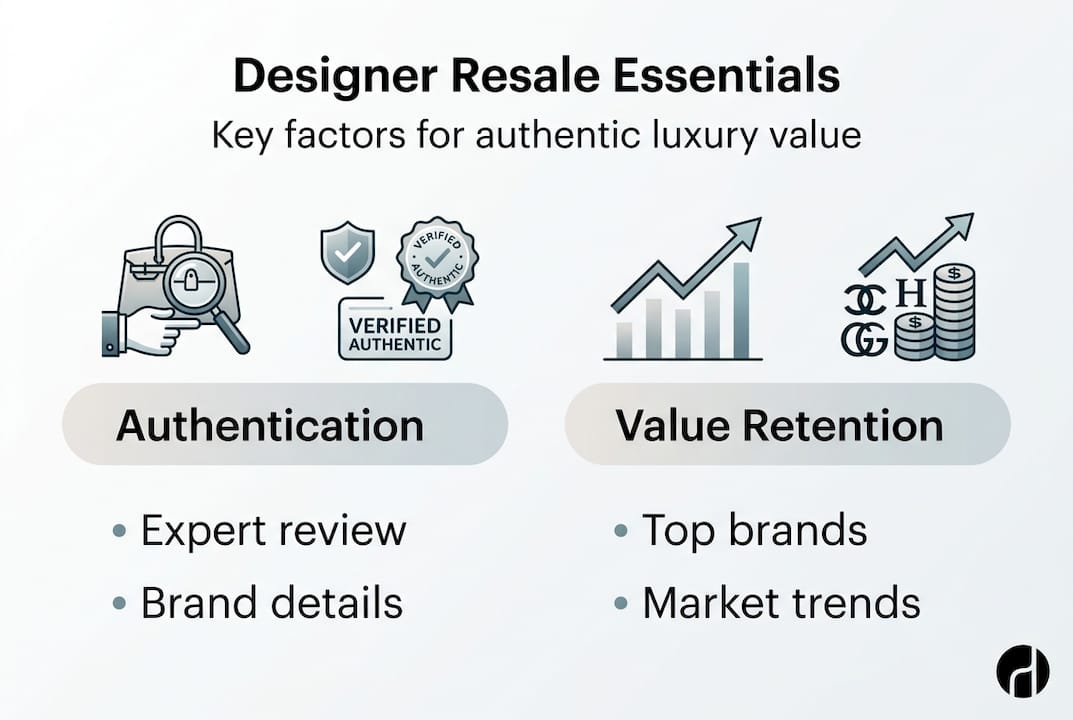
The brands at the top of the resale world are well known. Hermès, Chanel, Goyard, and Rolex consistently lead in both demand and value retention. According to Rebag’s annual Clair Report, Hermès retains 138% value on average, with Birkin and Kelly bags exceeding 180%. Goyard follows at 132%. Meanwhile, most platforms offer buyers discounts of 30 to 80% compared to retail prices on other brand lines.
| Brand | Value Retention | Typical Resale Discount vs. Retail |
|---|---|---|
| Hermès (Birkin/Kelly) | 138%+ (up to 180%+) | Rare, commands premium |
| Goyard | 132% | Modest discounts |
| Chanel | Strong, near retail | 10 to 30% |
| Gucci / Prada | Moderate | 30 to 60% |
| Other luxury brands | Varies | 40 to 80% |
Understanding handbag resale means recognizing this spectrum. Some pieces appreciate. Others offer buyers excellent discounts without sacrificing quality or style. That range is precisely what draws affluent shoppers to the resale market in growing numbers.
Authentication: The cornerstone of secure designer resale
If designer resale has one non-negotiable, it is authentication. This single factor separates a trustworthy transaction from a costly mistake. But what does authentication actually involve, and why is it so challenging?
Authentication is the process of verifying that an item is genuinely what it claims to be — made by the declared brand, with real materials, real hardware, and real craftsmanship. For luxury goods, this means expert review of stitching, hardware stamps, serial numbers, dust bags, receipts, and even the smell of the leather.
Here is what a thorough authentication process typically covers:
- Physical inspection: Stitching count, alignment, leather grain, hardware weight and finish
- Serial number and date code verification: Cross-referenced against brand records
- Documentation review: Original receipts, authenticity cards, dust bags, and boxes
- Material analysis: Leather type, lining fabric, zipper brand (e.g., Lampo or YKK)
- Technology-assisted checks: UV scanning, microscopic hardware review, database cross-checking
The challenge is real. Sophisticated counterfeits now use genuine parts sourced from factories, making visual inspection alone unreliable. Authentication can take 1 to 2 hours per item and involve up to 72 individual checkpoints. Vintage and rare pieces add another layer of difficulty because documentation is often incomplete or unavailable.
Pro Tip: Always ask your resale platform exactly how many checkpoints their authentication covers and whether they use third-party experts. Platforms that cannot answer clearly are worth avoiding.
“The biggest bottleneck in secondhand luxury is not supply — it is trust. Authentication is where buyers either gain confidence or walk away.”
For buyers wanting to spot authentic bags independently, learn the tell-tale details of your target brand before you purchase. Study the font on serial number stamps, the correct zipper pull weight, and the precise way a logo is embossed. And always choose platforms that explain their authenticity process openly, from inspection to certification.
When evaluating platforms, look for these clear signals:
| Platform Feature | Why It Matters |
|---|---|
| Multi-point inspection report | Shows thoroughness and transparency |
| Named authentication experts | Adds accountability |
| Authenticity certificate included | Supports resale value |
| Money-back guarantee | Protects your investment |
| Verification for authentic accessories | Extends trust beyond handbags |
Risks, rewards, and the rise of luxury handbags in resale
The designer resale market delivers real rewards, but it is not risk-free. Knowing both sides clearly puts you in control of every purchase decision.
The rewards:
- Access to sold-out, discontinued, or vintage styles unavailable in boutiques
- Discounts of 30 to 80% on select luxury brands versus current retail pricing
- Value retention, especially with Hermès and Goyard pieces that often outperform original retail prices
- Sustainability credentials, supporting a circular fashion economy
- A global selection beyond what any single boutique can offer
The risks:
- Counterfeit goods, including high-quality fakes using authentic components
- Fragmented pricing that creates buyer confusion when the same model lists at wildly different prices across platforms
- Vintage and rare items that are harder to authenticate and may lack documentation
- Condition grading inconsistencies from platform to platform
The handbag category stands out as the strongest performer in designer resale. With a 32% market share, handbags drive the industry forward more than any other segment. Hermès Birkin and Kelly bags exceeding 180% value retention illustrate why savvy buyers treat certain handbags as wearable investments.
Understanding designer bag value means looking beyond the sticker price. A Chanel Classic Flap purchased at resale today may sell for the same or more in five years. A limited-edition Gucci piece from a past season could be exactly what a collector has been hunting for months.

Pro Tip: Before buying any handbag in the resale market, research its historical resale price range, not just today’s listing. Platforms with verified trust guides often provide this data, helping you determine whether the current price reflects genuine market value or an inflated listing.
The emotional reward matters too. Designer resale gives you access to iconic styles that feel immediate and personal — pieces that carry history and character alongside their craftsmanship.
How brands respond: Control, partnerships, and the future of luxury resale
Luxury brands are not sitting on the sidelines as the resale market grows. Their responses vary dramatically — and understanding where your favorite brands stand shapes your shopping strategy.
Here is how major houses are navigating resale:
- Chanel pursues litigation aggressively to control distribution, combat counterfeits, and protect brand positioning
- Hermès focuses enforcement efforts on fake goods and the controversial practice of “flipping” — buying to immediately resell at a premium
- Rolex and Chloé have moved toward certified pre-owned (CPO) partnerships or in-house programs, bringing resale under brand supervision
- Other houses are experimenting with serialization and digital product passports to verify authenticity at every ownership stage
As research from BCG highlights, many brands fear cannibalization — the worry that resale competes directly with primary retail. But the data increasingly shows that resale often expands the customer base rather than shrinking it.
“Brands that partner with trusted resale platforms gain transparency, loyalty, and a new generation of buyers they might otherwise never reach.”
| Approach | Examples | Buyer Benefit |
|---|---|---|
| Litigation and enforcement | Chanel | Reduces fakes in market |
| Certified pre-owned programs | Rolex, Chloé | Brand-backed authenticity |
| Serialization and digital IDs | Emerging trend | Full ownership traceability |
| Independent marketplace | Most platforms | Wider selection, competitive pricing |
The future of online luxury trust will almost certainly involve more serialization and deeper brand involvement. Buyers who understand this shift are better positioned to choose platforms that evolve alongside these standards. The luxury trust guide lens matters: look for platforms aligned with where brand authentication is heading, not just where it has been.
Resale is reshaping luxury for Gen Z and millennials, who prioritize sustainability and accessibility alongside status. Brands that ignore this momentum risk losing a generation of future buyers.
Our take: Designer resale is reshaping luxury for the next decade
Here is the truth most conversations skip: designer resale is not just a discount channel. It is a fundamentally new access model for global luxury shoppers, and it is evolving faster than traditional retail can adapt.
The buyers who will win in this market are the ones who treat authentication and platform transparency as baseline requirements, not nice extras. Serialization and brand-resale partnerships are not future possibilities — they are already arriving, and they will become table stakes within this decade.
We believe the greatest misconception in designer resale is that price is the primary consideration. It is not. Trust is. A 60% discount means nothing if the item is not genuinely what it claims to be. The smartest shoppers prioritize platforms with verifiable authentication standards, clear return policies, and transparent pricing data.
Traditional luxury retail will continue adapting. The buyers who embrace authenticated resale now — armed with the right knowledge and the right designer deals guide — are the ones who will build extraordinary wardrobes without paying boutique markups for every single piece.
Discover authentic luxury for less
Ready to experience the best of designer resale for yourself? At Naise Shopper, every piece in our collection is authenticated, curated, and priced to deliver genuine value. From iconic Chanel and Gucci handbags to rare finds from Bottega Veneta and Saint Laurent, we bring the global luxury resale market directly to you with secure international shipping and flexible payment options.
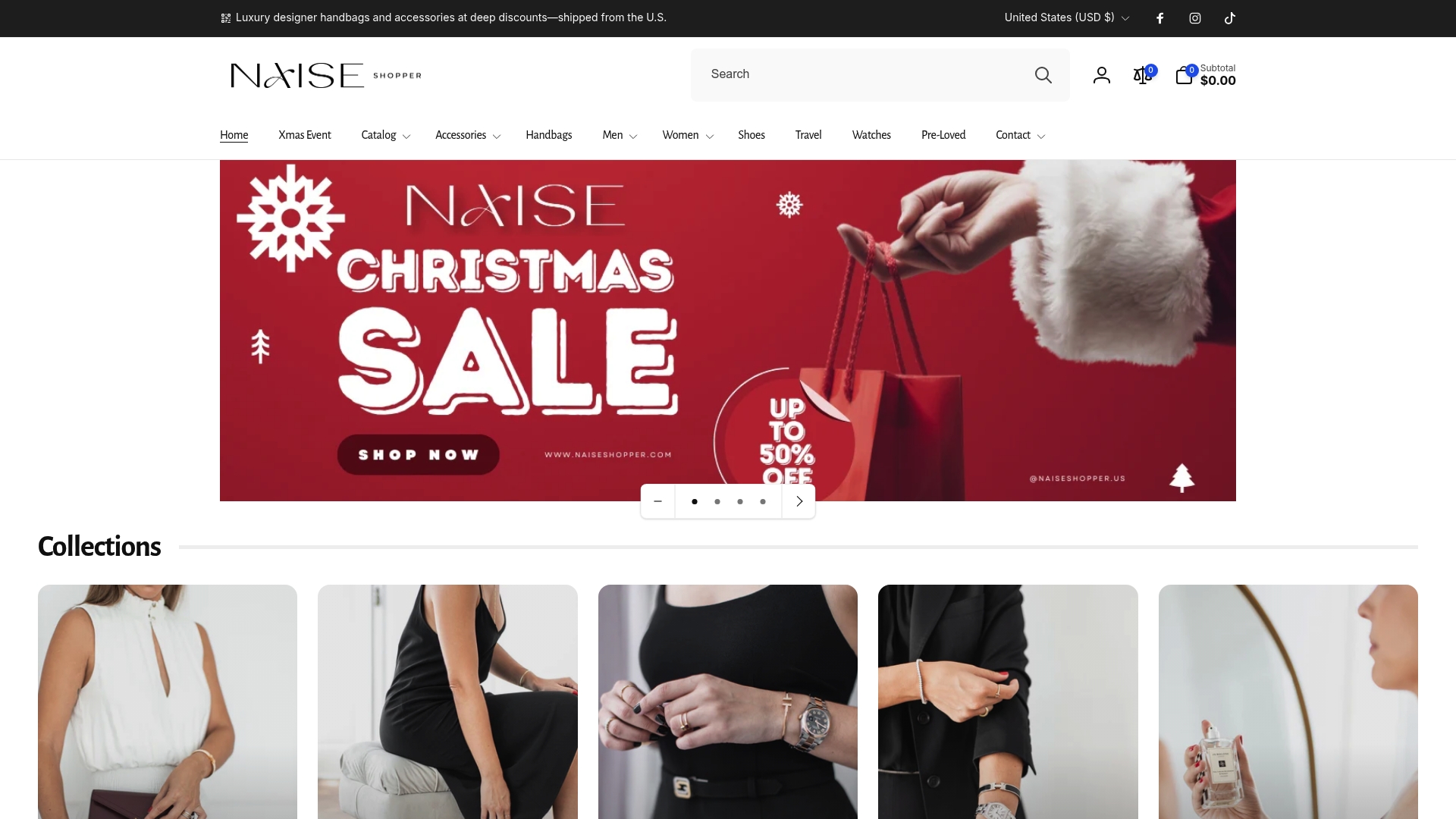
Start exploring our curated selection at Naise Shopper and discover how far your budget can take you in the world of authentic designer fashion. Want to shop smarter? Our guide to the best designer deals walks you through exactly where to find the most value across every category, every season.
Frequently asked questions
What makes designer resale different from standard secondhand shopping?
Designer resale focuses on authenticated luxury goods that often retain or increase in value over time, unlike generic secondhand items. Hermès bags, for example, retain over 138% of value on average, something no standard thrift-store find can claim.
How do resale platforms authenticate designer items?
Most reputable platforms use trained experts, multi-point inspections of up to 72 checkpoints, and technology-assisted verification combined with detailed documentation review. The process can take one to two hours per item to complete properly.
Why are handbags so dominant in designer resale?
Handbags command 32% of the resale market because top styles from Hermès, Chanel, and Gucci retain exceptional value and remain globally desirable across generations. They are simultaneously fashion statements and investment assets.
What risks should buyers consider when purchasing designer resale?
The primary risks include sophisticated counterfeits, fragmented pricing across platforms, and the additional authentication complexity of vintage or rare pieces. Choosing a platform with a clear, detailed authentication policy significantly reduces these risks.